

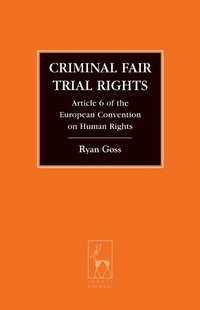
Criminal Fair Trial Rights
Article 6 of the European Convention on Human Rights
1st Edition
Published on 11. September 2014
248 pages
978-1-78225-495-9 (ISBN)
Description

The Article 6 fair trial rights are the most heavily-litigated Convention rights before the European Court of Human Rights, generating a large and complex body of case law. With this book, Goss provides an innovative and critical analysis of the European Court's Article 6 case law.
The category of 'fair trial rights' includes many component rights. The existing literature tends to chart the law with respect to each of these component rights, one by one. This traditional approach is useful, but it risks artificially isolating the case law in a series of watertight compartments.
This book takes a complementary but different approach. Instead of analysing the component rights one by one, it takes a critical look at the case law through a number of 'cross-cutting' problems and themes common to all or many of the component rights. For example: how does the Court view its role in Article 6 cases? When will the Court recognise an implied right in Article 6? How does the Court assess Article 6 infringements, and when will the public interest justify an infringement?
The book's case-law-driven approach allows Goss to demonstrate that the European Court's criminal fair trial rights jurisprudence is marked by considerable uncertainty, inconsistency, and incoherence.
The category of 'fair trial rights' includes many component rights. The existing literature tends to chart the law with respect to each of these component rights, one by one. This traditional approach is useful, but it risks artificially isolating the case law in a series of watertight compartments.
This book takes a complementary but different approach. Instead of analysing the component rights one by one, it takes a critical look at the case law through a number of 'cross-cutting' problems and themes common to all or many of the component rights. For example: how does the Court view its role in Article 6 cases? When will the Court recognise an implied right in Article 6? How does the Court assess Article 6 infringements, and when will the public interest justify an infringement?
The book's case-law-driven approach allows Goss to demonstrate that the European Court's criminal fair trial rights jurisprudence is marked by considerable uncertainty, inconsistency, and incoherence.
More details
Series
Edition
1. Auflage
Language
English
Place of publication
London
United Kingdom
Publishing group
Bloomsbury Publishing PLC
Target group
Professional and scholarly
ISBN-13
978-1-78225-495-9 (9781782254959)
Copyright in bibliographic data and cover images is held by Nielsen Book Services Limited or by the publishers or by their respective licensors: all rights reserved.
Schweitzer Classification
Other editions
Additional editions
Book
09/2016
Hart Publishing
€56.00
Shipment within 15-20 days
Book
09/2014
1st Edition
Hart Publishing
€133.10
Shipment within 15-20 days
Person
Ryan Goss is Lecturer in Law at the Australian National University, Canberra, and was formerly Junior Research Fellow in Law at Lincoln College, Oxford.
Content
Introduction
1.1 Framing the scope of the argument
1.2 Framing the measuring stick against which the European Court's case law will be tested
1.3 Outlining the structure of the book and how the argument is developed
Section I
A Interpreting Article 6
A.1 The European Court sometimes seeks guidance from the Vienna Convention in interpreting Article 6
A.2 Object and purpose: the Court's attempts at teleological interpretation are marked by incoherence
A.3 The European Court uses several techniques to overcome ordinary literal meanings
A.4 The European Court inconsistently cites the need for 'practical and effective' interpretation
A.5 The European Court's use of extrinsic materials is opaque
A.6 Democracy and Article 6
A.7 Building the foundations for a new approach to interpreting Article 6 B The European Court's Role in Article 6 Cases
B.1 The European Court adopts an ostensibly modest and deferential approach in Article 6 cases
B.2 The European Court states that its role is not to enunciate general doctrines
B.3 The European Court makes incoherent claims about avoiding abstract challenges
B.4 The European Court describes its role as limited by the 'fourth instance' doctrine
B.5 The Fourth instance doctrine is riddled with exceptions to the point of incoherence
B.6 The European Court's approach to the law of evidence is marked by incoherence
B.7 Building the foundations for a new approach to how the European Court describes its own role
C Out of One, Many? The Internal Structure of Article 6
C.1 The European Court has adopted several approaches to the internal structure of Article 6
C.2 The European Commission's decision in Nielsen provided a reasonably clear approach
C.3 The European Court sometimes describes the components of Article 6 as independent minimum requirements
C.4 The European Court has used three approaches based on the 'specific aspects' maxim
C.5 Building the foundations for a new approach to the internal structure of Article 6
D The Implied Rights
D.1 What are the implied rights?
D.2 The early implied rights jurisprudence was poorly explained
D.3 At least eight justifications for implied rights can be identified in the European Court's case law
D.4 The case law indicates uncertainty over the boundaries of the implied rights
D.5 Building the foundations for a new approach to the implied rights
Section II
E Assessing Infringements and Violations: the Puzzle of Article 6
E.1 Article 6 is different
E.2 The 'proceedings as a whole' test is used inconsistently and incoherently
E.3 Counterbalancing and defect-curing are attempts to provide a modest amount of structure to the European Court's balancing
E.4 The European Court's 'never fair' case law is inconsistent with its other case law, and internally incoherent
E.5 Assessing whether certain evidence was the 'sole or decisive' evidence against a defendant involves a particularly opaque form of semi-structured balancing
E.6 The European Court is inconsistent in approaching the extent to which the public interest may justify a restriction on Article 6
E.7 Building the foundations for a new approach to assessing violations of Article 6 Conclusion
