

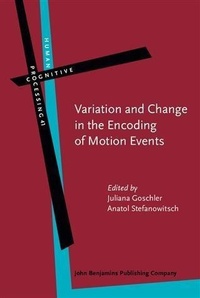
Variation and Change in the Encoding of Motion Events
1st Edition
Published on 14. November 2013
X, 251 pages
978-90-272-7094-8 (ISBN)
Description

The linguistic typology of motion event encoding is one of the central topics in Cognitive Linguistics. A vast body of typological, contrastive, and psycholinguistic research has shown the potential, but also the limitations of the original distinction between verb-framed and satellite-framed languages. This volume contains ten original papers focusing specifically on the variation and change of motion event encoding in individual languages and language families. The authors show that some of the central claims about motion event encoding need careful re-examination and reformulation and that individual languages and language families are more variable across space and time than even a refined typology could neatly capture at this time. The volume thus contributes to a more detailed and fine-grained foundation for the investigation of conceptual causes and consequences of different motion-event encoding strategies.
More details
Other editions
Additional editions
Juliana Goschler | Anatol Stefanowitsch
Variation and Change in the Encoding of Motion Events
Book
11/2013
John Benjamins Publishing Co
€95.40
Shipment within 10-15 days
Persons
Content
- Variation and Change in the Encoding of Motion Events
- Editorial page
- Title page
- LCC data
- Table of contents
- Editors and contributors
- Preface
- Introduction: Beyond typology
- 1. The typology of motion events
- 2. Re-examining the typology
- 2.1 Oversimplification of encoding types
- 2.2 Application of the typology to entire languages
- 2.3 Correlation between syntactic framing and the lexicon
- 2.4 Vagueness of the definition of "satellite"
- 2.5 Unjustified focus on motion-event clauses
- 3. The present volume
- 3.1 Variation
- 3.2 Change
- 4. Future explorations
- References
- Typology as a continuum: Intratypological evidence from English and Serbo-Croatian
- 1. Introduction
- 2. Talmy's typology and subsequent developments
- 2.1 Introducing the typology
- 2.2 Rethinking the typology
- 3. Intratypological contrasts: English vs. Serbo-Croatian lexicalization patterns
- 3.1 Means for lexicalization in Serbo-Croatian
- 3.2 Situation types and intratypological variation
- 3.3 Features of the Serbo-Croatian pattern: The combinatory potential of prefixes
- 4. Further evidence: Translation and experimental data
- 5. Conclusion and future directions
- References
- Same family, different paths: Intratypological differences in three Romance languages
- 1. Motion and typology
- 2. Path salience in motion event lexicalization
- 3. Motion events and path in Romance languages
- 4. Path in three Romance languages
- 5. Conclusions
- References
- Disentangling manner and path: Evidence from varieties of German and Romance
- 1. The standard theory of motion event encoding
- 2. Data and stimuli
- 3. Comparison of varieties
- 3.1 Path verbs
- 3.2 Manner verbs
- 3.3 Complex path descriptions and ground elements
- 3.4 Intermediate summary
- 4. Inferential statistics
- 5. Discussion
- References
- The encoding of motion events: Building typology bottom-up from text data in many languages
- 1. Introduction
- 2. Extracting marker complexes for the 'enter' domain
- 2.1 Marker complexes and what they are good for
- 2.2 'Enter' in parallel texts
- 3. Heterogeneity and general trends in motion event typology
- 4. Original texts in North America
- 5. Conclusions and outlook
- References
- Motion events in Turkish-German contact varieties
- 1. Introduction
- 2. Background
- 2.1 Motion event typology
- 2.2 Motion events in second language acquisition
- 3. Turkish and German in contact situations: Case studies on Turkish-German bilinguals
- 3.1 Typological background
- 3.2 Motion events in written elicited narratives: Schroeder (2009)
- 3.3 Motion events in spoken elicited narratives (i): Daller et al.(2011)
- 3.4 Motion events in spoken elicited narratives (ii): Goschler (2009)
- 3.5 Motion events in informal conversation: Goschler et al. (under revision)
- 4. Discussion
- 5. Conclusion
- References
- Variation in the categorization of motion events by Danish, German, Turkish, and L2 Danish speakers
- 1. Introduction
- 2. Review of literature
- 2.1 L1 lexicalization and categorization
- 2.2 L2 lexicalization and categorization
- 3. Method
- 3.1 Participants
- 3.2 Materials and procedures
- 4. Results
- 4.1 Motion verbs used by the informant groups
- 4.2 Categorical boundaries in the learner languages compared to Danish
- 4.3 The learners' task in restructuring the Danish L2 semantic categories
- 4.4 Reconstruction of meaning
- 5. Discussion and conclusion
- References
- Describing motion events in Old and Modern French: Discourse effects of a typological change
- 1. Introduction
- 2. Method, data, and annotation
- 3. Motion descriptions in Old French texts
- 3.1 Motion verbs in OF
- 3.2 Path satellites in OF
- 3.3 Combinations of motion verbs with Path satellites in OF
- 4. Motion descriptions in Modern French translations
- 4.1 Motion verbs in MF
- 4.2 Path satellites in MF
- 4.3 Combinations of motion verbs and Path satellites in MF
- 5. Translating Path from Old into Modern French
- 5.1 Choice of construction for the expression of Path
- 5.2 Segmentation of events into Path components
- 6. Effects of the typological change on the elaboration of Path
- 6.1 Degree of salience of Path
- 6.2 Degree of explicitness of Path
- 6.3 Focus of attention on the portions of Path
- 7. Conclusion
- References
- Coding manual
- Dictionaries
- Medieval narratives and their translations into Modern French
- Lexical splits in the encoding of motion events from Archaic to Classical Greek
- 1. The encoding of motion: Generalized types and language-specific deviations
- 2. Case study: Ancient Greek verb classes
- 2.1 Toward a consistent satellite-framed type
- 2.2 Verbs of externally caused motion
- 2.3 Change-of-configuration verbs
- 3. Concluding remarks
- References
- Caused-motion verbs in the Middle English intransitive motion construction
- 1. Introduction
- 2. Verbs in the intransitive motion construction in Middle English
- 2.1 Data
- 2.2 Middle English caused-motion verbs in the intransitive motion construction
- 3. Transitivity
- 4. Caused-motion and intransitive motion verbs: Similar patterns
- 4.1 Similar patterns I: Verb + reflexive
- 4.2 Similar patterns II: Be + past participle
- 4.3 A family of related constructions
- 5. Conclusion
- References
- Variation and change in English path verbs and constructions: Usage pattern and conceptual structure
- 1. Introduction
- 2. Background
- 2.1 Motion clause typology
- 2.2 Construction Grammar
- 2.3 More on motion clauses in English
- 3. Two empirical studies
- 3.1 Study 1: The historical development of spatial and metaphorical [enter NP] and [enter INTO]
- 3.2 Study 2: Enter PPinto vs. enter NP in Indian English
- 4. General discussion
- References
- Appendix
- Author index
- Language index
- Subject index
