

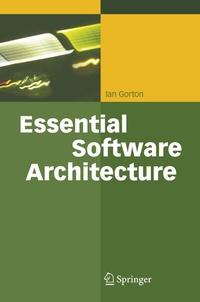
Essential Software Architecture
Description

Job titles like "Technical Architect" and "Chief Architect" nowadays abound in the software industry, yet many people suspect that "architecture" is one of the most overused and least understood terms in professional software development.
Gorton's book helps resolve this predicament. It concisely describes the essential elements of knowledge and key skills required to be a software architect. The explanations encompass the essentials of architecture thinking, practices, and supporting technologies. They range from a general understanding of software structure and quality attributes, through technical issues like middleware components and documentation techniques, to emerging technologies like model-driven architecture, software product lines, aspect-oriented design, service-oriented architectures, and the Semantic Web, all of which will influence future software system architectures.
All approaches are illustrated by an ongoing real-world example. So if you work as an architect or senior designer (or want to someday), or if you are a student in software engineering, here is a valuable and yet approachable source of knowledge.
"Ian's book helps us to head in the right direction through the various techniques and approaches... An essential guide to computer science students as well as developers and IT professionals who aspire to become an IT architect". (Anna Liu, Architect Advisor, Microsoft Australia)
Reviews / Votes
"Ian's book helps us to head in the right direction through the various techniques and approaches... An essential guide to computer science students as well as developers and IT professionals who aspire to become an IT architect". (Anna Liu, Architect Advisor, Microsoft Australia)
"All in all, Essential Software Architecture is head and shoulders above other books on the subject that I've read." (Gregory Wilson, Dr. Dobbs Journal)
"Gorton has produced a well-done, thorough work. Writing such a book on software architecture is a daunting task. (...) Very few texts on this subject have been able to achieve the delicate balance between generality and specificity. Essential Software Architecture does this." (Shantanu Bhattacharya, Siemens Information Systems Ltd., India, for ACM Reviews)
More details
Other editions
New editions
Additional editions
Person
Ian Gorton is a member of the Empirical Software Engineering group at National ICT Australia (NICTA), based in Sydney, Australia. NICTA is Australia's centre of excellence for Information and Communications Technology R&D. He was previously the Chief Architect in Information Sciences and Engineering at PNNL in USA, and has also worked for IBM Transarc, Microsoft Australia and CSIRO.
"I'm basically a software {architect, researcher, engineer}. I work on a whole range of projects, including new middleware technology R&D, designing architectures for enterprise applications, and carrying out software architecture research. I guess I must enjoy the variety!"
