
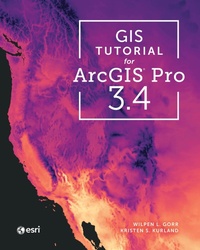
GIS Tutorial for ArcGIS Pro 3.4
Description
Alles über E-Books | Antworten auf Fragen rund um E-Books, Kopierschutz und Dateiformate finden Sie in unserem Info- & Hilfebereich.
Jump into GIS with this hands-on textbook, written and updated for ArcGIS Pro 3.4.
GIS Tutorial for ArcGIS Pro 3.4 is the book everyone needs to learn the powerful desktop app ArcGIS Pro. Written by award-winning instructors at Carnegie Mellon University, GIS Tutorial for ArcGIS Pro introduces readers step by step to basic ArcGIS Pro skills such as designing a map, using file geodatabases, geoprocessing, geocoding, doing spatial analysis, and more.
This resource offers numerous examples and experiences to help cement new concepts and skills. Complete with numerous exercises to practice and improve learning, and additional teaching resources for educators, GIS Tutorial for ArcGIS Pro 3.4 is the ideal book for both classrooms and self-learners looking to develop their understanding of and expertise of ArcGIS Pro.
Wilpen L. Gorr
Wilpen L. Gorr is a professor of public policy and management information systems at the Carnegie Mellon University Heinz School of Public Policy and Management, where he teaches and researches GIS applications.
Kristen S. Kurland
Kristen S. Kurland holds a joint faculty appointment at Carnegie Mellon University's Heinz School of Public Policy and Management and School of Architecture, where she teaches GIS, computer-aided design (CAD), 3D visualization, and computer-aided facilities management (CAFM).
All prices
More details
Other editions
Additional editions
Persons
Wilpen L. Gorr is emeritus professor of public policy and management information systems at the School of Public Policy and Management, H. John Heinz III College, Carnegie Mellon University, where he taught and researched GIS applications. He was also chairman of the school's Master of Science in Public Policy and Management program and editor of the International Journal of Forecasting.
Content
Part 1: Using, making, and sharing maps
Chapter 1 Introducing ArcGIS
Chapter 2 Map design
Chapter 3 Maps for end users
Part 2: Working with spatial data
Chapter 4 File geodatabases
Chapter 5 Spatial data
Chapter 6 Geoprocessing
Chapter 7 Digitizing
Chapter 8 Geocding
Part 3: Applying advanced geospatial technologies
Chapter 9 Spatial anallysis
Chapter 10 Raster GIS
Chapter 11 3D GIS

System requirements
File format: ePUB
Copy protection: Adobe-DRM (Digital Rights Management)
System requirements:
- Computer (Windows; MacOS X; Linux): Install the free reader Adobe Digital Editions prior to download (see eBook Help).
- Tablet/smartphone (Android; iOS): Install the free app Adobe Digital Editions or the app PocketBook before downloading (see eBook Help).
- E-reader: Bookeen, Kobo, Pocketbook, Sony, Tolino and many more (not Kindle).
The file format ePub works well for novels and non-fiction books – i.e., „flowing” text without complex layout. On an e-reader or smartphone, line and page breaks automatically adjust to fit the small displays.
This eBook uses Adobe-DRM, a „hard” copy protection. If the necessary requirements are not met, unfortunately you will not be able to open the eBook. You will therefore need to prepare your reading hardware before downloading.
Please note: We strongly recommend that you authorise using your personal Adobe ID after installation of any reading software.
For more information, see our ebook Help page.
File format: ePUB
Copy protection: Watermark-DRM (Digital Rights Management)
System requirements:
- Computer (Windows; MacOS X; Linux): Use a reading software that can process the file format ePUB: e.g., Adobe Digital Editions or FBReader – both free (see eBook Help).
- Tablet/Smartphone (Android; iOS): Before downloading, install the free app Adobe Digital Editions (see eBook Help).
- E-reader: Bookeen, Kobo, Pocketbook, Sony, Tolino and many more (not Kindle).
The file format ePUB works well for novels and non-fiction books – i.e., „flowing” text without complex layout. On an e-reader or smartphone, line and page breaks automatically adjust to fit the small displays.
This eBook uses Watermark-DRM, a „soft” copy protection. This means that there are no technical restrictions to prevent illegal distribution. However, there is a personalised watermark embedded in the eBook that can be used to identify the purchaser of the eBook in the event of misuse and to provide evidence for legal purposes.
For more information, see our eBook Help page.