

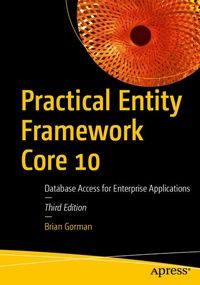
Practical Entity Framework Core 10
Description

Focus on the code-first approach to developing a database with EFCore 10. Taking the code-first approach allows the entire database to be built and maintained in code so there is never a situation in which you cannot restore the database schema. Additionally, the code-first approach creates an entirely transparent record of changes to the database that is easily tracked in your source control. Emphasis throughout the book is on leaving you well positioned to architect and lead data development efforts for your organization.
New to This Edition
Demonstrate the Object Relational Mapper (ORM) of choice for working with databases for enterprise applications using .Net Framework from the ground up. This third edition is revised to cover modern EFCore development as of EFCore 10 and includes information and examples for changes from EFCore 7, 8, 9, and 10. Throughout the book, practical examples and considerations are presented to help you understand how to create robust and efficient database solutions.
What You Will Learn
? Ability to build robust and maintainable database solutions using a code-first approach
? How to create and execute stored procedures, triggers, and functions
? Skills, tips, and tricks to analyze and optimize performance of database queries
? Confidence to architect data integrity through keys, constraints, and relationships
? Understanding of Data Annotations and the Fluent API for enhancing solutions
? Examples to leverage your learning, including information on the latest features in EFCore
Who This Book is For
This book is for .NET developers who work with enterprise-level applications and need to interact with data structures using Entity Framework. The major focus of this book is learning how to use Entity Framework in practical scenarios, with many examples for creating solutions to work through. If you like learning with a hands-on approach over theory, this book is for you.
More details
Other editions
Additional editions
Person
Brian Gorman is a developer, computer science instructor, and trainer. He has been working in .NET technologies as long as they have existed. He was originally MCSD certified in .NET 1 and re-certified with MCSA: Web Apps and MCSD: App Builder certifications in 2019. Brian has also earned multiple Azure certifications including the Administrator, Solutions Architect, Developer, and DevOps Expert certifications. Additionally, Brian officially became an MCT as of April 2019. Brian finds his greatest joy by developing and training developers with full-stack web solutions utilizing .NET Core and Azure. In addition to working with .NET technologies and training developers to design, create, and utilize Azure solutions, Brian is also an adjunct faculty in the computer science department for Franklin University for the last fifteen years, where his courses taught have included data structures, algorithms, design patterns, and, more recently, full-stack solutions in the capstone practicum course.
Content
Introduction.- Part I: Getting Started.- Chapter 1: Introduction to Entity Framework.- Chapter 2: Working with an Existing Database.- Chapter 3: Entity Framework: Code_First Database Interaction.- Part II: Building the Data Solution.- Chapter 4: Models and the Data Context.- Chapter 5: Constraints, Keys, and Relationships.- Chapter 6: Data Access (Create, Read, Update, Delete).- Chapter 7: Stored Procedures, Views, and Functions.- Chapter 8: Sorting, Filtering, and Paging.- Part III: Enhancing the Data Solution.- Chapter 9: Efficient Queries Using LINQ and Projections.- Chapter 10: Encryption of Data.- Chapter 11: Repository and Unit of Work Patterns.- Chapter 12: Unit Testing, Integration Testing, and Mocking.- Part IV: Modern Entity Framework.- Chapter 13: Modern Deployments.- Chapter 14: New Features in EFCore 7, 8, 9, and 10.- Appendix A: Troubleshooting.- Appendix B: Commands for Migrations.
