

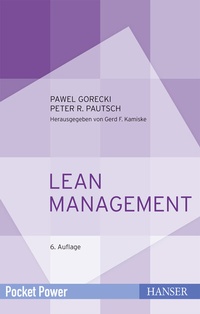
Lean Management
6th Edition
Published on 8. November 2021
128 pages
978-3-446-47145-0 (ISBN)
Description

Lean Management kompakt und auf das Wesentliche konzentriert!
- Wirtschaftlichkeit und Wettbewerbsfähigkeit steigern
- Kundenzufriedenheit erhöhen
- Mit Beispielen und praktischen Tipps
Mit Lean Management können Kosten reduziert und der wirtschaftliche Einsatz der verfügbaren Ressourcen nachhaltig garantiert werden - bei gleichzeitiger Erhöhung der Kundenzufriedenheit! Dieses Buch zeigt, wie Lean Management umgesetzt werden kann, welche Potenziale sich erschließen lassen und es vermittelt praxisorientiert die Methoden und Werkzeuge des Lean Managements.
More details
Other editions
Additional editions
Pawel Gorecki | Peter R. Pautsch
Lean Management
Book
11/2021
6th Edition
Hanser
€14.99
Available immediately
Pawel Gorecki | Peter R. Pautsch
Lean Management
E-Book
11/2021
6th Edition
Hanser
€14.99
Available for download
Persons
Author
Pawel Gorecki ist bei der Firma Ideal Automotive Deutschland GmbH als IAPS Koordinator Gruppe beschäftigt, außerdem unterrichtet er an der Technischen Hochschule Nürnberg Georg Simon Ohm das Fach "Lean Logistics". Kontakt: www.leanmgmt.de
ISNI:
ISNI:
Peter Pautsch war Professor für Wirtschaftswissenschaften an der Technischen Hochschule Nürnberg Georg Simon Ohm und bei der European Aeronautic Defence and Space Company (EADS) Leiter der Abteilung Logistik Prozessmanagement. Seit der Emeritierung coacht er Führungskräfte im Lean Management.
Content
- Intro
- Lean Management
- Inhaltsverzeichnis
- Einleitung
- 1 Historie des Lean Management
- 2 Leitfaden zur Implementierung von Lean Management
- 2.1 Die Lean-Philosophie verstehen
- 2.2 Added Value (Wertschöpfung)
- 2.3 Verschwendung, Unausgeglichenheit, Überbeanspruchung
- 2.4 Wertzuwachskurve
- 2.5 Implementierung
- 3 Kaizen (KVP)ÿ- Verbessern
- 3.1 Hanseiÿ- Notwendigkeit der Selbstreflexion
- 3.2 Hoshin Kanriÿ- Policy Deployment
- 3.3 Genchi Genbutsu und Gemba
- 3.4 Lean-Struktur/Ziele
- 3.5 Individuelle Verbesserungen
- 3.6 Workshops/Teamwork
- 3.7 Internes Verbesserungs-vorschlagswesen
- 4 Visual Managementÿ- Sehen lernen
- 4.1 Value Stream Mapping (VSM)
- 4.2 Key Performance Indicators (KPIs)
- 4.3 Zoning und Andon
- 4.4 Jidoka/First Defect Stop
- 4.5 Ziel und Status aktuell
- 5 Pull-Prinzip
- 5.1 Milk Run
- 5.2 Supermarkt
- 5.3 Small Train
- 5.4 Zellen-WIP
- 5.5 Shop Stock
- 5.6 Kanban
- 5.7 Heijunka
- 5.8 Truck Preparation Area (TPA)
- 6 TPM
- 6.1 Grundlagen
- 6.2 Einbeziehung der Mitarbeiter
- 6.3 Die 5-S-Methode
- 6.4 Anlageneffektivität und Anlagenerhaltung
- 7 Single Minute Exchange of Die (SMED)
- 7.1 Grundlagen
- 7.2 Reduzierung der Rüstzeiten
- 8 Fehlervermeidung
- 8.1 Poka Yoke
- 8.2 Fehlermöglichkeits- und einflussanalyse (FMEA)
- 8.3 Total Quality Management (TQM)
- 9 Nachhaltiges und kontinuierliches Kaizen
- 9.1 Plan
- 9.2 Do
- 9.3 Check
- 9.4 Act/Standard
- 9.5 PDCA und Hoshin Kanri
- 9.6 A3-Report/A3-Papier
- 9.7 8D-Report
- 9.8 OPL (One Point Lesson)
- 10 Lean Development
- 10.1 U-Zelle und Chaku-Chaku-Zelle
- 10.2 Cardboard Workshop und Minimum Technical Solution
- 11 Six Sigma
- 12 Werkzeuge des Lean Management
- 12.1 Sieben statistische Werkzeuge
- 12.2 M7ÿ- Sieben Managementwerkzeuge
- 12.3 6-W-Hinterfragetechnik
- 13 Personal Commitmentÿ- Abschluss
- Literatur
