

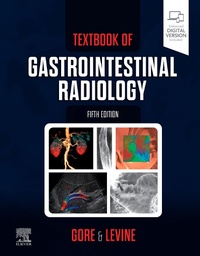
Textbook of Gastrointestinal Radiology E-Book
Textbook of Gastrointestinal Radiology E-Book
5th Edition
Published on 3. June 2021
1104 pages
978-0-323-64083-1 (ISBN)
Description

Ideal for both trainees and experienced practitioners, Textbook of Gastrointestinal Radiology, 5th Edition, provides detailed, concise, well-illustrated information on all aspects of GI imaging-now in a single volume for convenient point-of-care reference. Drs. Richard M. Gore and Marc S. Levine lead a team of world-renowned experts to provide unparalleled coverage of all major gastrointestinal disorders as well as the complete scope of abdominal imaging modalities. Every chapter has been thoroughly updated, and new authors provide fresh perspectives on complex imaging topics.
- Offers streamlined, actionable content in a new single-volume format for quicker access at the point of care.
- Highlights the complete scope of imaging modalities including the latest in MDCT, MRI, diffusion weighted and perfusion imaging, ultrasound, PET/CT, PET/MR, plain radiographs, MRCP, angiography, barium studies, and CT and MR texture analysis of abdominal and pelvic malignancies.
- Features more than 1,100 state-of-the art-images, with many in full color.
- Discusses the imaging features of abdominal and pelvic malignancies that are key in an era of personalized medicine, as well as the relationship of abdominal and pelvic malignancies to cancer genomics and oncologic mutations that guide novel molecular, targeted and immunotherapies.
- Provides a diagnostic approach to incidentally discovered hepatic, pancreatic, and splenic lesions now commonly found on cross-sectional imaging.
More details
Other editions
Additional editions
Richard M. Gore | Marc S. Levine
Textbook of Gastrointestinal Radiology
Book
08/2021
5th Edition
Elsevier
€384.50
Shipment within 10-15 days
Content
- Front cover
- IFC
- Half title
- Full title
- Copyright
- Dedication
- List of Contributors
- Preface
- Contents
- Video Contents
- 1 - Abdomen: Normal Anatomy and Examination Techniques
- Technique
- STANDARD PROJECTIONS
- SUPPLEMENTAL PROJECTIONS
- Normal Anatomy
- PERITONEAL CAVITY
- Liver
- Gallbladder
- Spleen
- Stomach
- Small Intestine
- Colon
- Potential Intraperitoneal Spaces
- RETROPERITONEUM AND ABDOMINAL WALL
- Perirenal Space: Kidneys and Adrenal Glands
- Posterior Pararenal Space
- Anterior Pararenal Space: Ascending and Descending Colon, Duodenum, and Pancreas
- Psoas Muscle
- Diaphragmatic Crura
- PELVIS
- Piriformis Muscle
- Obturator Internus Muscle
- Sacrospinous Ligament and Coccygeus Muscle
- Ischiorectal Fossa
- Gluteus Maximus Muscle
- Pelvic Viscera
- Acknowledgment
- REFERENCES
- 2 - Abnormal Bowel Gas Patterns and Extraluminal Gas in Abdomen
- Normal Bowel Gas Patterns
- Abnormal Bowel Gas Patterns
- GASTRIC OUTLET OBSTRUCTION
- ADYNAMIC ILEUS
- ACUTE COLONIC PSEUDO-OBSTRUCTION (OGILVIE'S SYNDROME)
- SMALL BOWEL OBSTRUCTION
- COLONIC OBSTRUCTION
- CLOSED LOOP OBSTRUCTION
- VOLVULUS
- Sigmoid Volvulus
- Cecal Volvulus
- Transverse Colon Volvulus
- Splenic Flexure Volvulus
- Appendicitis
- MAJOR SIGNS OF APPENDICITIS
- Appendicolith.
- Abnormal Bowel Gas Pattern.
- Abnormal Cecum and Ascending Colon.
- Extraluminal Soft Tissue Mass.
- Gas in the Appendix.
- Free Intraperitoneal Air.
- Obliteration of Normal Fat Planes.
- Scoliosis of the Lumbar Spine.
- Toxic Megacolon
- Pneumoperitoneum
- MAJOR SIGNS OF FREE AIR ON SUPINE ABDOMINAL RADIOGRAPHS
- Rigler's Sign.
- Increased Lucency in the Right Upper Quadrant.
- Visualization of the Undersurface of the Diaphragm.
- Air in Morison's Pouch (Posterior Hepatorenal Space).
- Outline of Normal Peritoneal Ligaments.
- Football Sign.
- Air in the Lesser Sac of the Peritoneal Cavity.
- Pneumoretroperitoneum
- Pneumobilia
- Portal Venous Gas
- Intramural Gas
- Abscesses
- ASCITES
- REFERENCES
- 3 - Abdominal Calcifications
- Physiology
- Morphology
- CONCRETIONS
- CONDUIT WALL CALCIFICATION
- CYSTIC CALCIFICATION
- SOLID MASS CALCIFICATION
- DIFFICULTY IN CLASSIFICATION
- Location
- Mobility
- REFERENCES
- 4 - Pharynx: Normal Anatomy and Function and Examination Techniques
- Anatomy
- LOCATION
- BASIC STRUCTURES AND MUCOSAL SURFACE PATTERNS
- DIVISIONS
- MUSCLES
- NERVES
- The Normal Swallow
- FEEDING
- ORAL PHASE
- Bolus Control
- Bolus Transfer into the Oropharynx
- PHARYNGEAL PHASE
- Nasopharyngeal Protection
- Airway Protection
- Bolus Transfer Through the Pharynx
- Principles of Technique
- PATIENT PREPARATION
- COMPONENTS OF ROUTINE EXAMINATION
- DOUBLE-CONTRAST INTERPRETATION
- Mucosal Coating
- Projections
- Distention
- MOTILITY EXAMINATION
- POSITION OF THE PATIENT
- WHAT IS EXAMINED?
- CHOICE OF CONTRAST AGENTS
- THERAPEUTIC EXAMINATION
- Compensatory Techniques
- Therapeutic Techniques
- REFERENCES
- 5 - Abnormalities of the Pharynx
- Functional Abnormalities
- AGING
- NEUROMUSCULAR ABNORMALITIES
- Pharyngeal Pouches and Diverticula
- LATERAL PHARYNGEAL POUCHES AND DIVERTICULA
- BRANCHIAL CLEFT CYSTS, BRANCHIAL CLEFT FISTULAS, AND BRANCHIAL POUCH SINUSES
- ZENKER'S DIVERTICULUM
- LATERAL CERVICAL ESOPHAGEAL POUCHES AND DIVERTICULA
- Pharyngeal and Cervical Esophageal Webs
- Inflammatory Lesions of the Pharynx
- LYMPHOID HYPERPLASIA OF THE LINGUAL AND PALATINE TONSILS
- Benign Tumors of the Pharynx
- Malignant Tumors of the Pharynx
- SQUAMOUS CELL CARCINOMA
- Pathology
- Radiographic Findings
- Specific Sites
- Palatine Tonsil.
- Base of the Tongue.
- Supraglottic Region.
- Piriform Sinus.
- Posterior Pharyngeal Wall.
- Postcricoid Area.
- LYMPHOMA
- RARE MALIGNANT TUMORS
- Carcinoma of the Minor Salivary Glands
- Sarcoma
- Cartilaginous Tumors
- Kaposi's Sarcoma
- Pharyngeal Damage From Radiation
- Postoperative Pharynx
- TOTAL LARYNGECTOMY
- PHARYNGOLARYNGECTOMY
- NECK DISSECTION
- VOICE CONSERVATION SURGERY
- Horizontal (Supraglottic) Laryngectomy
- Vertical Laryngectomy
- SURGERY FOR TONGUE AND OROPHARYNGEAL CANCERS
- Glossectomy
- Malignant Oropharyngeal Lesions
- TRACHEOSTOMY
- SURGERY FOR ZENKER'S DIVERTICULUM
- CRICOPHARYNGEAL MYOTOMY
- REFERENCES
- 6 - Barium Studies of the Upper Gastrointestinal Tract
- General Principles
- Double-Contrast Upper GI Study
- BARIUM SUSPENSIONS
- EFFERVESCENT AGENTS
- HYPOTONIC AGENTS
- RADIOGRAPHIC EQUIPMENT
- ROUTINE TECHNIQUE
- Single-Contrast Upper GI Study
- Anatomic Considerations
- ESOPHAGUS
- STOMACH
- DUODENUM
- Variations in Technique
- POSSIBLE PERFORATION
- PARTIAL GASTRECTOMY
- GASTRIC OUTLET OBSTRUCTION
- ESOPHAGEAL VARICES
- REFERENCES
- 7 - Motility Disorders of the Esophagus
- Normal Esophageal Anatomy
- Normal Esophageal Physiology
- Radiographic Evaluation
- Esophageal Motility Disorders
- PRIMARY MOTILITY DISORDERS
- Achalasia
- Diffuse Esophageal Spasm
- NONSPECIFIC ESOPHAGEAL MOTILITY DISORDER
- SECONDARY MOTILITY DISORDERS
- Gastroesophageal Reflux Disease
- Collagen Vascular Diseases
- Other Secondary Motility Disorders
- REFERENCES
- 8 - Gastroesophageal Reflux Disease
- Reflux Esophagitis
- PATHOGENESIS
- RELATIONSHIP AMONG HIATAL HERNIA, GASTROESOPHAGEAL REFLUX, AND REFLUX ESOPHAGITIS
- CLINICAL FINDINGS
- DIAGNOSIS
- Gastroesophageal Reflux
- Reflux Esophagitis
- RADIOGRAPHIC FINDINGS
- Esophageal Dysmotility
- Mucosal Granularity
- Ulceration
- Thickened Folds
- Inflammatory Esophagogastric Polyps
- Scarring and Strictures
- DIFFERENTIAL DIAGNOSIS
- Artifacts
- Mucosal Granularity
- Ulceration
- Thickened Folds
- Scarring and Strictures
- Barrett's Esophagus
- CLINICAL FINDINGS
- ENDOSCOPIC AND HISTOLOGIC FINDINGS
- RADIOGRAPHIC FINDINGS
- Long-Segment Barrett's Esophagus
- Short-Segment Barrett's Esophagus
- DIFFERENTIAL DIAGNOSIS
- REFERENCES
- 9 - Infectious Esophagitis
- Candida Esophagitis
- PATHOGENESIS
- CLINICAL FINDINGS
- ENDOSCOPIC FINDINGS
- RADIOGRAPHIC FINDINGS
- DIFFERENTIAL DIAGNOSIS
- Herpes Esophagitis
- PATHOGENESIS
- CLINICAL FINDINGS
- ENDOSCOPIC FINDINGS
- RADIOGRAPHIC FINDINGS
- DIFFERENTIAL DIAGNOSIS
- Cytomegalovirus Esophagitis
- RADIOGRAPHIC FINDINGS
- Human Immunodeficiency Virus Esophagitis
- CLINICAL FINDINGS
- RADIOGRAPHIC FINDINGS
- Tuberculosis
- RADIOGRAPHIC FINDINGS
- Actinomycosis
- Other Infections
- REFERENCES
- 10 - Other Esophagitides
- Drug-Induced Esophagitis
- PATHOGENESIS
- Causative Agents
- Tetracycline and Doxycycline
- Potassium Chloride
- Quinidine
- Nonsteroidal Anti-inflammatory Drugs
- Alendronate
- Other Drugs
- CLINICAL FINDINGS
- RADIOGRAPHIC FINDINGS
- DIFFERENTIAL DIAGNOSIS
- Radiation Esophagitis
- PATHOGENESIS
- CLINICAL FINDINGS
- RADIOGRAPHIC FINDINGS
- DIFFERENTIAL DIAGNOSIS
- Caustic Esophagitis
- PATHOGENESIS
- CLINICAL FINDINGS
- DIAGNOSIS AND TREATMENT
- RADIOGRAPHIC FINDINGS
- DIFFERENTIAL DIAGNOSIS
- Eosinophilic Esophagitis
- CLINICAL FINDINGS
- RADIOGRAPHIC FINDINGS
- DIFFERENTIAL DIAGNOSIS
- Crohn's Disease
- CLINICAL FINDINGS
- RADIOGRAPHIC FINDINGS
- DIFFERENTIAL DIAGNOSIS
- Epidermolysis Bullosa Dystrophica
- PATHOGENESIS
- CLINICAL FINDINGS
- RADIOGRAPHIC FINDINGS
- Benign Mucous Membrane Pemphigoid
- CLINICAL FINDINGS
- RADIOGRAPHIC FINDINGS
- Erythema Multiforme Major
- CLINICAL FINDINGS
- RADIOGRAPHIC FINDINGS
- Lichen Planus
- RADIOGRAPHIC FINDINGS
- Nasogastric Intubation Esophagitis
- PATHOGENESIS
- CLINICAL FINDINGS
- RADIOGRAPHIC FINDINGS
- Alkaline Reflux Esophagitis
- CLINICAL FINDINGS
- RADIOGRAPHIC FINDINGS
- Acute Alcohol-Induced Esophagitis
- CLINICAL FINDINGS
- RADIOGRAPHIC FINDINGS
- Chronic Graft-Versus-Host Disease
- CLINICAL FINDINGS
- RADIOGRAPHIC FINDINGS
- Glutaraldehyde-Induced Esophageal Injury
- Behçet's Disease
- Esophageal Intramural Pseudodiverticulosis
- PATHOGENESIS
- CLINICAL FINDINGS
- RADIOGRAPHIC FINDINGS
- DIFFERENTIAL DIAGNOSIS
- REFERENCES
- 11 - Benign Tumors of the Esophagus
- Mucosal Lesions
- SQUAMOUS PAPILLOMA
- Radiographic Findings
- ADENOMA
- Radiographic Findings
- INFLAMMATORY ESOPHAGOGASTRIC POLYP
- Radiographic Findings
- GLYCOGENIC ACANTHOSIS
- Radiographic Findings
- Differential Diagnosis
- LEUKOPLAKIA
- ACANTHOSIS NIGRICANS
- Submucosal Lesions
- LEIOMYOMA
- Clinical Findings
- Radiographic Findings
- Differential Diagnosis
- GASTROINTESTINAL STROMAL TUMOR
- Radiographic Findings
- LEIOMYOMATOSIS AND IDIOPATHIC MUSCULAR HYPERTROPHY
- Radiographic Findings
- FIBROVASCULAR POLYP
- Clinical Findings
- Radiographic Findings
- Differential Diagnosis
- GRANULAR CELL TUMOR
- Radiographic Findings
- LIPOMA
- HEMANGIOMA
- HAMARTOMA
- OTHER MESENCHYMAL TUMORS
- CYSTS
- Duplication Cyst
- Radiographic Findings.
- Retention Cyst
- REFERENCES
- 12 - Carcinoma of the Esophagus
- Squamous Cell Carcinoma
- EPIDEMIOLOGY
- PREDISPOSING CONDITIONS
- Achalasia
- Lye Strictures
- Head and Neck Tumors
- Celiac Disease
- Plummer-Vinson Syndrome
- Radiation
- Tylosis
- PATHOLOGY
- Gross Features
- Histologic Features
- Distribution
- ROUTES OF SPREAD
- Direct Extension
- Lymphatic Spread
- Hematogenous Metastases
- CLINICAL ASPECTS
- ENDOSCOPIC FINDINGS
- RADIOGRAPHIC FINDINGS
- Early Esophageal Cancer
- Advanced Carcinoma
- Chest Radiography.
- Barium Studies.
- Associated Conditions
- Achalasia.
- Lye Strictures.
- Tylosis.
- Adenocarcinoma
- EPIDEMIOLOGY AND PATHOGENESIS
- Barrett's Esophagus
- Risk of Adenocarcinoma.
- Dysplasia-Carcinoma Sequence.
- Surveillance and Management of Barrett's Esophagus.
- Relationship Among Scleroderma, Barrett's Esophagus, and Adenocarcinoma.
- PATHOLOGY
- Gross Features
- ROUTES OF SPREAD
- CLINICAL ASPECTS
- RADIOGRAPHIC FINDINGS
- Early Adenocarcinoma
- Advanced Adenocarcinoma
- Differential Diagnosis
- EARLY ESOPHAGEAL CANCER
- ADVANCED CARCINOMA
- COMPUTED TOMOGRAPHY FINDINGS
- Staging
- COMPUTED TOMOGRAPHY
- Technique
- Staging Criteria
- ENDOSCOPIC ULTRASOUND
- Technique
- Staging Criteria
- POSITRON EMISSION TOMOGRAPHY
- STAGING ALGORITHM
- Treatment
- SURGERY
- RADIATION THERAPY
- REFERENCES
- 13 - Other Malignant Tumors of the Esophagus
- Metastases
- SITES OF ORIGIN
- CLINICAL FINDINGS
- RADIOGRAPHIC FINDINGS
- Direct Invasion
- Contiguous Involvement by Mediastinal Lymph Nodes
- Hematogenous Metastases
- DIFFERENTIAL DIAGNOSIS
- Secondary Achalasia
- PATHOGENESIS
- CLINICAL FINDINGS
- RADIOGRAPHIC FINDINGS
- Lymphoma
- CLINICAL FINDINGS
- RADIOGRAPHIC FINDINGS
- Spindle Cell Carcinoma
- PATHOLOGY
- CLINICAL FINDINGS
- RADIOGRAPHIC FINDINGS
- DIFFERENTIAL DIAGNOSIS
- Leiomyosarcoma
- CLINICAL FINDINGS
- RADIOGRAPHIC FINDINGS
- DIFFERENTIAL DIAGNOSIS
- Malignant Melanoma
- CLINICAL FINDINGS
- RADIOGRAPHIC FINDINGS
- DIFFERENTIAL DIAGNOSIS
- Kaposi's Sarcoma
- RADIOGRAPHIC FINDINGS
- Small Cell Carcinoma
- RADIOGRAPHIC FINDINGS
- Leukemia
- Miscellaneous Tumors
- REFERENCES
- 14 - Miscellaneous Abnormalities of the Esophagus
- Mallory-Weiss Tear
- PATHOGENESIS
- CLINICAL FINDINGS
- RADIOGRAPHIC FINDINGS
- Esophageal Hematoma
- PATHOGENESIS
- CLINICAL FINDINGS
- RADIOGRAPHIC FINDINGS
- Esophageal Perforation
- PATHOGENESIS
- Instrumentation
- Foreign Bodies
- Trauma
- Spontaneous Esophageal Perforation (Boerhaave's Syndrome)
- CLINICAL FINDINGS
- Cervical Esophageal Perforation
- Thoracic Esophageal Perforation
- RADIOGRAPHIC FINDINGS
- Plain Radiographs
- Cervical Esophageal Perforation.
- Thoracic Esophageal Perforation.
- Fluoroscopic Examinations
- Computed Tomography
- Foreign Body Impaction
- CLINICAL FINDINGS
- RADIOGRAPHIC FINDINGS
- Plain Radiographs
- Fluoroscopic Examinations
- Fistulas
- ESOPHAGEAL-AIRWAY FISTULA
- ESOPHAGOPLEURAL FISTULA
- AORTOESOPHAGEAL FISTULA
- ESOPHAGOPERICARDIAL FISTULA
- Diverticula
- PULSION AND TRACTION DIVERTICULA
- Radiographic Findings
- EPIPHRENIC DIVERTICULUM
- Radiographic Findings
- Ectopic Gastric Mucosa
- Congenital Esophageal Stenosis
- CLINICAL FINDINGS
- RADIOGRAPHIC FINDINGS
- DIFFERENTIAL DIAGNOSIS
- Extrinsic Impressions
- NORMAL IMPRESSIONS
- ABNORMAL IMPRESSIONS
- ESOPHAGEAL RETRACTION
- Varices
- UPHILL VARICES
- Pathophysiology
- Clinical Findings
- Radiographic Findings
- Chest Radiographs.
- Barium Studies.
- Computed Tomography.
- Angiography.
- Differential Diagnosis
- Treatment
- Endoscopic Sclerotherapy.
- Endoscopic Variceal Ligation.
- DOWNHILL VARICES
- Pathophysiology
- Clinical Findings
- Radiographic Findings
- Differential Diagnosis
- IDIOPATHIC VARICES
- Radiographic Findings
- REFERENCES
- 15 - Abnormalities of the Gastroesophageal Junction
- Radiographic Technique
- Normal Radiographic Appearances
- CARDIA
- Z LINE
- MUCOSAL RING
- MUSCULAR RING
- Schatzki Ring
- PATHOGENESIS
- CLINICAL FINDINGS
- RADIOGRAPHIC FINDINGS
- DIFFERENTIAL DIAGNOSIS
- Gastric Hernias
- HIATAL HERNIA
- Pathogenesis
- Clinical Importance
- Radiographic Diagnosis
- PARAESOPHAGEAL HERNIA
- Pathogenesis
- Clinical Importance
- Radiographic Diagnosis
- Carcinoma of the Cardia
- Prolapsed Esophagogastric Mucosa
- Other Abnormalities
- REFERENCES
- 16 - Postoperative Esophagus
- General Principles
- Gastroesophageal Reflux and Hiatal Hernia
- NORMAL POSTOPERATIVE APPEARANCES
- COMPLICATIONS
- Obstruction
- Recurrent Hiatal Hernia and Gastroesophageal Reflux
- Benign Strictures
- Carcinoma
- ESOPHAGOGASTRECTOMY
- Complications
- COLONIC INTERPOSITION
- PALLIATIVE INTUBATION
- Achalasia
- PNEUMATIC DILATION
- CARDIOMYOTOMY
- Varices
- REFERENCES
- 17 - Peptic Ulcers
- Epidemiology and Pathogenesis
- HELICOBACTER PYLORI GASTRITIS
- NONSTEROIDAL ANTI-INFLAMMATORY DRUGS
- TOBACCO, ALCOHOL, AND COFFEE
- STRESS
- GASTRODUODENAL REFLUX OF BILE AND DELAYED GASTRIC EMPTYING
- HEREDITARY FACTORS
- Clinical Findings
- Treatment
- Radiographic Findings
- GASTRIC ULCERS
- Shape
- Size
- Location
- Morphologic Features
- Lesser Curvature Ulcers.
- Greater Curvature Ulcers.
- Posterior Wall Ulcers.
- Anterior Wall Ulcers.
- Multiplicity
- Ulcer Healing and Scarring
- Benign Versus Malignant Ulcers
- DUODENAL ULCERS
- Shape
- Size
- Location
- Morphologic Features
- Bulbar Ulcers.
- Postbulbar Ulcers.
- Giant Duodenal Ulcers.
- Multiplicity
- Ulcer Healing and Scarring
- PYLORIC CHANNEL ULCERS
- Differential Diagnosis
- Complications
- UPPER GASTROINTESTINAL BLEEDING
- OBSTRUCTION
- PERFORATION
- Free Perforation
- Confined Perforation
- Fistulas
- Gastroduodenal Fistulas (Double-Channel Pylorus) .
- Gastrocolic Fistulas.
- Duodenocolic Fistulas.
- Choledochoduodenal Fistulas.
- Duodenorenal Fistulas.
- Gastropericardial Fistulas.
- Zollinger-Ellison Syndrome
- PATHOLOGY
- CLINICAL ASPECTS
- RADIOGRAPHIC FINDINGS
- DIFFERENTIAL DIAGNOSIS
- REFERENCES
- 18 - Inflammatory Conditions of the Stomach and Duodenum
- Erosive Gastritis
- PATHOGENESIS
- CLINICAL FINDINGS
- RADIOGRAPHIC FINDINGS
- DIFFERENTIAL DIAGNOSIS
- Antral Gastritis
- RADIOGRAPHIC FINDINGS
- DIFFERENTIAL DIAGNOSIS
- Helicobacter pylori Gastritis
- CLINICAL FINDINGS
- RADIOGRAPHIC FINDINGS
- DIFFERENTIAL DIAGNOSIS
- Hypertrophic Gastritis
- RADIOGRAPHIC FINDINGS
- DIFFERENTIAL DIAGNOSIS
- Ménétrier's Disease
- PATHOLOGY
- CLINICAL FINDINGS
- RADIOGRAPHIC FINDINGS
- DIFFERENTIAL DIAGNOSIS
- Atrophic Gastritis
- PATHOLOGY AND PATHOGENESIS
- CLINICAL FINDINGS
- RELATIONSHIP TO GASTRIC CARCINOMA
- RADIOGRAPHIC FINDINGS
- DIFFERENTIAL DIAGNOSIS
- Granulomatous Conditions
- CROHN'S DISEASE
- Clinical Findings
- Radiographic Findings
- Gastric Involvement.
- Duodenal Involvement.
- Differential Diagnosis
- Stomach.
- Duodenum.
- SARCOIDOSIS
- Clinical Findings
- Radiographic Findings
- TUBERCULOSIS
- Clinical Findings
- Radiographic Findings
- SYPHILIS
- Radiographic Findings
- FUNGAL DISEASES
- STRONGYLOIDIASIS
- Radiographic Findings
- Eosinophilic Gastritis
- RADIOGRAPHIC FINDINGS
- DIFFERENTIAL DIAGNOSIS
- Emphysematous Gastritis
- RADIOGRAPHIC FINDINGS
- DIFFERENTIAL DIAGNOSIS
- Caustic Ingestion
- RADIOGRAPHIC FINDINGS
- Radiation
- RADIOGRAPHIC FINDINGS
- Floxuridine Toxicity
- PATHOGENESIS
- CLINICAL FINDINGS
- RADIOGRAPHIC FINDINGS
- Duodenitis
- RADIOGRAPHIC FINDINGS
- REFERENCES
- 19 - Benign Tumors of the Stomach and Duodenum
- Mucosal Lesions
- HYPERPLASTIC POLYP
- Pathology
- Clinical Findings
- Radiographic Findings
- Differential Diagnosis
- Treatment
- ADENOMATOUS POLYP
- Pathology
- Clinical Findings
- Radiographic Findings
- Differential Diagnosis
- Treatment
- DUODENAL POLYP
- Radiographic Findings
- Differential Diagnosis
- VILLOUS TUMOR
- Pathology
- Clinical Findings
- Radiographic Findings
- Differential Diagnosis
- POLYPOSIS SYNDROMES
- Submucosal Lesions
- Gastrointestinal Stromal Tumor
- Pathology
- Clinical Findings
- Radiographic Findings
- Differential Diagnosis
- Treatment
- LEIOMYOBLASTOMA
- Pathology
- Clinical Findings
- Radiographic Findings
- LIPOMA
- Pathology
- Clinical Findings
- Radiographic Findings
- HEMANGIOMA
- Radiographic Findings
- LYMPHANGIOMA
- Radiographic Findings
- GLOMUS TUMOR
- Radiographic Findings
- NEURAL TUMOR
- Radiographic Findings
- GRANULAR CELL TUMOR
- Radiographic Findings
- INFLAMMATORY FIBROID POLYP
- Clinical Findings
- Radiographic Findings
- ECTOPIC PANCREATIC REST
- Pathology
- Clinical Findings
- Radiographic Findings
- Differential Diagnosis
- BRUNNER GLAND HYPERPLASIA OR HAMARTOMA
- Pathology
- Clinical Findings
- Radiographic Findings
- Differential Diagnosis
- DUPLICATION CYST
- Pathology
- Clinical Findings
- Radiographic Findings
- Differential Diagnosis
- REFERENCES
- 20 - Carcinoma of the Stomach and Duodenum
- Gastric Carcinoma
- EPIDEMIOLOGY
- Dietary Factors
- Helicobacter Pylori Gastritis
- Atrophic Gastritis
- Gastric Polyps
- Partial Gastrectomy
- Ménétrier's Disease
- PATHOLOGY
- Gross Features
- Histologic Features
- Distribution
- ROUTES OF SPREAD
- Direct Extension
- Lymphatic Spread
- Intraperitoneal Seeding
- Hematogenous Metastases
- CLINICAL FINDINGS
- ENDOSCOPIC FINDINGS
- RADIOGRAPHIC FINDINGS
- Early Gastric Cancer
- Advanced Gastric Cancer
- Abdominal Radiographs.
- Barium Studies.
- Scirrhous Carcinoma.
- Carcinoma of the Cardia.
- Computed Tomography.
- DIFFERENTIAL DIAGNOSIS
- Early Gastric Cancer
- Advanced Carcinoma
- STAGING
- Computed Tomography
- Endoscopic Ultrasonography
- Technique.
- Diagnostic Accuracy.
- Other Imaging Modalities
- Summary
- TREATMENT AND PROGNOSIS
- Duodenal Carcinoma
- REFERENCES
- 21 - Other Malignant Tumors of the Stomach and Duodenum
- Metastases
- CLINICAL FINDINGS
- RADIOGRAPHIC FINDINGS
- Hematogenous Metastases
- Lymphatic Spread
- Direct Invasion
- Esophageal Carcinoma.
- Pancreatic Carcinoma.
- Renal Cell Carcinoma.
- Colonic Carcinoma.
- Gallbladder Carcinoma.
- Omental Metastases.
- DIFFERENTIAL DIAGNOSIS
- Lymphoma
- PATHOLOGY
- CLINICAL FINDINGS
- ENDOSCOPIC FINDINGS
- TREATMENT AND PROGNOSIS
- RADIOGRAPHIC FINDINGS
- Low-Grade Mucosa-Associated Lymphoid Tissue Lymphoma
- Advanced Gastric Lymphoma
- Barium Studies.
- Computed Tomography.
- Endoscopic Ultrasonography.
- Positron Emission Tomography/Computed Tomography.
- DIFFERENTIAL DIAGNOSIS
- DUODENAL LYMPHOMA
- Malignant Gastrointestinal Stromal Tumor
- PATHOLOGY
- CLINICAL FINDINGS
- RADIOGRAPHIC FINDINGS
- DIFFERENTIAL DIAGNOSIS
- MALIGNANT DUODENAL GASTROINTESTINAL STROMAL TUMOR
- Carcinoid Tumors
- PATHOLOGY
- CLINICAL FINDINGS
- RADIOGRAPHIC FINDINGS
- DUODENAL CARCINOIDS
- Kaposi's Sarcoma
- CLINICAL FINDINGS
- PATHOLOGIC AND ENDOSCOPIC FINDINGS
- RADIOGRAPHIC FINDINGS
- DIFFERENTIAL DIAGNOSIS
- Miscellaneous Tumors
- REFERENCES
- 22 - Miscellaneous Abnormalities of the Stomach and Duodenum
- Gastric Varices
- Pathophysiology
- Portal Hypertension
- Splenic Vein Obstruction
- Clinical Findings
- Radiographic Findings
- Abdominal Radiographs
- Barium Studies
- Computed Tomography
- Angiography
- Differential Diagnosis
- Treatment
- Portal Hypertensive Gastropathy
- RADIOGRAPHIC FINDINGS
- Diverticula
- GASTRIC DIVERTICULA
- DUODENAL DIVERTICULA
- True Diverticula
- Pseudodiverticula
- Intraluminal Diverticula
- Webs
- ANTRAL WEBS
- DUODENAL WEBS
- Adult Hypertrophic Pyloric Stenosis
- Gastric Outlet Obstruction
- Duodenal Obstruction
- SUPERIOR MESENTERIC ROOT SYNDROME
- OTHER CAUSES
- Gastric Dilation Without Gastric Outlet Obstruction
- ACUTE GASTRIC DILATION
- CHRONIC GASTRIC DILATION AND GASTROPARESIS
- Abnormal Extrinsic Masses
- STOMACH
- DUODENUM
- Widening of the Duodenal Sweep
- Pancreatic Diseases Affecting the Stomach and Duodenum
- Unusual Filling Defects
- BEZOARS
- FOREIGN BODIES
- HEMATOMAS
- INTRAGASTRIC AND INTRADUODENAL GALLSTONES
- Gastric Volvulus
- Gastroduodenal and Duodenojejunal Intussusception
- Fistulas
- GASTROCOLIC AND DUODENOCOLIC FISTULAS
- CHOLECYSTODUODENAL FISTULAS
- AORTODUODENAL FISTULAS
- Gastric and Duodenal Perforation
- Gastric Emphysema
- Amyloidosis
- Cystic Fibrosis
- REFERENCES
- 23 - Postoperative Stomach and Duodenum
- Diagnostic Evaluation After Gastric and Duodenal Surgery
- IMAGING STUDIES
- Fluoroscopic Studies of the Upper Gastrointestinal Tract
- Computed Tomography
- Nuclear Medicine
- Endoscopy
- Surgical Considerations for Peptic Ulcer Disease
- INDICATIONS FOR SURGERY
- SURGICAL PROCEDURES FOR PEPTIC ULCER DISEASE
- Vagotomy
- Pyloroplasty
- Antrectomy
- Surgical Procedures for Gastric Resection
- BILLROTH I PROCEDURE
- BILLROTH II PROCEDURE
- ROUX-EN-Y GASTROJEJUNOSTOMY
- IDENTIFICATION OF POSTSURGICAL ANATOMY ON IMAGING STUDIES
- COMPLICATIONS AFTER GASTRIC RESECTION
- Metabolic Problems
- Postoperative Leaks
- Gastric Stasis
- Roux Stasis Syndrome
- Obstruction
- Bezoar Formation
- Dumping Syndrome
- Marginal Ulcers
- Jejunogastric Intussusception
- Afferent Loop Syndrome
- Bile Reflux Gastritis
- Malignant Tumors After Partial Gastrectomy for Benign Disease
- Surgical Considerations for Gastric and Duodenal Neoplasms
- SURGERY FOR MALIGNANT GASTRIC NEOPLASMS
- SURGERY FOR MALIGNANT DUODENAL NEOPLASMS
- COMPLICATIONS AFTER GASTRIC AND DUODENAL SURGERY FOR MALIGNANT NEOPLASMS
- Surgery for Weight Loss (Bariatric Surgery)
- ROUX-EN-Y GASTRIC BYPASS
- Imaging After Roux-en-Y Gastric Bypass
- Upper Gastrointestinal Study.
- Computed Tomography.
- Complications
- Extraluminal Leaks.
- Communication with the Excluded Stomach.
- Marginal Ulcers.
- Small Bowel Obstruction
- Acute Obstruction.
- Late Obstruction.
- Internal Hernias.
- Anastomotic Stenosis.
- Intussusception.
- LAPAROSCOPIC ADJUSTABLE GASTRIC BANDING
- Imaging After Laparoscopic Adjustable Gastric Banding
- Radiography.
- Upper Gastrointestinal Study.
- Computed Tomography.
- Band Adjustments.
- Complications of Laparoscopic Adjustable Gastric Banding
- Pouch Dilation.
- Band Slippage.
- Intragastric Band Erosion.
- Device-Related Complications.
- SLEEVE GASTRECTOMY
- Imaging after Sleeve Gastrectomy
- Upper Gastrointestinal Study.
- Computed Tomography.
- Complications of Sleeve Gastrectomy
- BILIOPANCREATIC DIVERSION WITH DUODENAL SWITCH
- REFERENCES
- 24 - Barium Studies of the Small Bowel
- Normal Small Intestine
- Principles for Performing and Interpreting Small Bowel Studies
- Small Bowel Follow-Through
- Peroral Pneumocolon
- Enteroclysis
- Hypotonic Duodenography
- Small Bowel Studies Using Water-Soluble Contrast Agents
- Retrograde Examinations of the Small Bowel
- BARIUM ENEMA
- ILEOSTOMY ENEMA
- Choice of Barium Study Versus Other Diagnostic Tests
- CHRONIC DIARRHEA
- SMALL BOWEL OBSTRUCTION
- ABDOMINAL PAIN
- SUSPECTED PERFORATION
- MALABSORPTION
- UNEXPLAINED GASTROINTESTINAL BLEEDING
- REFERENCES
- 25 - Computed Tomography Enterography
- Computed Tomography Enterography: How It Differs From Routine Abdominal Computed Tomography
- Indications
- Technique
- Interpretation of Computed Tomography Enterography Images
- SUSPECTED CROHN'S DISEASE
- GASTROINTESTINAL BLEEDING
- LOW-GRADE OBSTRUCTION
- Integration With Other Tests
- REFERENCES
- 26 - Magnetic Resonance Enterography
- Technical Considerations
- ENTERAL CONTRAST AGENTS FOR MAGNETIC RESONANCE IMAGING
- TECHNIQUE
- MAGNETIC RESONANCE IMAGING PROTOCOL AND PULSE SEQUENCES
- Image Interpretation
- Clinical Applications
- CROHN'S DISEASE
- SMALL BOWEL NEOPLASMS
- CELIAC DISEASE
- BOWEL ISCHEMIA AND VASCULITIS
- INFECTIONS
- SMALL BOWEL OBSTRUCTION
- Summary
- REFERENCES
- 27 - Crohn's Disease of the Small Bowel
- Clinical Considerations
- Classification and Therapy
- Diagnostic Tools
- BARIUM CONTRAST EXAMINATIONS
- Early Radiographic Active Inflammatory Disease
- Intermediate Radiographic Active Inflammatory Disease
- Advanced Radiographic Active Inflammatory Disease
- Quiescent or Inactive Disease
- Fibrostenotic Disease
- Fistulizing or Penetrating Disease
- ULTRASOUND
- MAGNETIC RESONANCE IMAGING
- COMPUTED TOMOGRAPHY
- Nomenclature for Computed Tomography and Magnetic Resonance Enterography Findings
- COMPUTED TOMOGRAPHY AND MAGNETIC RESONANCE ENTEROGRAPHY FINDINGS OF SMALL BOWEL CROHN'S DISEASE
- Wall Findings
- Hyperenhancement.
- Thickening.
- Luminal Narrowing, Stricture Formation, and Upstream Dilation.
- Ulcer and Sinus Tract.
- Simple and Complex Fistulae.
- Mesenteric Findings
- Vasa Recta Distention.
- Fibrofatty Proliferation.
- Perienteric Edema and Inflammation.
- Inflammatory Mass and Abscess
- Adenopathy.
- Extraintestinal Findings
- Active Inflammatory Small Bowel Crohn's Disease
- Quiescent or Inactive Small Bowel Crohn's Disease
- Mixed Fibrostenotic and Active Inflammatory Small Bowel Crohn's Disease
- Penetrating Crohn's Disease
- Fibrostenotic Small Bowel Crohn's Disease
- ASSESSMENT OF DISEASE ACTIVITY
- Magnetic Resonance Imaging-Derived Disease Activity Indices
- Additional Imaging Considerations
- Acknowledgment
- REFERENCES
- 28 - Other Inflammatory Conditions of the Small Bowel
- Parasitic Infestations
- ASCARIASIS
- HOOKWORM INFESTATION (ANCYLOSTOMIASIS)
- STRONGYLOIDIASIS
- ANISAKIASIS
- TAPEWORM (CESTODE) INFESTATION
- TREMATODE (FLUKES) INFESTATION
- GIARDIASIS
- TRYPANOSOMIASIS
- Bacterial Infections
- TUBERCULOSIS
- YERSINIOSIS
- SALMONELLOSIS
- CAMPYLOBACTERIOSIS
- Fungal Infections
- HISTOPLASMOSIS
- Viral Infections
- Drug-Induced Disorders
- ULCERS AND STENOSES RELATED TO NONSTEROIDAL ANTI-INFLAMMATORY DRUGS
- FLUORINATED ANTIPYRIMIDINES
- Inflammatory Disease in Immunocompromised States
- SELECTIVE IMMUNOGLOBULIN A AND COMMON VARIABLE IMMUNODEFICIENCY
- GRAFT-VERSUS-HOST DISEASE
- TYPHLITIS
- GASTROINTESTINAL INFECTIONS IN AIDS
- HUMAN IMMUNODEFICIENCY VIRUS ENTERITIS
- CYTOMEGALOVIRUS INFECTION
- CRYPTOSPORIDIOSIS
- ISOSPORIASIS AND OTHER INTRACELLULAR PROTOZOANS
- MYCOBACTERIUM AVIUM-INTRACELLULARE COMPLEX
- ACTINOMYCOSIS
- CANDIDIASIS
- REFERENCES
- 29 - Malabsorption
- Anatomic Classification of Malabsorption
- HEPATOBILIARY AND PANCREATIC DISORDERS
- GASTRIC DISORDERS
- SMALL BOWEL DISORDERS
- Intraluminal Stasis with Bacterial Overgrowth
- Brush Border Disease
- Mucosal Damage
- Postmucosal Disease
- Diseases with Multifactorial Causes
- Small Bowel Hypomotility
- JEJUNOILEAL DIVERTICULOSIS
- PROGRESSIVE SYSTEMIC SCLEROSIS, VISCERAL NEUROPATHIES, AND MYOPATHIES
- Epithelial Cell Damage
- CELIAC DISEASE
- Radiographic Findings
- Complications
- TROPICAL SPRUE
- WHIPPLE'S DISEASE
- EOSINOPHILIC GASTROENTERITIS
- AMYLOIDOSIS
- SHORT BOWEL SYNDROME
- Nonformation of Chylomicrons
- ABETALIPOPROTEINEMIA
- Lymphatic Obstruction and Lymphangiectasia
- Multifactorial Diseases
- DIABETES MELLITUS
- CYSTIC FIBROSIS
- Differential Diagnosis of Thickened Folds in Malabsorption
- REFERENCES
- 30 - Benign Tumors of the Small Bowel
- Clinical Considerations
- Imaging Considerations
- Specific Tumors
- ADENOMA
- GASTROINTESTINAL STROMAL TUMOR
- LIPOMA
- HEMANGIOMA
- UNCOMMON TUMORS
- Polyposis Syndromes
- FAMILIAL ADENOMATOUS POLYPOSIS SYNDROME
- PEUTZ-JEGHERS SYNDROME
- COWDEN'S DISEASE
- CRONKHITE-CANADA SYNDROME
- REFERENCES
- 31 - Malignant Tumors of the Small Bowel
- Imaging of Small Bowel Neoplasm
- Neuroendocrine Tumor
- Adenocarcinoma
- Gastrointestinal Stromal Tumor
- Lymphoma
- Metastasis
- Conclusion
- REFERENCES
- 32 - Small Bowel Obstruction
- Terms Used in Describing Small Bowel Obstruction and Adynamic Ileus
- Radiologic Imaging
- PLAIN RADIOGRAPHY OF THE ABDOMEN
- COMPUTED TOMOGRAPHY
- BARIUM STUDIES
- Classification of Small Bowel Obstruction
- EXTRINSIC LESIONS
- Adhesions
- Closed Loop Obstruction and Strangulation
- Hernias
- Extrinsic Tumors in Mesentery or Retroperitoneum
- INTRAMURAL LESIONS
- Primary Tumors
- Inflammatory Conditions
- Vascular Diseases
- Radiation Enteropathy.
- INTRALUMINAL CAUSES
- INTUSSUSCEPTION
- REFERENCES
- 33 - Vascular Disorders of the Small Intestine
- Mesenteric Ischemia
- ACUTE MESENTERIC ISCHEMIA
- Computed Tomography Findings
- Bowel Dilation.
- Bowel Wall Thickening.
- Bowel Wall Attenuation and Abnormal Enhancement.
- Stranding and Ascites.
- Pneumatosis and Portomesenteric Venous Air.
- Patterns of Ischemia: Arterial Occlusive Ischemia Versus Venous Occlusive Ischemia.
- CHRONIC MESENTERIC ISCHEMIA
- Vasculitis
- LARGE VESSEL VASCULITIS
- MEDIUM VESSEL VASCULITIS
- SMALL VESSEL VASCULITIS
- Henoch-Schönlein Purpura
- Systemic Lupus Erythematosus
- Behçet's Disease
- Acute Small Bowel Bleeding
- Computed Tomography in the Diagnosis of Gastrointestinal Bleeding.
- Miscellaneous Disorders
- SUPERIOR MESENTERIC ARTERY DISSECTION
- TRAUMA
- RADIATION ENTERITIS
- SPLANCHNIC ARTERY ANEURYSMS
- DRUG-INDUCED SMALL BOWEL ANGIOEDEMA
- MEDIAN ARCUATE LIGAMENT SYNDROME
- Summary
- REFERENCES
- 34 - Postoperative Small Bowel
- Small Bowel After Gastric Surgery
- AFFERENT LOOP OBSTRUCTION
- Enterectomy and Anastomosis
- POSTOPERATIVE BLIND POUCH AND LOOP
- Enterostomy
- JEJUNOSTOMY
- ILEOSTOMY
- Ileal Reservoir
- CONTINENT ILEOSTOMY RESERVOIR
- ILEAL POUCH WITH ILEOANAL ANASTOMOSIS
- Small Bowel Transplantation
- REFERENCES
- 35 - Miscellaneous Abnormalities of the Small Bowel
- Abnormalities of Small Bowel Development in Adults
- MECKEL'S DIVERTICULUM
- MIDGUT DUPLICATIONS
- HETEROTOPIC TISSUE
- ILEAL DYSGENESIS (SEGMENTAL DILATION)
- INTESTINAL MALROTATION
- PARADUODENAL (MESOCOLIC) HERNIAS
- Endometriosis
- Bezoars and Enteroliths
- REFERENCES
- 36 - Barium Studies of the Colon
- Single- Versus Double-Contrast Technique
- Double-Contrast Barium Enema
- PATIENT PREPARATION
- MATERIALS AND EQUIPMENT
- ADMINISTRATION OF GLUCAGON
- INSERTION OF ENEMA TIP
- ROUTINE EXAMINATION
- NORMAL APPEARANCES
- Single-Contrast Barium Enema
- Technical Problems
- POOR PREPARATION
- DIVERTICULOSIS
- INCONTINENCE
- FILLING OF ENTIRE COLON
- Complications
- Variations in Technique
- SUSPECTED PERFORATION
- PERORAL PNEUMOCOLON
- COLOSTOMY ENEMA
- REFERENCES
- 37 - Functional Imaging of Anorectal and Pelvic Floor Dysfunction
- Normal Anatomy
- Assessment of Pelvic Floor
- PREPROCEDURE PREPARATION
- IMAGING TECHNIQUE
- Measurements
- ANORECTAL ANGLE
- ANAL CANAL LENGTH
- LEVEL OF ANORECTAL JUNCTION
- Pathology
- ENTEROCELE AND SIGMOIDOCELE
- ANTERIOR MUCOSAL WALL PROLAPSE AND RECTOCELE
- RECTAL INTUSSUSCEPTION
- Solitary Rectal Ulcer Syndrome
- POSTERIOR-LATERAL RECTAL POUCHES
- PELVIC FLOOR DYSSYNERGY (ANISMUS)
- DESCENDING PERINEUM SYNDROME
- ANTERIOR MUCOSAL PROLAPSE
- UTERINE AND VAGINAL VAULT PROLAPSE
- CYSTOCELE
- CONSTIPATION AND INCONTINENCE
- Comparison With Other Methods of Examining the Pelvic Floor
- Normal Variations
- Summary
- REFERENCES
- 38 - Computed Tomography Colonography and Evaluation of the Colon
- Indications and Use
- SCREENING FOR COLORECTAL CANCER
- DIAGNOSTIC INDICATIONS
- STAGING AND SURVEILLANCE
- History of Computed Tomography Colonography Trial Results and Supporting Evidence
- Computed Tomography Colonography Exam
- TECHNICAL COMPONENTS
- Bowel Preparation
- Alternative Protocols.
- Colonic Distention
- Image Acquisition
- INTERPRETATION
- Detection
- Characterization
- Polyp Differential
- REPORTING
- Specific Issues/Topics in Computed Tomography Colonography
- COMPLICATIONS
- RADIATION
- EXTRACOLONIC FINDINGS
- Summary
- REFERENCES
- 39 - Diverticular Disease of the Colon
- Diverticulosis
- RADIOLOGIC FINDINGS
- Plain Radiographic Studies
- Barium Studies
- Computed Tomography
- Diverticulitis
- RADIOLOGIC FINDINGS
- Plain Radiographic Studies
- Contrast Enema Examination
- Ultrasonography
- Magnetic Resonance Imaging
- Computed Tomography
- SURGICAL AND COMPUTED TOMOGRAPHY STAGING
- DIFFERENTIATION OF DIVERTICULITIS FROM CARCINOMA
- CHRONIC DIVERTICULITIS
- DIFFERENTIAL DIAGNOSIS
- Epiploic Appendagitis
- Cecal Diverticulitis
- COMPLICATIONS
- Fistulas and Sinus Tracts
- Free Intraperitoneal Perforation
- Bowel Obstruction
- Pylephlebitis and Liver Abscess
- Diverticular Hemorrhage
- Giant Sigmoid Diverticulum
- REFERENCES
- 40 - Diseases of the Appendix
- Anatomy
- Acute Appendicitis
- EPIDEMIOLOGY
- CAUSES
- PATHOPHYSIOLOGY
- CLINICAL AND RADIOLOGIC ASSESSMENT
- FINDINGS
- Clinical Findings
- Imaging
- Plain Radiographs and Barium Enema.
- Computed Tomography.
- Computed Tomography Protocols.
- Ultrasonography.
- Magnetic Resonance Imaging.
- DIFFERENTIAL DIAGNOSIS
- Mesenteric Adenitis
- Infectious Enterocolitis
- Epiploic Appendagitis
- Omental Infarction
- Right-Sided and Ileal Diverticulitis
- Meckel's Diverticulum
- Neutropenic Colitis (Typhlitis)
- Ischemia
- Cecal Carcinoma
- Crohn's Disease
- Ulcerative Colitis
- Endometriosis
- Appendiceal Diverticulitis
- Appendiceal Intussusception
- Appendiceal Neoplasms
- MUCOCELE
- Epidemiology, Cause, and Pathology
- Clinical Findings
- Imaging Findings
- Barium Enema.
- Cross-Sectional Imaging.
- MUCINOUS CYSTADENOMA AND CYSTADENOCARCINOMA
- NONMUCINOUS ADENOCARCINOMA
- CARCINOID
- LYMPHOMA
- Metastases
- REFERENCES
- 41 - Ulcerative and Granulomatous Colitis: Idiopathic Inflammatory Bowel Disease
- Ulcerative Colitis
- FINDINGS
- Radiologic Findings
- Plain Abdominal Radiographs.
- Colonic Fecal Residue.
- Mucosa.
- Haustration.
- Colon Diameter.
- Mural Thickness.
- Barium Enema
- Granular Pattern.
- Mucosal Stippling.
- "Collar Button" Ulcers.
- Polyps.
- Inflammatory Pseudopolyps.
- Postinflammatory Pseudopolyps.
- Backwash Ileitis.
- Blunting and Lost Haustra.
- Widened Presacral Space.
- Rectal Valve Abnormalities.
- Strictures.
- Distribution.
- Computed Tomography
- Ultrasonography
- Magnetic Resonance Imaging
- Scintigraphy
- Crohn's Disease
- FINDINGS
- Radiologic Findings
- Radiography.
- Barium Enema
- Lymphoid Hyperplasia.
- Aphthoid Ulcerations.
- Cobblestoning.
- Deep Ulcerations.
- Sinus Tracts, Fissures, and Fistulas.
- Mural Thickening.
- Luminal Narrowing and Strictures.
- Sacculations.
- Anorectal Disease.
- Distribution.
- Computed Tomography
- Mesenteric Involvement.
- Fibrofatty Proliferation of the Mesentery.
- Phlegmon.
- Abscess.
- Transrectal Ultrasonography
- Transabdominal Ultrasonography
- Magnetic Resonance Imaging
- Intestinal Complications of Inflammatory Bowel Disease
- CARCINOMA
- TOXIC MEGACOLON
- Radiologic Findings
- Differential Diagnosis of Colitis
- Summary
- REFERENCES
- 42 - Other Inflammatory Conditions of the Colon
- Bacterial Infections
- SALMONELLOSIS
- SHIGELLOSIS
- CAMPYLOBACTERIOSIS
- YERSINIA ENTEROCOLITIS
- COLITIS CAUSED BY ESCHERICHIA COLI O157:H7
- TUBERCULOSIS
- ACTINOMYCOSIS
- Viral Infections
- Parasitic Infections
- AMEBIASIS
- SCHISTOSOMIASIS
- Fungal Infections
- HISTOPLASMOSIS
- MUCORMYCOSIS
- Noninfectious Colitis
- GRAFT-VERSUS-HOST DISEASE
- Exogenous Causes of Colitis
- TYPHLITIS (NEUTROPENIC COLITIS)
- CLOSTRIDIUM DIFFICILE COLITIS
- REFERENCES
- 43 - Polyps and Colon Cancer
- Epidemiology
- Factors Involved
- DIETARY FACTORS
- HEREDITARY FACTORS
- RISK FACTORS
- Clinical Aspects
- Radiology and Diagnostic Methods
- Benign Epithelial Polyps
- INCIDENCE
- PATHOLOGY
- POLYP DETECTION
- Barium Enema
- Cross-Sectional Imaging
- Adenocarcinoma
- BARIUM ENEMA
- Early Cancer
- Advanced Cancer
- Complications
- COMPUTED TOMOGRAPHY
- Primary Colorectal Carcinoma
- Preoperative Staging by Computed Tomography
- MAGNETIC RESONANCE IMAGING
- Preoperative Staging by Magnetic Resonance Imaging
- TRANSRECTAL ULTRASOUND
- Primary Tumor
- Preoperative Staging by Endoluminal Ultrasound
- IMMUNOSCINTIGRAPHY WITH MONOCLONAL ANTIBODIES
- Detection of Primary Colorectal Neoplasm
- Preoperative Staging of Primary Colorectal Neoplasm
- POSITRON EMISSION TOMOGRAPHY
- Primary Colorectal Neoplasm
- Staging of Primary Colorectal Neoplasm
- Conclusions for Cross-Sectional Imaging in Primary Colorectal Neoplasm
- Postoperative Follow-Up
- CONTRAST ENEMA
- CROSS-SECTIONAL IMAGING
- Computed Tomography
- Magnetic Resonance Imaging
- Transrectal Ultrasound
- Immunoscintigraphy
- Positron Emission Tomography
- Conclusions for Cross-Sectional Imaging in Recurrent Colorectal Carcinoma
- REFERENCES
- 44 - Other Tumors of the Colon
- Lymphoma
- PATHOLOGIC FINDINGS
- CLINICAL FINDINGS
- RADIOGRAPHIC FINDINGS AND DIFFERENTIAL DIAGNOSIS
- Vascular Lesions
- HEMANGIOMA
- Clinical and Pathologic Findings
- Radiographic Findings and Differential Diagnosis
- LYMPHANGIOMA
- ANGIODYSPLASIA
- Clinical and Pathologic Findings
- Radiographic Findings
- KAPOSI'S SARCOMA
- Endocrine (Carcinoid) Tumors
- PATHOLOGIC FINDINGS
- ENDOCRINE CELL TUMORS OF THE RECTUM
- ENDOCRINE TUMORS (EXCLUSIVE OF THE RECTUM)
- Fatty Lesions
- LIPOMA
- Clinical Findings
- Pathologic Findings
- Radiographic Findings
- FATTY INFILTRATION OF THE ILEOCECAL VALVE
- Pathologic, Clinical, and Radiographic Findings
- Differential Diagnosis
- Stromal Tumors
- PATHOLOGIC FINDINGS
- SMALL STROMAL TUMORS
- LARGE STROMAL TUMORS
- Squamous Cell Carcinoma
- Cloacogenic Carcinoma
- Metastases
- DIRECT INVASION FROM CONTIGUOUS PRIMARY TUMORS
- DIRECT INVASION FROM NONCONTIGUOUS PRIMARY TUMORS
- INTRAPERITONEAL SEEDING
- Radiographic Findings
- EMBOLIC METASTASES
- REFERENCES
- 45 - Polyposis Syndromes
- Familial Adenomatous Polyposis Syndrome
- COLONIC MANIFESTATIONS
- EXTRACOLONIC GASTROINTESTINAL MANIFESTATIONS
- EXTRAINTESTINAL MANIFESTATIONS
- Hamartomatous Polyposis Syndromes
- PEUTZ-JEGHERS SYNDROME
- JUVENILE POLYPOSIS SYNDROME
- PTEN HAMARTOMA SYNDROMES
- Multiple Hamartoma Syndrome (Cowden Syndrome)
- Bannayan-Riley-Ruvalcaba Syndrome
- CRONKHITE-CANADA SYNDROME
- REFERENCES
- 46 - Miscellaneous Abnormalities of the Colon
- Colonic Obstruction
- PATHOPHYSIOLOGY
- RADIOLOGIC APPROACH TO SUSPECTED LARGE BOWEL OBSTRUCTION
- Radiography
- Computed Tomography
- Ultrasonography and Magnetic Resonance Imaging
- MAJOR TYPES OF COLONIC OBSTRUCTION
- Carcinoma of the Colon
- Diverticulitis
- Volvulus
- Adult Intussusception
- Adhesions
- Hernias
- Obturation Obstruction
- Strictures
- Extracolonic Diseases Involving the Colon
- ENDOMETRIOSIS
- MALIGNANT GYNECOLOGIC TUMORS
- SEXUALLY TRANSMITTED DISEASES
- PANCREATITIS
- METASTASES
- Colonic Ischemia
- CLINICAL FINDINGS
- RADIOLOGIC FINDINGS
- Radiography
- Computed Tomography, Ultrasonography, and Magnetic Resonance Imaging
- Radiation Colitis
- Internal Hemorrhoids
- Rectal Mucosal Prolapse Syndromes
- Irritable Bowel Syndrome
- Nonobstructive Megacolon
- Pneumatosis Intestinalis
- PRIMARY INTESTINALIS
- SECONDARY INTESTINALIS
- REFERENCES
- 47 - Postoperative Colon
- Segmental Resection
- Colostomy
- END COLOSTOMY
- LOOP COLOSTOMY
- DOUBLE-BARRELED COLOSTOMY
- DIVIDED COLOSTOMY AND MUCOUS FISTULA
- Cecostomy
- Anterior Resection
- LOW ANTERIOR RESECTION
- Proctectomy and Coloanal Anastomoses
- Hartmann Procedure
- Abdominoperineal Resection
- Ileal Pouch-Anal Anastomosis
- Appendectomy
- Colonic Stents
- REFERENCES
- 48 - Magnetic Resonance Cholangiopancreatography
- Technique
- Clinical Applications
- BILE DUCT CALCULI
- NEOPLASMS
- Pancreatic Carcinoma
- Cholangiocarcinoma: Hilar and Distal Duct
- Intraductal Papillary Mucinous Neoplasm of the Pancreas
- CONGENITAL ANOMALIES
- Choledochal or Bile Duct Cysts
- Anatomic Variants of the Biliary Tract
- Pancreas Divisum
- Postoperative Alterations of the Pancreaticobiliary Tract and Gastrointestinal Tract
- Primary Sclerosing Cholangitis
- Pancreatitis
- ACUTE PANCREATITIS
- CHRONIC PANCREATITIS
- Gallbladder Diseases
- REFERENCES
- 49 - Cholelithiasis, Cholecystitis, Choledocholithiasis, and Hyperplastic Cholecystoses
- Cholelithiasis
- Abdominal Radiography
- Ultrasound
- Computed Tomography
- Magnetic Resonance Imaging
- Biliary Sludge
- Acute Cholecystitis
- Cholescintigraphy
- Ultrasound
- Computed Tomography
- Magnetic Resonance Imaging
- Acute Acalculous Cholecystitis
- Ultrasound
- Computed Tomography and Magnetic Resonance Imaging
- Complications of Acute Cholecystitis
- GANGRENOUS CHOLECYSTITIS
- HEMORRHAGIC CHOLECYSTITIS
- EMPHYSEMATOUS CHOLECYSTITIS
- GALLBLADDER PERFORATION
- Chronic Cholecystitis
- CHRONIC ACALCULOUS CHOLECYSTITIS
- XANTHOGRANULOMATOUS CHOLECYSTITIS
- Choledocholithiasis
- Ultrasound
- Computed Tomography
- Magnetic Resonance Imaging
- Intrahepatic Biliary Calculi
- RECURRENT PYOGENIC CHOLANGITIS
- IMAGING
- Other Conditions Related to Gallstones
- SPILLED GALLSTONES AFTER LAPAROSCOPIC CHOLECYSTECTOMY
- MIRIZZI SYNDROME
- GALLSTONE ILEUS
- Hyperplastic Cholecystoses
- CHOLESTEROLOSIS
- ADENOMYOMATOSIS
- Ultrasound.
- Computed Tomography.
- Magnetic Resonance Imaging.
- Milk of Calcium Bile
- Gallbladder Hydrops
- REFERENCES
- 50 - Neoplasms of the Gallbladder and Biliary Tract
- Gallbladder Carcinoma
- EPIDEMIOLOGY
- ETIOLOGY
- PATHOLOGIC FINDINGS
- CLINICAL FINDINGS
- RADIOGRAPHIC FINDINGS
- Radiologic Evaluation of the Primary Tumor
- Carcinoma Manifesting as Mural Thickening.
- Carcinoma Manifesting as a Polypoid Mass.
- Carcinoma Manifesting as a Gallbladder Fossa Mass.
- Differential Diagnosis
- Pathways of Tumor Spread
- TREATMENT AND PROGNOSIS
- Intracholecystic Papillary Neoplasm
- Benign Gallbladder Neoplasms
- Cholangiocarcinoma
- EPIDEMIOLOGY
- PRECANCEROUS LESIONS
- CLASSIFICATION
- PATHOLOGIC FINDINGS
- CLINICAL FINDINGS
- RADIOGRAPHIC FINDINGS
- Intrahepatic CCA
- Perihilar CCA
- Distal CCA
- Intraductal Growing CCA and IPNB
- Differential Diagnosis
- TREATMENT
- Ampullary Carcinoma
- Neuroendocrine Neoplasm of Biliary Tract
- Mucinous Cystic Neoplasm of Biliary Tract
- Other Malignant Neoplasms of Biliary Tract
- Benign Bile Duct Neoplasms
- REFERENCES
- 51 - Inflammatory Disorders of the Biliary Tract
- Primary Sclerosing Cholangitis
- EPIDEMIOLOGY AND CLINICAL FINDINGS
- RADIOGRAPHIC FINDINGS
- FLUOROSCOPIC CHOLANGIOGRAPHY
- ULTRASOUND, COMPUTED TOMOGRAPHY, AND MAGNETIC RESONANCE IMAGING
- DIFFERENTIAL DIAGNOSIS
- Cholangiocarcinoma
- Benign Ductal Diseases
- Primary Biliary Cholangitis
- EPIDEMIOLOGY AND CLINICAL FINDINGS
- RADIOGRAPHIC FINDINGS
- Obstructive Cholangitis
- Recurrent Pyogenic Cholangitis (Oriental Cholangiohepatitis)
- Parasitic Infestation
- ASCARIASIS
- CLONORCHIASIS
- INFESTATION WITH OTHER LIVER FLUKES
- ECHINOCOCCAL CHOLANGITIS
- REFERENCES
- 52 - Postsurgical and Traumatic Lesions of the Biliary Tract
- Laparoscopic Cholecystectomy
- NORMAL IMAGING FINDINGS AFTER UNCOMPLICATED LAPAROSCOPIC CHOLECYSTECTOMY
- GENERAL POSTSURGICAL COMPLICATIONS
- BILIARY TRACT COMPLICATIONS
- Bile Duct Injury and Bile Leak
- Retained Biliary Stones
- Bile Duct Strictures
- Imaging of Postoperative Bile Duct Injuries
- Ultrasound and Multidetector Computed Tomography.
- Hepatobiliary Scintigraphy.
- Percutaneous Transhepatic Cholangiography.
- Endoscopic Retrograde Cholangiopancreatography.
- Magnetic Resonance Cholangiopancreatography.
- Spilled Gallstones
- Imaging of Spilled Gallstones.
- Biliary-Enteric Anastomosis
- BACKGROUND, INDICATIONS, AND TECHNICAL CONSIDERATIONS
- COMPLICATIONS
- Biliary Leak
- Biliary Stricture
- Post-Traumatic Lesions of the Biliary Tree
- IMAGING OF POST-TRAUMATIC LESIONS
- REFERENCES
- 53 - Benign Tumors of the Liver
- Hemangioma
- PLAIN RADIOGRAPHIC FINDINGS
- NUCLEAR MEDICINE
- ULTRASOUND
- COMPUTED TOMOGRAPHY
- ANGIOGRAPHY
- MAGNETIC RESONANCE IMAGING
- DIAGNOSTIC WORKUP
- Focal Nodular Hyperplasia
- PLAIN RADIOGRAPHIC FINDINGS
- NUCLEAR MEDICINE
- ULTRASOUND
- COMPUTED TOMOGRAPHY
- ANGIOGRAPHY
- MAGNETIC RESONANCE IMAGING
- Hepatocellular Adenoma
- PLAIN RADIOGRAPHIC FINDINGS
- NUCLEAR MEDICINE
- ULTRASOUND
- COMPUTED TOMOGRAPHY
- ANGIOGRAPHY
- MAGNETIC RESONANCE IMAGING
- MULTIPLE HEPATOCELLULAR ADENOMATOSIS
- Nodular Regenerative Hyperplasia
- INCIDENCE AND CLINICAL PRESENTATION
- PLAIN RADIOGRAPHIC FINDINGS
- NUCLEAR MEDICINE
- ULTRASOUND
- COMPUTED TOMOGRAPHY
- ANGIOGRAPHY
- MAGNETIC RESONANCE IMAGING
- Lipomatous Tumors
- PSEUDOLIPOMA
- Cysts and Cystic Tumors
- SIMPLE CYST
- Radiologic Findings
- BILE DUCT HAMARTOMAS (VON MEYENBERG COMPLEXES)
- CONGENITAL HEPATIC FIBROSIS AND POLYCYSTIC LIVER DISEASE
- Radiologic Findings
- CYSTADENOMA
- Infantile Hemangioendothelioma
- PLAIN RADIOGRAPHIC FINDINGS
- ULTRASOUND
- COMPUTED TOMOGRAPHY
- MAGNETIC RESONANCE IMAGING
- Mesenchymal Hamartoma
- PLAIN RADIOGRAPHIC FINDINGS
- ULTRASOUND
- COMPUTED TOMOGRAPHY
- MAGNETIC RESONANCE IMAGING
- Miscellaneous Benign Tumors
- BILE DUCT ADENOMA
- LYMPHANGIOMATOSIS
- LEIOMYOMA
- INFLAMMATORY PSEUDOTUMOR
- REFERENCES
- 54 - Malignant Tumors of the Liver
- Hepatocellular Carcinoma
- RADIOLOGIC FINDINGS
- Plain Radiography
- Nuclear Medicine
- Ultrasound
- Computed Tomography
- Magnetic Resonance Imaging
- Fibrolamellar Carcinoma
- RADIOLOGIC FINDINGS
- Ultrasound
- Computed Tomography
- Magnetic Resonance Imaging
- Differential Diagnosis
- Hepatoblastoma
- PATHOLOGIC FINDINGS
- RADIOLOGIC FINDINGS
- Plain Radiography
- Nuclear Medicine
- Ultrasound
- Computed Tomography
- Angiography
- Magnetic Resonance Imaging
- Intrahepatic Cholangiocarcinoma
- RADIOLOGIC FINDINGS
- Plain Radiography
- Nuclear Medicine
- Ultrasound
- Computed Tomography
- Angiography
- Magnetic Resonance Imaging
- Cystadenoma and Cystadenocarcinoma
- PATHOLOGIC FINDINGS
- RADIOLOGIC FINDINGS
- Angiosarcoma
- PATHOLOGIC FINDINGS
- RADIOLOGIC FINDINGS
- Plain Radiography
- Ultrasound
- Computed Tomography
- Angiography
- Magnetic Resonance Imaging
- Undifferentiated (Embryonal) Sarcoma
- INCIDENCE AND CLINICAL PRESENTATION
- RADIOLOGIC FINDINGS
- Plain Radiography
- Nuclear Medicine
- Ultrasound
- Computed Tomography
- Angiography
- Magnetic Resonance Imaging
- Epithelial Hemangioendothelioma
- PATHOLOGIC FINDINGS
- INCIDENCE AND CLINICAL PRESENTATION
- RADIOLOGIC FINDINGS
- Other Mesenchymal Sarcomas (Leiomyosarcoma, Malignant Fibrous Histiocytoma)
- Lymphoma
- RADIOLOGIC FINDINGS
- Nuclear Medicine
- Ultrasound
- Computed Tomography
- Magnetic Resonance Imaging
- Metastases
- RADIOLOGIC FINDINGS
- Plain Radiography
- Nuclear Medicine
- Ultrasound
- Hyperechoic Metastases
- Bull's-Eye or Target Pattern
- Hypoechoic Metastases
- Cystic Metastases
- Calcified Metastases
- Diffuse Infiltration
- Computed Tomography
- Magnetic Resonance Imaging
- Doughnut
- Target
- Amorphous
- Halo
- Light Bulb
- Role of Magnetic Resonance Imaging
- REFERENCES
- 55 - Focal Hepatic Infections
- Bacterial (Pyogenic) Hepatic Abscesses
- Amebic Abscesses
- INCIDENCE
- RADIOLOGIC FINDINGS
- Ultrasound
- Computed Tomography
- Magnetic Resonance Imaging
- Hepatic Echinococcal Disease
- RADIOLOGIC FINDINGS
- Plain Radiographic Findings
- Ultrasound
- Computed Tomography
- Magnetic Resonance Imaging
- COMPLICATIONS
- Fasciola hepatica
- Candidiasis and Fungal Infections
- Schistosomiasis
- Pneumocystis carinii (Pneumocystis jiroveci) Infection
- Tuberculosis
- REFERENCES
- 56 - Diffuse Liver Disease
- Hepatic Steatosis
- RADIOLOGIC FINDINGS
- Ultrasound
- Computed Tomography
- Magnetic Resonance Imaging
- Hepatitis
- VIRAL HEPATITIS
- Ultrasound
- Computed Tomography
- Magnetic Resonance Imaging
- ALCOHOLIC HEPATITIS
- Ultrasound
- Computed Tomography
- Magnetic Resonance Imaging
- Toxin- and Drug-Induced Liver Disease
- CHEMOTHERAPY TOXICITY
- AMIODARONE TOXICITY
- Radiation-Induced Liver Disease
- Hemosiderosis and Hemochromatosis
- RADIOLOGIC FINDINGS
- Ultrasound
- Computed Tomography
- Magnetic Resonance Imaging
- Glycogen Storage Disease
- RADIOLOGIC FINDINGS
- Ultrasound
- Computed Tomography
- Magnetic Resonance Imaging
- Amyloidosis
- Wilson's Disease
- Gaucher's Disease
- Sarcoidosis
- Primary Biliary Cholangitis
- Secondary Biliary Cholangitis
- Cirrhosis
- PORTAL HYPERTENSION
- Varices
- GENERAL RADIOLOGIC FINDINGS: CIRRHOSIS
- Liver Morphology
- Etiology of Specific Findings
- ULTRASOUND: CIRRHOSIS
- Liver Morphology
- Vascular Changes
- Extrahepatic Findings
- COMPUTED TOMOGRAPHY: CIRRHOSIS
- Liver Morphology
- Vascular Findings
- MAGNETIC RESONANCE IMAGING: CIRRHOSIS
- Liver Morphology
- ULTRASOUND: PORTAL HYPERTENSION
- COMPUTED TOMOGRAPHY: PORTAL HYPERTENSION
- MAGNETIC RESONANCE IMAGING: PORTAL HYPERTENSION
- TRANSJUGULAR INTRAHEPATIC PORTOSYSTEMIC SHUNT
- REFERENCES
- 57 - Vascular Disorders of the Liver and Splanchnic Circulation
- Transient Hepatic Attenuation Differences (THADs) and Transient Hepatic Intensity Differences (THIDs)
- THADs AND THIDs NOT ASSOCIATED WITH A MASS LESION
- Budd-Chiari Syndrome and Sinusoidal Obstruction Syndrome
- RADIOLOGIC FINDINGS
- Ultrasound
- Computed Tomography
- Magnetic Resonance Imaging
- Nodular Regenerative Hyperplasia
- Liver in Cardiac Disease
- RADIOLOGIC FINDINGS
- Ultrasound
- Computed Tomography
- Magnetic Resonance Imaging
- Peliosis Hepatis
- Portal Vein Thrombosis
- RADIOLOGIC FINDINGS
- Plain Radiography
- Ultrasound
- Computed Tomography
- Magnetic Resonance Imaging
- Cavernous Transformation of the Portal Vein
- Superior Mesenteric Vein Thrombosis
- Splenic Vein and Inferior Mesenteric Vein Thrombosis
- Hepatic Infarction
- Hemolysis, Elevated Liver Enzymes, Low Platelets (HELLP) Syndrome
- Visceral Artery Aneurysms
- CLINICAL FINDINGS
- Splanchnic Vein Aneurysms
- Osler-Weber-Rendu Disease
- REFERENCES
- 58 - Hepatic Trauma and Surgery
- Hepatic Trauma
- CLASSIFICATION OF HEPATIC TRAUMA
- PATHOPHYSIOLOGY
- Blunt Trauma
- Penetrating Injuries
- Iatrogenic Injuries
- Spontaneous Rupture
- RADIOLOGIC FINDINGS
- Computed Tomography of Hepatic Injuries
- Ultrasound
- Nuclear Scintigraphy
- Magnetic Resonance Imaging
- Angiography
- Plain Radiographs
- TREATMENT
- COMPLICATIONS
- Bleeding
- Infection
- Biliary Tract Complications
- Hepatic Surgery
- RADIOLOGY IN SURGICAL PLANNING
- INTRAOPERATIVE ULTRASOUND
- INDICATIONS
- Benign Lesions
- Malignant Lesions
- Hepatic Resection for Liver Metastases
- Selection of Patients for Resection
- TYPES OF HEPATIC RESECTION
- Wedge Excision
- Subsegmentectomy
- Right Hepatic Lobectomy
- Right Trisegmentectomy
- Left Hepatic Lobectomy
- Left Lateral Segmentectomy
- Left Trisegmentectomy
- Right Posterior Segmentectomy
- Minimally Invasive Hepatic Resection
- REFERENCES
- 59 - Pancreatitis
- Classification of Pancreatitis
- Acute Pancreatitis
- ETIOLOGY
- DEFINITIONS
- CLINICAL FINDINGS
- RADIOLOGIC FINDINGS
- Ultrasonography
- Computed Tomography and Magnetic Resonance Imaging
- Diagnosis.
- Diagnostic Sensitivity.
- Staging.
- Grading System.
- Delineation of Necrosis.
- Indications for Examination.
- COMPLICATIONS
- Acute Peripancreatic Fluid Collection
- Pseudocyt
- Acute Necrotic Colletion
- Walled-off Necrosis
- Hemorrhage
- Chronic Pancreatitis
- ETIOLOGY
- CLINICAL FINDINGS
- RADIOLOGIC FINDINGS
- Plain Films
- Ultrasonography
- Endoscopic Ultrasound
- Endoscopic Retrograde Cholangiopancreatography
- Magnetic Resonance Cholangiopancreatography
- Computed Tomography and Magnetic Resonance Imaging
- Pancreaticopleural Fistula
- Paraduodenal Pancreatitis
- Autoimmune Pancreatitis
- Summary
- ACKNOWLEDGMENT
- REFERENCES
- 60 - Pancreatic Neoplasms
- Introduction
- Ductal Adenocarcinoma
- IMAGING
- Goals of Imaging
- Imaging Findings
- Multidetector Computed Tomography.
- Magnetic Resonance Imaging.
- Endoscopic Ultrasound.
- Changes in the Main Pancreatic Duct
- Accuracies of Multidetector Computed Tomography, Magnetic Resonance Imaging, and Endoscopic Ultrasound
- Other Imaging Modalities
- CURRENT TREATMENT OF PANCREATIC DUCTAL ADENOCARCINOMA
- Cystic Neoplasms
- SEROUS CYSTADENOMA
- MUCINOUS CYSTIC TUMOR
- INTRADUCTAL PAPILLARY MUCINOUS NEOPLASM
- OTHER CYSTIC TUMORS
- Pancreatic Neuroendocrine Tumors
- INSULINOMA
- GASTRINOMA
- NONFUNCTIONING PANCREATIC NEUROENDOCRINE TUMOR
- IMAGING
- Secondary Pancreatic Neoplasms
- REFERENCES
- 61 - Pancreatic Trauma and Surgery
- Pancreatic Trauma
- EPIDEMIOLOGY AND PATHOPHYSIOLOGY
- CLINICAL FINDINGS
- SURGICAL CLASSIFICATION
- RADIOLOGIC FINDINGS
- Computed Tomography
- Ultrasound
- Magnetic Resonance Pancreatography
- Conventional Pancreatography
- Gastrointestinal Studies
- TREATMENT
- Pancreatic Surgery
- INDICATIONS FOR PANCREATIC SURGERY
- Benign Disease
- Malignant Disease
- ROLE OF RADIOLOGY
- Computed Tomography
- FDG PET/CT
- Magnetic Resonance Imaging
- Intraoperative Ultrasound
- TYPES OF PANCREATIC OPERATIONS AND POSTOPERATIVE RADIOLOGIC FINDINGS
- Sphincterotomy
- Puestow Procedure
- Frey Procedure
- Beger Procedure
- Central Pancreatectomy
- Whipple Operation
- Bypass Procedures
- POSTOPERATIVE COMPLICATIONS
- REFERENCES
- 62 - Benign and Malignant Lesions of the Spleen
- Benign Lesions
- DIFFERENTIAL DIAGNOSIS OF CYSTIC SPLENIC LESIONS
- CONGENITAL CYSTS AND PSEUDOCYSTS
- Epidemiology and Clinical Presentation
- Pathology
- Radiologic Findings
- HEMANGIOMA
- Epidemiology and Clinical Presentation
- Pathology
- Radiologic Findings
- LYMPHANGIOMA
- Epidemiology and Clinical Presentation
- Pathology
- Radiologic Findings
- HAMARTOMA
- Epidemiology and Clinical Presentation
- Pathology
- Radiologic Findings
- INFLAMMATORY PSEUDOTUMOR
- Epidemiology and Clinical Presentation
- Pathology
- Radiologic Findings
- SCLEROSING NODULAR ANGIOMATOID TRANSFORMATION
- SPLENIC INFECTION AND INFLAMMATORY DISEASE
- Hydatid Disease
- Epidemiology and Clinical Presentation.
- Radiologic Imaging.
- Pyogenic Abscess
- Epidemiology and Clinical Presentation.
- Radiologic Findings.
- SPLENIC NODULAR DISEASE
- Fungal Abscess and Microabscess
- Epidemiology and Clinical Presentation.
- Pathology.
- Radiologic Findings.
- Mycobacterial Infections
- Pneumocystis jiroveci Infection
- Bartonella Infection (Cat-Scratch Disease)
- Sarcoidosis
- SPLENIC INFARCTION
- Epidemiology and Clinical Presentation
- Pathology
- Radiologic Findings
- NONTRAUMATIC SPLENIC RUPTURE
- SPLENOMEGALY
- MISCELLANEOUS DISORDERS
- Gamna-Gandy Bodies
- Peliosis of the Spleen
- Epidemiology and Clinical Presentation.
- Pathology.
- Radiologic Findings.
- Sickle Cell Disease
- Epidemiology and Clinical Presentation.
- Gaucher's Disease
- Hemosiderosis
- Thorotrast
- Intermediate Lesions
- LITTORAL CELL TUMORS
- HEMANGIOENDOTHELIOMA AND HEMANGIOPERICYTOMA
- Malignant Lesions
- ANGIOSARCOMA
- Epidemiology and Clinical Presentation
- Pathology
- Radiologic Findings
- LYMPHOMA
- Epidemiology and Clinical Presentation
- Pathology
- Radiologic Findings
- Ultrasound.
- Computed Tomography.
- Magnetic Resonance Imaging.
- Nuclear Imaging.
- LEUKEMIA AND MYELOPROLIFERATIVE DISORDERS
- METASTATIC DISEASE
- Epidemiology and Clinical Presentation
- Radiologic Findings
- Ultrasound.
- Computed Tomography.
- Magnetic Resonance Imaging.
- Nuclear Scintigraphy.
- REFERENCES
- 63 - Splenic Trauma and Surgery
- Splenic Trauma
- RADIOLOGIC FINDINGS
- Computed Tomography
- Surgical and CT Classification of Splenic Injury.
- Ultrasound
- Other Techniques
- COMPLICATIONS OF SPLENIC INJURY
- TREATMENT AND OUTCOME
- Splenic Surgery
- REFERENCES
- 64 - Pathways of Abdominal and Pelvic Disease Spread
- Hematogenous Spread
- MALIGNANT DISEASE
- Liver Metastases
- Gut Metastases
- INFECTION
- Portal Vein
- Systemic Arteries
- Lymphatic Spread
- Biliary Spread
- INFECTION
- MALIGNANT DISEASE
- Peritoneal Spread
- INTRAPERITONEAL FLOW OF FLUID
- POUCH OF DOUGLAS
- Malignant Disease
- Infection
- PERIHEPATIC SPACES
- Malignant Disease
- Infection
- LEFT SUBPHRENIC SPACE
- LOWER SMALL BOWEL MESENTERY
- SIGMOID MESOCOLON
- Retroperitoneal Spread
- ANTERIOR PARARENAL SPACE
- PERIRENAL SPACE
- POSTERIOR PARARENAL SPACE
- Subperitoneal Spread
- TRANSVERSE MESOCOLON
- GASTROCOLIC LIGAMENT AND GREATER OMENTUM
- GASTROHEPATIC LIGAMENT
- HEPATODUODENAL LIGAMENT
- DUODENOCOLIC LIGAMENT
- GASTROSPLENIC LIGAMENT
- SPLENORENAL LIGAMENT
- PHRENICOCOLIC LIGAMENT
- SMALL BOWEL MESENTERY
- SIGMOID MESOCOLON
- BROAD LIGAMENT
- FALCIFORM LIGAMENT AND LIGAMENTUM TERES
- CORONARY LIGAMENT AND BARE AREA
- Extraperitoneal Spread
- ILIOPSOAS MUSCLE ROUTE
- SACROSCIATIC NOTCH ROUTE
- OBTURATOR FORAMEN ROUTE
- ABDOMINAL WALL ROUTE
- Conclusions
- REFERENCES
- 65 - Ascites and Peritoneal Fluid Collections
- Introduction
- Types of Peritoneal Fluid Collections
- Pathways of Fluid Distribution
- Radiologic Findings
- CHEST RADIOGRAPHY
- PLAIN ABDOMINAL RADIOGRAPHY
- BARIUM STUDIES
- ULTRASONOGRAPHY
- COMPUTED TOMOGRAPHY
- MAGNETIC RESONANCE IMAGING
- REFERENCES
- 66 - Mesenteric and Omental Lesions
- Primary Neoplasms
- DESMOID TUMORS
- MALIGNANT PERITONEAL MESOTHELIOMA
- PRIMARY PERITONEAL SEROUS CARCINOMA
- WELL-DIFFERENTIATED PAPILLARY MESOTHELIOMA
- MULTICYSTIC PERITONEAL MESOTHELIOMA
- DESMOPLASTIC SMALL ROUND CELL TUMOR
- ADENOMATOID TUMOR
- OTHER PRIMARY MESENCHYMAL TUMORS
- Secondary Tumors
- PERITONEAL CARCINOMATOSIS
- CARCINOID TUMOR
- LYMPHOMA
- Inflammatory and Infiltrative Diseases
- MESENTERIC PANNICULITIS OR SCLEROSING MESENTERITIS
- TUBERCULOSIS
- WHIPPLE'S DISEASE
- AMYLOIDOSIS
- EXTRAMEDULLARY HEMATOPOIESIS
- TRAUMA AND HEMORRHAGE
- MESENTERIC EDEMA
- MESENTERIC CYSTS
- Omentum
- PRIMARY NEOPLASMS
- METASTATIC DISEASE AND LYMPHOMA
- INFLAMMATORY DISEASES
- Pancreatitis
- Tuberculosis
- Panniculitis
- MISCELLANEOUS CONDITIONS
- REFERENCES
- 67 - Hernias and Abdominal Wall Pathology
- Abdominal Hernias
- Hernia Classification
- Hernias
- INTERNAL ABDOMINAL HERNIAS
- Paraduodenal Hernia
- Foramen of Winslow Hernia
- Pericecal Hernia
- Intersigmoid Hernia
- Transmesenteric Hernia
- Transomental Hernia
- Retroanastomotic Hernia
- ABDOMINAL WALL HERNIAS
- Umbilical Hernia
- Ventral Hernia
- Spigelian Hernia
- Lumbar Hernia
- Incisional Hernia
- PELVIC AND GROIN HERNIAS
- Inguinal Hernia
- Femoral Hernia
- Obturator Hernia
- Sciatic Hernia
- Perineal Hernia
- DIAPHRAGMATIC HERNIAS
- Foramen of Morgagni Hernia
- Foramen of Bochdalek Hernia
- Traumatic Hernias
- Anterior Abdominal Wall
- ANATOMY
- CONGENITAL LESIONS
- Urachal Abnormalities
- Omphalomesenteric Duct Abnormalities
- Prune-Belly Syndrome
- FLUID COLLECTIONS
- Hematoma
- Abscess and Cellulitis
- NEOPLASMS
- Primary Malignant Neoplasms
- Metastatic Disease
- Benign Lesions
- Vascular Lesions
- REFERENCES
- Index
- IBC
