

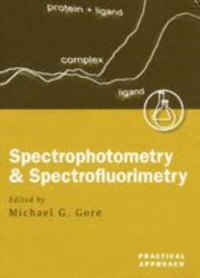
Spectrophotometry and Spectrofluorimetry
A Practical Approach
1st Edition
Published on 4. May 2000
387 pages
978-0-19-156605-9 (ISBN)
Description

Spectrophotometry and Spectrofluormetry: A Practical Approach Second Edition describes the theory and practical applications of many analytical techniques based upon the light absorbing properties of molecules. Such techniques form the basis of routine tests in chemical, biological and medical science laboratories. Practical advice is given, from experts in the different topics, together with lists of useful literature. - ,Spectrophotometry and Spectrofluorimetry: A Practical Approach Second Edition was written with the intention to help the reader understand the background concepts and practical applications of spectrophotometry and spectrofluorimetry. Optical spectroscopy underpins the day to day operations of most laboratories in the chemical, biological and medical sciences and this edition contains substantially updated and new chapters addressing the principles of most of the more common applications such as: spectrophotometry, spectrophotometric assays, spectrofluorimetry, time resolved fluorescence and phosphorescence studies, circular dichroism and pre-equilibrium spectroscopic techniques. In all chapters, the emphasis is placed upon the practical aspects, with protocols to guide readers through test experiments. Other chapters are included to introduce subjects that have traditionally depended upon spectroscopy such as basic enzyme kinetics, ligand binding, data handling and the more recently established interest in the study of protein and DNA stability. Finally, the concept of 'global analysis' is introduced to provide the reader with an insight into this method of utilizing the vast arrays of experimental data provided by current instrumentation. -
More details
Other editions
Additional editions
Book
05/2000
2nd Edition
Oxford University Press
€100.44
Shipment within 15-20 days
Content
- Intro
- Contents
- List of protocols
- Abbreviations
- 1 Introduction to light absorption: visible and ultraviolet spectra
- 1 Introduction
- Radiation and light
- UV and visible spectra
- 2 Spectrophotometry
- The Beer-Lambert law
- Deviations from-the Beer-Lambert law
- Absorbance or light scattering?
- 3 Spectra of some important naturally occurring chromophores
- Amino acids and proteins
- Nucleic acids
- NAD(P)H
- Carotenoids
- Haem proteins
- 4 Spectrophotometer configurations
- Single beam spectrophotometers
- Split beam or 'double beam' spectrophotometers
- Dual-wavelength spectrophotometers
- Multi-wavelength spectrophotometers
- Diode array spectrophotometers
- Microwell plate-reading spectrophotometers
- Reflectance methods
- Novel double monochromator methods
- Computing and Spectrophotometry
- 5 Choice of Spectrophotometer operating conditions
- Wavelength range and light source
- Spectral versus natural bandwidth
- Spectral resolution
- Scan speed and instrument response time
- Temperature
- 6 Use of the spectrophotometer
- The choices
- Baselines
- Isosbestic points
- Wavelength and absorbance calibrations
- Choice and use of cuvettes (cells)
- A detailed example: recording of a cytochrome difference spectrum (reduced minus oxidized)
- Post-scan options
- Acknowledgements
- References
- 2 Fluorescence principles and measurement
- 1 Introduction
- 2 Physical principles
- The absorption process
- Excited singlet state deactivation processes
- 3 Fluorescence parameters
- Fluorescence spectrum
- Fluorescence quantum yield, FF
- Singlet and radiative lifetime
- 4 Fluorescence spectrometers
- The light source
- Wavelength selectors
- Sample excitation components
- Sample compartment
- Fluorescence path optical components
- Fluorescence instrumentation electronics
- 5 Fluorescence spectra
- Inner filter effect
- Light scattering
- Instrumental settings
- Fluorescence spectral corrections
- Excitation spectra
- Quantum yield measurement
- 6 Fluorescence applications
- Fluorescence resonance energy transfer
- Fluorescence anisotropy
- Protein fluorescence
- Fluorescence quenching
- 7 Conclusion
- References
- 3 Time-resolved fluorescence and phosphorescence spectroscopy
- 1 Introduction
- 2 Background
- Basic photophysics and time dependence of fluorescence and phosphorescence decays
- Fluorescence and phosphorescence energy transfer and sensitized luminescence
- Observed time dependence of fluorescence
- Decay associated spectra (DAS) and discrete lifetimes versus lifetime distributions
- Polarized excitation and emission anisotropy decay
- Data analysis
- 3 Equipment for time-resolved fluorescence measurements
- Excitation sources
- Detectors
- Recording electronics
- 4 Phosphorescence
- Phosphorescence of proteins
- Time-dependent phosphorescence anisotropy
- Acknowledgements
- References
- 4 Introduction to circular dichroism
- 1 Introduction
- Circular dichroism
- Optical rotatary dispersion
- Chapter outline
- 2 Measuring a CD spectrum
- The instrumentation
- The sample
- The cuvette
- The baseline and zeroing
- The parameters
- Noise reduction
- 3 Equations of CD spectroscopy
- Degenerate coupled-oscillator CD
- Non-degenerate coupled-oscillator CD
- Carbonyl np[sup(*)] CD
- d-d transitions of tris-chelate transition metal complexes
- Optical activity (optical rotation, OR)
- Dissymmetry factor
- 4 Units of CD spectroscopy
- 5 Circular dichroism of biomolecules
- Introduction
- CD of polypeptides and proteins
- Protein UV spectroscopy
- Protein structure determination from CD
- Determining the percentage of different structural units in a protein from peptide region CD spectra
- Other applications of protein CD
- Membrane proteins
- DNA geometry and CD spectra
- UV spectroscopy of the DNA bases
- Nucleic acid CD
- DNA/ligand interactions
- References
- General CD references
- 5 Quantitative determination of equilibrium binding isotherms for multiple ligand-macromolecule interactions using spectroscopic methods
- 1 Introduction
- 2 Thermodynamic basis of quantitative spectroscopic titrations
- The signal used to monitor ligand-macromolecule interactions originates from the macromolecule
- Signal used to monitor the interactions originates from the ligand
- 3 Summary
- Acknowledgement
- References
- 6 Steady-state kinetics
- 1 Introduction to rate equations, first-order, second-order reactions etc.
- 2 Units
- 3 Basic assumptions in steady-state kinetics
- 4 Measurement of specific activity
- 5 Graphical determination of K[sub(m)] and V
- 6 Inhibition of enzyme activity
- 7 Specificity
- 8 Activators
- 9 Environmental effects on enzyme activity
- pH
- Temperature
- 10 Cooperativity
- 11 Experimental conditions for kinetic studies
- 12 Concluding remarks
- References
- 7 Spectrophotometric assays
- 1 Introduction
- Spectrophotometers
- Beer-Lambert Law
- The nature of the sample
- 2 Some general comments on, and practical aspects of, assay design
- Accuracy and precision
- 3 End point and rate assays
- End point assays
- Rate assays
- Rate assays involving amplification
- 4. Spectrophotometric assays for proteins
- A[sub(280)]
- The Biuret method
- The Lowry method
- The bicinchoninic assay
- Dye-binding assay
- Fluorimetric assay
- 5. Spectrophotometric assays for nucleic acids
- 6. Enzyme-based Spectrophotometric assays
- Some general points on assay design
- Amount of enzyme required
- Determination of glucose-a comparison of two methods
- 7. Luminescence-based assays
- 8. Spectrophotometric assays of enzymes
- Some elementary enzyme kinetics
- Continuous assays
- Stopped assays
- Coupled assays
- Plate readers
- Centrifugal analysers
- 9. Spectrophotometric assays for protein amino acid side chains
- Cysteine
- Lysine
- Tyrosine
- Histidine
- Tryptophan
- 10. Concluding remarks
- References
- 8 Stopped-flow spectroscopy
- 1. Introduction
- 2. Features of the basic instrument
- Instruments available
- 3. Measurement at a single wavelength
- Setting up
- Selecting the wavelength for a real experiment
- The form of a simple progress curve: Making sure the apparatus is mixing and transferring reactants to the observation chamber rapidly
- Measurement of the dead time
- Amplitude of the signal
- Assigning a signal
- 4. Determining rate constants
- First-order processes
- Second-order processes
- 5. Multiwavelength detection: diode array 'rapid scan methods'
- SVD (singular value decomposition)
- Fitting to a mechanism
- Acknowledgements
- References
- 9 Stopped-flow fluorescence spectroscopy
- 1. Introduction
- 2. Instrumentation
- Data collection
- Instrument calibration, stability and dead time
- Measuring mixing efficiency
- Sample preparation
- Artefacts
- Temperature effects
- Density differences between the two solutions
- 3. Factors affecting the sensitivity of the optical system
- Slit width
- Selection of wavelength of emitted light
- Voltage applied to PMT
- 4. Selection of reporter group
- Intrinsic reporter groups
- Examples of the use of protein fluorescence to follow binding reactions
- Use of ligand fluorescence to monitor binding reactions
- Extrinsic probes
- Examples of reactions monitored by changes in fluorescence of covalently attached fluorophores
- References
- 10 Stopped-flow circular dichroism
- 1. Introduction
- 2. Instrumentation considerations
- Available budget
- Sensitivity required
- Minimum dead time required
- Corrosiveness and adsorbance of the samples to be studied
- Type of flow system: stepper motor or compressed air driven
- Size and design of the optical cell
- The number of syringes and mixing stages required
- Mixing ratios required and whether these need to be variable from experiment to experiment
- Sample viscosity
- Wavelength range for detection, wavelength scanning and bandwidth
- Software
- 3. Currently available instrumentation
- Stopped-flow attachment for CD spectropolarimeters
- Integrated stopped-flow CD systems
- 4. Additional experimental considerations
- Parameters
- Zero-time and dead-time calibration
- Baseline
- System tests
- 5. Examples
- Stopped-flow CD and lysozyme folding
- DNA as a catalytic template
- References
- 11 Spectrophotometry and fluorimetry of cellular compartments and Intracellular processes
- 1. Introduction
- 2. Experimental design
- Apparatus
- Light sources
- Wavelength selection
- Chromophore selection
- Characterization and calibration of optical signals
- 3. Examples
- Oxidation-reduction state of tissue mitochondria
- Membrane potential of cells and organelles
- pH of cellular compartments
- Membrane cycling and recycling
- 4. Future prospects
- Acknowledgements
- References
- 12 Use of optical spectroscopic methods to study the thermodynamic stability of proteins
- 1. Introduction
- 2. Basic thermodynamic principles
- The two-state model
- Thermal unfolding
- Denaturant induced unfolding
- Acid induced unfolding
- Pressure induced unfolding
- Simulations
- Unfolding of oligomeric proteins
- 3. Practical considerations and deviations from the two-state model
- Existence of equilibrium intermediates
- Kinetic considerations
- Irreversibility
- Baseline considerations
- Interfering substances
- Global analysis
- 4. Advantages of different spectroscopic signals
- Absorbance
- Circular dichroism
- Fluorescence
- 5. Concluding remarks
- Acknowledgements
- References
- 13 The use of spectroscopic techniques in the study of DNA stability
- 1. Introduction
- 2. Overview of UV melting
- Strengths and weaknesses of UV melting and calorimetry
- 3. Sample
- Sequence design
- Redundant design of motifs
- Sample preparation
- Choice of buffer
- 4. Instrumentation
- Microvolume cuvettes and aluminium cuvette adapters
- Spectrophotometer
- 5. Data analysis
- Curve fitting to calculate thermodynamic parameters
- Presentation of normalized absorbance curves
- Error analysis
- References
- A1 List of suppliers
- Index
- A
- B
- C
- D
- E
- F
- G
- H
- I
- K
- L
- M
- N
- O
- P
- Q
- R
- S
- T
- U
- V
- W
- X
- Z
