

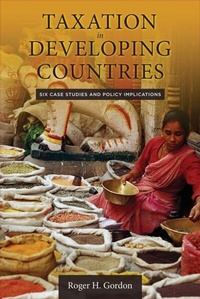
Taxation in Developing Countries
Six Case Studies and Policy Implications
1st Edition
Published on 25. September 2015
352 pages
978-0-231-52007-2 (ISBN)
Description

Taxes are a crucial policy issue, especially in developing countries. Just recently, proposals to raise middle-class taxes toppled the Bolivian government, and plans to extend or increase the value-added tax caused political unrest in Ecuador and Mexico. Despite the impact of tax policy on developing countries, a comprehensive study has yet to be written. Treating Argentina, Brazil, India, Kenya, Korea, and Russia as key case studies, this volume outlines the major aspects of current tax codes and explores their economic and political implications.
Examples of both the poorest and wealthiest developing countries, Argentina, Brazil, India, Kenya, Korea, and Russia uniquely demonstrate the diverse fiscal problems of tax reform. Each economy relies heavily on indirect and corporate income taxes, though recently some have reduced their tariff rates and have switched from excise to value-added taxes. There is a large, informal economy in most of these countries, and tax evasion by firms is a significant concern. As a result, tax revenue remains low, even though rates are as high as those in developed economies. Also, unconventional methods to collect revenue have been implemented, including bank debit taxes, state ownership of firms, and implicit taxes on individuals in the informal sector.
Exploring these and other concerns, as well as changes in tax law, administration, and fiscal pressures, this comprehensive anthology clarifies the current landscape of tax administration and the economic future of the world's poorer economies.
Examples of both the poorest and wealthiest developing countries, Argentina, Brazil, India, Kenya, Korea, and Russia uniquely demonstrate the diverse fiscal problems of tax reform. Each economy relies heavily on indirect and corporate income taxes, though recently some have reduced their tariff rates and have switched from excise to value-added taxes. There is a large, informal economy in most of these countries, and tax evasion by firms is a significant concern. As a result, tax revenue remains low, even though rates are as high as those in developed economies. Also, unconventional methods to collect revenue have been implemented, including bank debit taxes, state ownership of firms, and implicit taxes on individuals in the informal sector.
Exploring these and other concerns, as well as changes in tax law, administration, and fiscal pressures, this comprehensive anthology clarifies the current landscape of tax administration and the economic future of the world's poorer economies.
All prices
More details
Other editions
Additional editions
Book
07/2010
Columbia University Press
€76.82
Article not available at the moment
Person
Roger Gordon is professor of economics at the University of California, San Diego. His research focuses on diverse topics in public finance. He has served as editor of the Journal of Economic Literature, the Journal of Public Economics, and the American Economic Review.
Content
Acknowledgments
Acronyms
Introduction: Overview of Tax Policy in Developing Countries, by Roger H. Gordon
1. Development-Oriented Tax Policy, by Joseph E. Stiglitz
2. Taxes and Development: Experiences of India vs. China, and Lessons for Other Developing Countries, by Roger H. Gordon
3. Tax Policy in Argentina: Between Solvency and Emergency, by Oscar Cetrángolo and Juan Carlos Gómez Sabaini
4. Tax System Reform in India, by M. Govinda Rao and R. Kavita Rao
5. History of Russian VAT, by Sergei Koulayev
6. Tax Reform in Kenya: Policy and Administrative Issues, by Nada O. Eissa and William Jack
7. Korea's Tax System: A Growth- Oriented Choice, by Joosung Jun
8. Tax Structure and Tax Burden in Brazil: 1980-2004, by José Teófi lo Oliveira and Ana Carolina Giuberti
Contributors
Index
Acronyms
Introduction: Overview of Tax Policy in Developing Countries, by Roger H. Gordon
1. Development-Oriented Tax Policy, by Joseph E. Stiglitz
2. Taxes and Development: Experiences of India vs. China, and Lessons for Other Developing Countries, by Roger H. Gordon
3. Tax Policy in Argentina: Between Solvency and Emergency, by Oscar Cetrángolo and Juan Carlos Gómez Sabaini
4. Tax System Reform in India, by M. Govinda Rao and R. Kavita Rao
5. History of Russian VAT, by Sergei Koulayev
6. Tax Reform in Kenya: Policy and Administrative Issues, by Nada O. Eissa and William Jack
7. Korea's Tax System: A Growth- Oriented Choice, by Joosung Jun
8. Tax Structure and Tax Burden in Brazil: 1980-2004, by José Teófi lo Oliveira and Ana Carolina Giuberti
Contributors
Index

