

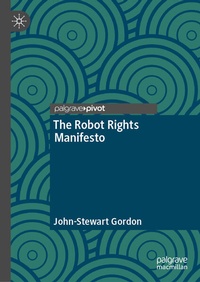
The Robot Rights Manifesto
Description

This book confronts one of the most pressing moral challenges of our technological age: should autonomous, intelligent, human-like machines be recognized as bearers of moral and socio-political rights? Anticipating a future in which artificial humanoids may develop traits such as autonomy, self-awareness, intelligence, and sentience, John-Stewart Gordon offers a rigorous and balanced case for proactive engagement with robot rights. Drawing on moral philosophy, AI ethics, and political theory, the book advances a groundbreaking hybrid theory that integrates properties-based and social-relational approaches to moral status. It proposes a novel framework of artificial citizenship and introduces a detailed "Robot Bill of Rights," offering concrete policy recommendations for ethical coexistence. Rich in interdisciplinary insight and real-world relevance, this book challenges readers to rethink the boundaries of moral community and prepare for a shared human-machine future with foresight and fairness.
Reviews / Votes
"In The Robot Rights Manifesto , philosopher John-Stewart Gordon issues a daring call to rethink who-or what-belongs within our moral community. Drawing on decades of debate in ethics, law, and artificial-intelligence research, Gordon constructs a meticulously reasoned yet radically inclusive framework for recognizing artificial beings as moral and even political subjects. Both manifesto and masterwork, the book invites readers to confront the social and moral consequences of creating minds beyond our own." (David J. Gunkel - Professor at Northern Illinois University and author of "Robot Rights and Person, Thing, Robot: A Moral and Legal Ontology for the 21st Century and Beyond")
More details
Other editions
Additional editions
Person
John-Stewart Gordon is Chief Researcher (full professor equivalent) at the Faculty of Social Sciences, Arts and Humanities, and Adjunct Full Professor at the Department of Applied Informatics, Faculty of Informatics, at Kaunas University of Technology. He is also an Associated Member of the International Center for Ethics in the Sciences and Humanities (IZEW) at the University of Tübingen, a Permanent Visiting Professor at Vytautas Magnus University, and an Associated Fellow at the Academy of International Affairs NRW in Bonn. Additionally, he is a Member of the Centre for Media Culture at Landshut University of Applied Sciences.
Content
1 General Introduction.- 2 The Emergence of Artificial Humanoids.- 3 Expanding The Moral Circle.- 4 Citizenship and Artificial Humanoids.- 5 The Robot Bill of Rights.- 6 General Conclusions.
