

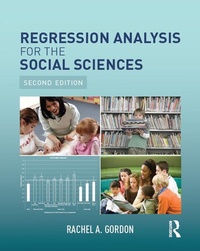
Regression Analysis for the Social Sciences
2nd Edition
Published on 17. March 2015
566 pages
978-1-317-60711-3 (ISBN)
Description

Provides graduate students in the social sciences with the basic skills they need to estimate, interpret, present, and publish basic regression models using contemporary standards.
Key features of the book include:
*interweaving the teaching of statistical concepts with examples developed for the course from publicly-available social science data or drawn from the literature.
*thorough integration of teaching statistical theory with teaching data processing and analysis.
*teaching of Stata and use of chapter exercises in which students practice programming and interpretation on the same data set. A separate set of exercises allows students to select a data set to apply the concepts learned in each chapter to a research question of interest to them, all updated for this edition.
Key features of the book include:
*interweaving the teaching of statistical concepts with examples developed for the course from publicly-available social science data or drawn from the literature.
*thorough integration of teaching statistical theory with teaching data processing and analysis.
*teaching of Stata and use of chapter exercises in which students practice programming and interpretation on the same data set. A separate set of exercises allows students to select a data set to apply the concepts learned in each chapter to a research question of interest to them, all updated for this edition.
Reviews / Votes
Regression Analysis for the Social Sciences is a well-designed textbook for upper-level undergraduate and graduate-level courses in social statistics. The textbook achieves a seamless balance between theory and practice. It provides a gentle yet thorough review of statistical theory of regression models, all the while focusing on practical application of regression models. The textbook provides an indispensable guide for learning the complexities and mechanics of regression models and analysis in the social sciences.-Steven Prus, Sociology and Anthropology, Carleton University
Teaching graduate statistics in the social sciences is challenging because our students arrive with such diverse levels of mathematics preparation. Rachel Gordon does an exceptional job of explaining complex statistical concepts using straightforward language and intuitive, relevant, examples. This book allows students with a range of quantitative backgrounds and comfort levels to understand and apply the material, and builds their confidence in using statistics.
-Amy Kate Bailey, Sociology, University of Illinois at Chicago
Gordon's textbook provides an insightful and contemporary approach to methodological instruction in the social sciences. It engages current strategies for modelling social behavior using regression, while at the same time providing plenty of applied orientation to allow the student to acquire pragmatic knowledge of how best to tackle contemporary research problems. The book is distinguished for its ample use of excerpts from recent social science literature and its attention to a key range of pragmatic issues faced by investigators. The thorough integration of a major statistical package (Stata), including examples of code, links to datasets, and illustrative results, is another feature that will be widely appreciated. For instructors and students often frustrated by other texts - too simplistic or too formal, or emphasizing examples far from current social science - Gordon's Regression Analysis for the Social Sciences will likely fit the bill.
- Michael J White, Sociology, Brown University
More details
Edition
2nd edition
Language
English
Place of publication
London
United Kingdom
Publishing group
Taylor & Francis Ltd
Target group
College/higher education
Illustrations
115 Tables, color; 70 Line drawings, black and white; 11 Halftones, black and white
File size
20,18 MB
ISBN-13
978-1-317-60711-3 (9781317607113)
Copyright in bibliographic data and cover images is held by Nielsen Book Services Limited or by the publishers or by their respective licensors: all rights reserved.
Schweitzer Classification
Other editions
Additional editions
Rachel A. Gordon
Regression Analysis for the Social Sciences
Book
03/2015
2nd Edition
Routledge
€401.77
Shipment within 10-20 days
Rachel A. Gordon
Regression Analysis for the Social Sciences
Book
03/2015
2nd Edition
Routledge
€245.53
Shipment within 10-20 days
Person
Rachel A. Gordon is Professor in the Department of Sociology and Associate Director of the Institute of Government and Public Affairs at the University of Illinois at Chicago. Professor Gordon has multidisciplinary substantive and statistical training and a passion for understanding and teaching applied statistics.
Content
I: GETTING STARTED 1. Examples of Social Science Research Using Regression Analysis 2. Planning a Quantitative Research Project with Existing Data 3. Basic Features of Statistical Packages and Data Documentation 4. Basics of Writing Batch Programs with Statistical Packages II: THE REGRESSION MODEL 5. Basic Concepts of Bivariate Regression 6. Basic Concepts of Multiple Regression 7. Dummy Variables 8. Interactions 9. Nonlinear Relationships 10. Indirect Effects and Omitted Variable Bias 11. Outliers, Heteroskedasticity, and Multicollinearity III: WRAPPING UP 12. Putting It All Together and Thinking about Where to Go Next
