

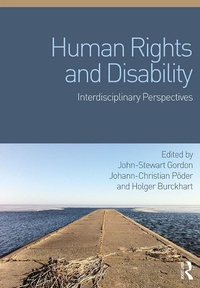
Human Rights and Disability
Interdisciplinary Perspectives
1st Edition
Published on 14. July 2017
196 pages
978-1-317-11988-3 (ISBN)
Description

The formerly established medically-based idea of disability, with its charity-based approach to treatment and services, is being replaced by a human rights-based approach in which people with impairments are no longer considered medical problems, totally dependent on the beneficence of non-impaired people in society, but have fundamental rights to support, inclusion, and participation. This interdisciplinary book examines the diverse concerns that people with impairments face in the context of human rights, provides insights into new developments on important issues relating human rights to disability, and features new approaches and solutions to vital problems in the current debate.
Reviews / Votes
Disability human rights talk is ubiquitous, but disability human rights thought is scarce. This book helps fill that gap, by subjecting human rights rhetoric to rigorous but supportive interrogation. An excellent roster of authors show us what is needed to promote the flourishing of disabled people. Professor Tom Shakespeare, University of East Anglia.More details
Edition
1. Auflage
Language
English
Place of publication
London
United Kingdom
Publishing group
Taylor & Francis Ltd
Target group
College/higher education
Product notice
Reflowable
Illustrations
1 Tables, black and white
File size
1,24 MB
ISBN-13
978-1-317-11988-3 (9781317119883)
Copyright in bibliographic data and cover images is held by Nielsen Book Services Limited or by the publishers or by their respective licensors: all rights reserved.
Schweitzer Classification
Other editions
Additional editions
John-Stewart Gordon | Johann-Christian Poder | Holger Burckhart
Human Rights and Disability
Interdisciplinary Perspectives
Book
10/2018
1st Edition
Routledge
€56.94
Shipment within 15-20 days
John-Stewart Gordon | Johann-Christian Poder | Holger Burckhart
Human Rights and Disability
Interdisciplinary Perspectives
Book
12/2016
1st Edition
Routledge
€222.84
Shipment within 10-20 days
Persons
John-Stewart Gordon, MA in philosophy and history from the University of Konstanz (2001) and Ph.D. in philosophy from the University of Goettingen (2005), Germany. He is full professor and head of the Research Cluster for Applied Ethics at Vytautas Magnus University in Kaunas, Lithuania. In addition, he has been visiting professor at Queen's University Kingston, Canada (2009-2010) and permanent visiting professor at Vytautas Magnus University in Kaunas, Lithuania (2012-2015). Furthermore, he is member of the board of Bioethics since 2007 and has been area-editor and board member of the Internet Encyclopedia of Philosophy (2007-2014). He had written and edited several books in the context of practical philosophy and published peer-reviewed articles and special issues at international leading journals and encyclopaedias including Bioethics, Ethical Theory and Moral Practice, Kennedy Institute of Ethics Journal, The Journal of Law, Medicine & Ethics, Baltic Journal of Law & Politics, Ethical Perspectives, Internet Encyclopedia of Philosophy and Oxford Bibliographies Online Philosophy. He taught philosophy and bioethics at the University of Tuebingen (Germany), Ruhr-University Bochum (Germany), Duisburg-Essen University (Germany), Queen's University in Kingston (Canada), Vytautas Magnus University in Kaunas (Lithuania) and the University of Cologne (Germany).
Johann-Christian Poder studied theology and philosophy in Tartu, Greifswald and Goettingen. He graduated from Tartu University in Estonia (theology, 2001) and received his Ph.D. in theology from Goettingen University in Germany (2010) with a thesis on phenomenological ethics of K. E. Logstrup. He was lecturer in ethics at the Theological Institute of the Estonian Evangelical Lutheran Church in Tallinn (2008-11) and substitute lecturer in modern theology at Tartu University (2011). He was also working as chaplain at Tallinn Prison (2007-2008) and Chaplain General of Prisons at Estonian Ministry of Justice (2009-2013). In 2011-2012 and 2014, he was research associate in GANI_MED-Project at Greifswald University in Germany, where he is still member of a working group in medical and theological ethics. Since 2015 he is Carlsberg Foundation postdoctoral fellow at the Faculty of Theology at Copenhagen University, Denmark, working on a book on predictive medicine, ethics, and religion.
Holger Burckhart, born in 1956, completed his Ph.D. in philosophy in 1990 and his postdoctoral lecture qualification in 1997. In 2008 he was appointed to the professorship for "Anthropology and Ethics in Curative Education, taking Special Account of People with Disabilities" at the Faculty of Human Sciences at the University of Cologne. From 2007 to 2009 he was also prorector for "Teaching, Studies and Study Reform" at the University of Cologne. He is currently the rector of the University of Siegen, vice-president of the German Rectors' Conference for the department of "Teaching, Learning, Teacher Training, and Lifelong Learning" and member of the German Accreditation Council. In 2014 he was appointed to the professorship for "Philosophy of Education with special focus in Philosophical Anthropology, Ethics and Theory of Science" at the University of Siegen. In 2015 he was elected to the board of the European University Association.
Johann-Christian Poder studied theology and philosophy in Tartu, Greifswald and Goettingen. He graduated from Tartu University in Estonia (theology, 2001) and received his Ph.D. in theology from Goettingen University in Germany (2010) with a thesis on phenomenological ethics of K. E. Logstrup. He was lecturer in ethics at the Theological Institute of the Estonian Evangelical Lutheran Church in Tallinn (2008-11) and substitute lecturer in modern theology at Tartu University (2011). He was also working as chaplain at Tallinn Prison (2007-2008) and Chaplain General of Prisons at Estonian Ministry of Justice (2009-2013). In 2011-2012 and 2014, he was research associate in GANI_MED-Project at Greifswald University in Germany, where he is still member of a working group in medical and theological ethics. Since 2015 he is Carlsberg Foundation postdoctoral fellow at the Faculty of Theology at Copenhagen University, Denmark, working on a book on predictive medicine, ethics, and religion.
Holger Burckhart, born in 1956, completed his Ph.D. in philosophy in 1990 and his postdoctoral lecture qualification in 1997. In 2008 he was appointed to the professorship for "Anthropology and Ethics in Curative Education, taking Special Account of People with Disabilities" at the Faculty of Human Sciences at the University of Cologne. From 2007 to 2009 he was also prorector for "Teaching, Studies and Study Reform" at the University of Cologne. He is currently the rector of the University of Siegen, vice-president of the German Rectors' Conference for the department of "Teaching, Learning, Teacher Training, and Lifelong Learning" and member of the German Accreditation Council. In 2014 he was appointed to the professorship for "Philosophy of Education with special focus in Philosophical Anthropology, Ethics and Theory of Science" at the University of Siegen. In 2015 he was elected to the board of the European University Association.
Content
Table of Contents
Acknowledgment *
Chapter 1 General Introduction: Human Rights and Disability - Interdisciplinary Perspectives
Alicia Oullette *
Part 1: Human Rights and Disability - Different Voices *
Chapter 2 Remarks on a Disability-Conscious Bioethics
John-Stewart Gordon *
Chapter 3 Theology, Disability, and Human Rights: Difficult Past, Promising Future
Johann-Christian Poder *
Part 2: Human Development and Inclusion *
Chapter 4 Grounding Disability and Human Rights with the Capabilities Approach
Christopher A. Riddle *
Chapter 5 Human Rights and Persons with Intellectual and Developmental Disabilities: An Elusive but Emerging Paradigm
Donato Tarulli, Dorothy Griffiths and Frances Owen *
Chapter 6 On Human Rights and Human Duties: Is there a Moral Obligation to Inclusion?
Holger Burckhart and Bennet Jaeger *
Chapter 7 The Right to Inclusive Education: Practical Implications in German Schools
Petr Frantik *
Part 3: Justice and Legal Protection *
Chapter 8 Disability Rights, Legal and Moral
Hans Reinders *
Chapter 9 From Manifesto to Action: Transforming the Aspiration of Disability Human Rights into Accountable Government Action
Jerome Bickenbach *
Chapter 10 Human and Civil Models of Rights: Healthy and Ill Disabled and Access to Healthcare
Anita Silvers and Leslie Pickering Francis *
Chapter 11 Agency and Disability. A Rights-Based Approach
Michael Boylan *
Chapter 12 Afterword
Akiko Ito *
Index *
Contributors *
Bibliography *
Acknowledgment *
Chapter 1 General Introduction: Human Rights and Disability - Interdisciplinary Perspectives
Alicia Oullette *
Part 1: Human Rights and Disability - Different Voices *
Chapter 2 Remarks on a Disability-Conscious Bioethics
John-Stewart Gordon *
Chapter 3 Theology, Disability, and Human Rights: Difficult Past, Promising Future
Johann-Christian Poder *
Part 2: Human Development and Inclusion *
Chapter 4 Grounding Disability and Human Rights with the Capabilities Approach
Christopher A. Riddle *
Chapter 5 Human Rights and Persons with Intellectual and Developmental Disabilities: An Elusive but Emerging Paradigm
Donato Tarulli, Dorothy Griffiths and Frances Owen *
Chapter 6 On Human Rights and Human Duties: Is there a Moral Obligation to Inclusion?
Holger Burckhart and Bennet Jaeger *
Chapter 7 The Right to Inclusive Education: Practical Implications in German Schools
Petr Frantik *
Part 3: Justice and Legal Protection *
Chapter 8 Disability Rights, Legal and Moral
Hans Reinders *
Chapter 9 From Manifesto to Action: Transforming the Aspiration of Disability Human Rights into Accountable Government Action
Jerome Bickenbach *
Chapter 10 Human and Civil Models of Rights: Healthy and Ill Disabled and Access to Healthcare
Anita Silvers and Leslie Pickering Francis *
Chapter 11 Agency and Disability. A Rights-Based Approach
Michael Boylan *
Chapter 12 Afterword
Akiko Ito *
Index *
Contributors *
Bibliography *
