


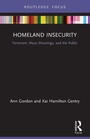
Homeland Insecurity
Terrorism, Mass Shootings and the Public
1st Edition
Published on 9. March 2021
120 pages
978-1-000-35335-8 (ISBN)
Description

In this book, Ann Gordon and Kai Hamilton Gentry expertly illuminate how the public has a role to play in ensuring its own security.
Recent terror attacks and mass shootings in the United States have added urgency to the need for research on terrorism, the public's understanding of the precursors of terrorism and public preparedness for mass shootings and acts of terror. Unfortunately, most Americans do not understand what constitutes suspicious behavior or how to report it. Even more alarmingly, the public does not know what to do in the event of terrorist attack or mass casualty incident. Drawing on five years of the Chapman Survey of American Fears (CSAF), a nationally representative survey, and real-world events, Homeland InSecurity offers actionable solutions on how to educate the public to overcome fear and play an active role securing schools, public venues and the homeland itself. The book addresses proposals by survivors and victims' families to reduce violence through campaigns to deny shooters the notoriety they seek and reduce access to guns. It also explores the rise of activism among survivors of school shootings and their quest to educate the public and end school shootings.
Homeland InSecurity will be essential for scholars, students, and policy makers.
Recent terror attacks and mass shootings in the United States have added urgency to the need for research on terrorism, the public's understanding of the precursors of terrorism and public preparedness for mass shootings and acts of terror. Unfortunately, most Americans do not understand what constitutes suspicious behavior or how to report it. Even more alarmingly, the public does not know what to do in the event of terrorist attack or mass casualty incident. Drawing on five years of the Chapman Survey of American Fears (CSAF), a nationally representative survey, and real-world events, Homeland InSecurity offers actionable solutions on how to educate the public to overcome fear and play an active role securing schools, public venues and the homeland itself. The book addresses proposals by survivors and victims' families to reduce violence through campaigns to deny shooters the notoriety they seek and reduce access to guns. It also explores the rise of activism among survivors of school shootings and their quest to educate the public and end school shootings.
Homeland InSecurity will be essential for scholars, students, and policy makers.
Reviews / Votes
"Homeland InSecurity is a timely and comprehensive examination of the intersection of fear, conspiracy thinking, and violence. Drawing upon The Chapman Survey of American Fears, the authors present a rich and rigorous analysis of the vicious cycle linking fears, real or imagined, to physical attacks on fellow citizens, and government policy responses. This impressive and original volume puts into present-day focus Benjamin Franklin's maxim regarding the tension between liberty and security. As dividing lines continue to harden between adversaries and political violence becomes more frequent, there has never been a greater need for such an instructive book. Anyone with even a passing interest in the roots of political violence in the contemporary United States should give this insightful book a close read."Todd L. Belt, Professor and Director, Political Management Program, The George Washington University
"This distressingly timely book uses data from the Chapman University trend study of American Fears to describe what frightens us, especially fears of violence in public spaces like schools, churches, and shopping malls. Then the authors look to recent events and national data to see why those fears are not all that irrational. Finally, however, they describe some positive developments that may give us hope for the future."
Earl Babbie, Campbell Professor Emeritus in Behavioral Sciences, Chapman University
More details
Series
Edition
1. Auflage
Language
English
Place of publication
London
United Kingdom
Publishing group
Taylor & Francis Ltd
Target group
College/higher education
Illustrations
3 Tables, black and white
ISBN-13
978-1-000-35335-8 (9781000353358)
Copyright in bibliographic data and cover images is held by Nielsen Book Services Limited or by the publishers or by their respective licensors: all rights reserved.
Schweitzer Classification
Other editions
Additional editions
Book
09/2022
1st Edition
Routledge
€35.80
Shipment within 15-20 days
Book
03/2021
1st Edition
Routledge
€76.70
Shipment within 15-20 days
Persons
Ann Gordon is associate professor of political science at Chapman University. She is the director of the Babbie Social Science Research Center and the Ludie and David C. Henley Social Sciences Research Laboratory. She is Co-PI of the ongoing Chapman Survey of American Fears and co-author of Fear Itself: The Causes and Consequences of Fear in America.
Kai Hamilton Gentry is a recent graduate of Chapman University with a B.A. in political science. He began working on the Chapman Survey of American Fears in 2015, and served as the assistant director of the Henley Social Sciences Research Laboratory. He plans to pursue graduate work in counterterrorism analysis.
Kai Hamilton Gentry is a recent graduate of Chapman University with a B.A. in political science. He began working on the Chapman Survey of American Fears in 2015, and served as the assistant director of the Henley Social Sciences Research Laboratory. He plans to pursue graduate work in counterterrorism analysis.
Content
1. Introduction 2. Terrorism 3. Mass Shootings 4. Conspiracy Theories 5. Conclusion
