

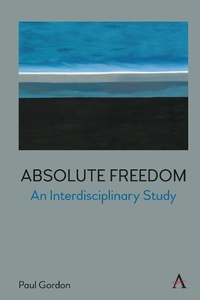
Absolute Freedom: An Interdisciplinary Study
1st Edition
Published on 13. September 2022
150 pages
978-1-83998-519-5 (ISBN)
Description

At a time when the term "freedom" is loosely-and dangerously-bandied about, this work makes the important distinction between positive and negative freedom, and examines the various "zones" of positive freedom (art, religion, academia, politics, speech, etc.)
Reviews / Votes
"Paul Gordon has provided a wonderfully broad and deep exploration of the 'highest sense' of freedom. Ranging from Plato to Thelma and Louise, via Nietzsche and Isaiah Berlin, Gordon creates an engaging web of cross-associations revealing freedom, in its most positive sense, as a potential condition of transcendence, a 'field' of creative energy" -Stephen Barker, PhD, UCI Claire Trevor School of the Arts, USA "After his groundbreaking Art and the Absolute, which explored art as a privileged domain of freedom from the conceptual, Paul Gordon's Positive Freedom turns to freedom itself: freedom not merely from, but for. In a dizzying and dire series of reflections on freedom from Kant to Camus, from free speech to friendship, Gordon posits positive freedom as the very foundation of our liberal democracy" -Dr Matthew Gumpert, Department of Western Languages and Literature, Bogazici University, Turkey. "In subject and mode, Gordon's Positive Freedom: An Interdisciplinary Study is a vindication of comparative work-in all its creativity and potential originality-as a route to absolute freedom: that domain where thinking about thinking becomes possible" -Dr Chiara Alfano, Assistant Professor in English and Education, New College of the Humanities at Northeastern, UK. "Paul Gordon's Positive Freedom makes a timely philosophical intervention in our present-day political and epidemiological controversies about freedom. Gordon reveals the limitations of defining freedom simply negatively, as immunity from restrictions. And he compellingly posits what he calls positive freedom as the pursuit or experience of a higher absolute" -Thomas Albrecht, Professor of English, Tulane University, USA. It is commonplace, especially in the US, for people to think of freedom as individual and political. Some people even think that freedom means the right to do whatever one likes. In Absolute Freedom, Gordon (comparative literature/humanities, Univ. of Colorado, Boulder) shows the poverty-if not the outright wrongheadedness-of those ideas. Real freedom, he argues, is properly understood as the link to absolute truth, a link humans pursue through artistic creativity and scholarly inquiry. Such pursuits are transformative, moving people from the ordinary to the extraordinary. Such pursuits also tend to be collective, for in consensus humans are freed to move past the limits of the self. The first section of the book builds up this theory of freedom through readings of Isaiah Berlin, Immanuel Kant, Johann Gottlieb Fichte, Friedrich Wilhelm Joseph von Schelling, Friedrich Nietzsche, Jean-Paul Sartre, and Albert Camus. In the second section, Gordon brings this theory to bear on questions of academic freedom, political freedom, free speech, artistic freedom, and friendship. Gordon's own commitment to the liberal arts shines in these pages. His chapter on academic freedom is particularly impressive, a vision of scholarly community that puts to shame the managerial culture dominating higher education today. - S. M. Barndt, Pomona College, Choice August 2023More details
Language
English
Place of publication
London
United Kingdom
Target group
Professional and scholarly
US School Grade: College Graduate Student
Edition type
Digital original
ISBN-13
978-1-83998-519-5 (9781839985195)
Copyright in bibliographic data and cover images is held by Nielsen Book Services Limited or by the publishers or by their respective licensors: all rights reserved.
Schweitzer Classification
Other editions
Additional editions
Book
09/2022
Anthem Press
€145.50
Shipment within 3-4 weeks
Person
Paul Gordon is a professor of comparative literature/humanities at the University of Colorado, Boulder. He received his PhD in comparative literature from Yale.
Previous books: The Critical Double; Rapturous Superabundance: Tragedy after Nietzsche; Dial 'M' for Mother: A Freudian Hitchcock; Art as the Absolute; Synaesthetics.
Previous books: The Critical Double; Rapturous Superabundance: Tragedy after Nietzsche; Dial 'M' for Mother: A Freudian Hitchcock; Art as the Absolute; Synaesthetics.
Content
Introduction: Positive Freedom: The Absolute Within; Part. I The Idea of Freedom-Chapter One: Positive Freedom: Berlin; Chapter Two: The Reason for Freedom: Kant; Chapter Three: The Essence of Human Freedom: Fichte/Schelling; Chapter Four: The Joy of Freedom: Nietzsche/Sartre/Camus; Part II The Practice of Freedom-Chapter Five: Academic Freedom; Chapter Six: Political Freedom?; Chapter Seven: Free Speech; Chapter Eight: Artistic Freedom: Beethoven; Chapter Nine: Friendship as Freedom.
