

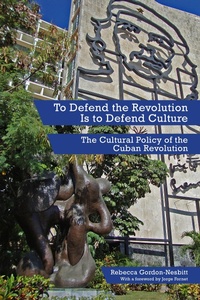
To Defend the Revolution Is to Defend Culture
Description

Grounded in painstaking research, To Defend the Revolution Is to Defend Culture revisits the circumstances which led to the arts being embraced at the heart of the Cuban Revolution. Introducing the main protagonists to the debate, this previously untold story follows the polemical twists and turns that ensued in the volatile atmosphere of the 1960s and '70s. The picture that emerges is of a struggle for dominance between Soviet-derived approaches and a uniquely Cuban response to the arts under socialism. The latter tendency, which eventually won out, was based on the principles of Marxist humanism. As such, this book foregrounds emancipatory understandings of culture.
To Defend the Revolution Is to Defend Culture takes its title from a slogan - devised by artists and writers at a meeting in October 1960 and adopted by the First National Congress of Writers and Artists the following August - which sought to highlight the intrinsic importance of culture to the Revolution. Departing from popular top-down conceptions of Cuban policy-formation, this book establishes the close involvement of the Cuban people in cultural processes and the contribution of Cuba's artists and writers to the policy and praxis of the Revolution. Ample space is dedicated to discussions that remain hugely pertinent to those working in the cultural field, such as the relationship between art and ideology, engagement and autonomy, form and content. As the capitalist world struggles to articulate the value of the arts in anything other than economic terms, this book provides us with an entirely different way of thinking about culture and the policies underlying it.
More details
Other editions
Additional editions
Persons
With a BSc in Biochemistry and Molecular Biology, an MA in the History of Art, an MRes in Social Research, a PhD in Sociology and a decade of experience as a curator of contemporary art, Dr. Rebecca Gordon-Nesbitt is a Renaissance woman. Increasingly deploying an investigative approach, she has scrutinised the devolution of cultural provision from local government to the private sector. As Researcher-in-Residence at the Centre for Contemporary Art Derry~Londonderry, she interrogated claims of culture-led regeneration being made in relation to the first incarnation of UK City of Culture. As Research Associate at Arts for Health, Manchester Metropolitan University, she compiled an international evidence base around the longitudinal relationship between arts engagement and health, which tentatively demonstrated a positive association between attending arts events and longer lives better lived. Her writing has been extensively published in anthologies, monographs, catalogues and journals.
Content
- Front Cover
- Title Page
- Copyright
- Dedication
- Contents
- Acknowledgements
- List of Illustrations
- Key to Institutions and Abbreviations
- Foreword Jorge Fornet
- Preamble Cuba as an Antidote to Neoliberalism
- One Conceptualising Cultural Policy in Cuba
- Cultural Policy under Capitalism
- The Cuban Revolution Dawns
- The Centrality of Culture to the Revolution
- A Uniquely Cuban Approach to Culture
- A Subject for the Object
- The Cultural Gains of the Revolution
- Charting the Trajectory of Cuban Cultural Policy
- A Focus on the Plastic Arts
- A Note on Style by Way of Conclusion
- Two Revolutionary Rebuilding
- Nuestro Tiempo Cultural Society
- Cuban Institute of Cinematographic Arts and Industries (ICAIC)
- Casa de las Américas
- National Council of Culture (CNC)
- The Ministry of Culture (MINCULT)
- National Union of Cuban Writers and Artists (UNEAC)
- Museums and Galleries
- Casas de Cultura
- Educational Institutions
- An Institutional Overview
- Three The Emancipatory Potential of Culture under Socialism
- Art as a Form of Social Production
- Culture as a Tool of Class Struggle
- Culture as a Means of Enhancing Spiritual Growth
- The Revolution and Aesthetics
- Freedom of Expression
- Remarks in Conclusion
- Four The Early Cultural Climate
- Cultural Discussions as the Revolution Dawns
- Words from the Intellectuals (October-November 1960)
- PM and Its Aftermath (May-June 1961)
- Words to the Intellectuals (30 June 1961)
- The First National Congress of Writers and Artists (18-22 August 1961)
- Remarks in Conclusion
- Five Cultural Policy 1961-7
- Formulation of Cultural Policy by the CNC 1961-4
- The Persistent Polemic around Socialist Aesthetics
- Socialism and Man in Cuba, March 1965
- Crisis Talks between Armando Hart and Intellectuals, October 1965
- Military Units to Aid Production (UMAP), November 1965
- The Centrality of 1966 to Cultural Discussions
- Remarks in Conclusion
- Six The Cultural Congress of Havana (5-12 January 1968)
- Commission I: Culture and National Independence
- Commission II: The Integral Formation of Man
- Commission III: The Responsibility of Intellectuals with Respect to the Problems of the Underdeveloped World
- Commission IV: Culture and the Mass Media
- Commission V: Problems of Artistic Creation and of Scientific and Technical Work
- Closing the Congress
- Internal Repercussions
- Remarks in Conclusion
- Seven Cultural Policy of the Revolution 1968-76
- The Padilla Case (1968-1971)
- The First National Congress of Education - and Culture (23-30 April 1971)
- The 'Five Grey Years' (1971-6)
- The Grey Areas within the Grey Years
- Emerging from the Grey Years
- First Congress of the Cuban Communist Party (17-22 December 1975)
- Ministry of Culture (1976-)
- Remarks in Conclusion
- Eight Towards a Marxist-Humanist Cultural Policy
- Bibliography
- Appendix A Towards a National Culture Serving the Revolution
- Appendix B Timeline of Events Significant to Cultural Development in Cuba
- About the Authors
- Index
