

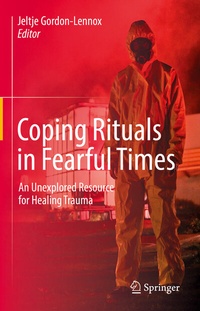
Coping Rituals in Fearful Times
Description

This collection of articles reveals ritual to be a unique and powerful asset in healing trauma and broken relationships. Each contribution offers insights on how, in the face of uncertainty, threat and dislocation, human beings feel compelled to 'do something', usually with or for others, to alleviate their anxiety, fears and sense of powerlessness. The editor and authors demonstrate how the imaginative processes at the heart of ritualmaking contribute to self- and group regulation by healing and mitigating the negative impact of trauma on individuals, collective groups, and even global systems.
The authors are a group of remarkable scholars, researchers and practitioners who represent a diverse range of disciplines and subfields, including archaeology, Chinese studies, digital culture, ecological science, philosophy, psychology, psychotherapy, the politics of memory and the preservation of cultural heritage in wartime, ritual anthropology, socialresearch, physics, research on traumatic stress, and peace studies. Students and researchers across the social and behavioural sciences will find this volume useful.
More details
Other editions
Additional editions
Person
Jeltje Gordon-Lennox is a psychotherapist, author and independent researcher in the fields of psychotraumatology and emerging secular ritual. She has edited Emerging Ritual in Secular Societies. A Transdisciplinary Conversation (2017), the first book of its kind to discuss the importance of secular rituals for cultural and personal growth. She has written five practical guides for crafting non-religious ritual: Three guides in English published by Jessica Kingsley Publishers, London, UK and two guides in French published by Labor et Fides, Geneva, Switzerland. She writes on psychotrauma and emerging ritual in both languages for publication in art expositions, catalogues and theological journals.
Content
Chapter 1. Introduction: Ritual, Dignity, and the Fragility of Life (Jeltje Gordon-Lennox).- Part I: Trauma and Ritual in Other Times and Places.- Chapter 2. Deeply Human: Archaeological Traces of Rituals for Coping with Death, Adversity, and Trauma (Liv Nilsson Stutz and Aaron Jonas Stutz).- Chapter 3. Ancient Rituals, Contemplative Practices, and Vagal Pathways (Stephen W. Porges).- Chapter 4. Coping with Social Trauma in Ancient China: The Healing Power of Meditation, Ritual, and Music (Ori Tavor).- Chapter 5. Processions and Masks: Facing Hardship in Ancient Europe (Matthieu Smyth).- Part II: The Role of Ritual in Healing Trauma.- Chapter 6. At the Sharp End of Medical Care: Healing and Reconnecting Through Ritual (Robin Karr-Morse).- Chapter 7. Dinka Community Case Study: Healing Post-Conflict Trauma Through Ritual (Alex N. Kamwaria).- Chapter 8. Memory Boxes: Ritualising Memory in Transitional Justice (Sophia Milosevic Bijleveld).- Chapter 9. Networked Solidarity: Online Rituals of Mourning Following Public Death Events (Sasha A.Q. Scott).- Part III: Global Threat, Trauma, and Ritual.- Chapter 10. Challenging Global-Dislocation Through Local Community and Ritual (Bruce K. Alexander).- Chapter 11. Ritual in an Age of Terror: From Taliban to Trump (Lisa Schirch).- Chapter 12. Nuclear Disaster, Trauma, and the Rituals of Scientific Method (Mae-Wan Ho).- Chapter 13: 'Dead Land Dead Water' - Nowhere Left to Go (Jeltje Gordon-Lennox).
