

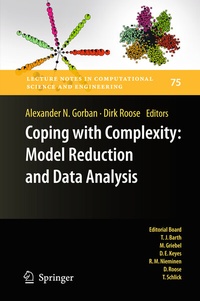
Coping with Complexity: Model Reduction and Data Analysis
1st Edition
Published on 21. October 2010
XII, 356 pages
978-3-642-14941-2 (ISBN)
Description

This volume contains the extended version of selected talks given at the international research workshop "Coping with Complexity: Model Reduction and Data Analysis", Ambleside, UK, August 31 - September 4, 2009. The book is deliberately broad in scope and aims at promoting new ideas and methodological perspectives. The topics of the chapters range from theoretical analysis of complex and multiscale mathematical models to applications in e.g., fluid dynamics and chemical kinetics.
More details
Other editions
Additional editions

Alexander N. Gorban | Dirk Roose
Coping with Complexity: Model Reduction and Data Analysis
Book
10/2010
Springer
€106.99
Shipment within 7-9 days
Content
1 - Coping with Complexity:Model Reduction and DataAnalysis [Seite 4]
2 - Preface [Seite 6]
3 - Contents [Seite 8]
4 - Contributors [Seite 10]
5 - Averaging of Fast-Slow Systems [Seite 14]
6 - The Use of Global Sensitivity Methods for the Analysis, Evaluation and Improvement of Complex Modelling Systems [Seite 21]
7 - Optimisation and Linear Control of Large Scale Nonlinear Systems: A Review and a Suite of Model Reduction-Based Techniques [Seite 49]
8 - Universal Algorithms, Mathematics of Semirings and Parallel Computations [Seite 74]
9 - Scaling Invariant Interpolation for Singularly Perturbed Vector Fields (SPVF) [Seite 101]
10 - Think Globally, Move Locally: Coarse Graining of Effective Free Energy Surfaces [Seite 122]
11 - Extracting Functional Dependence from Sparse Data Using Dimensionality Reduction: Application to Potential Energy Surface Construction [Seite 141]
12 - A Multilevel Algorithm to Compute Steady States of Lattice Boltzmann Models [Seite 158]
13 - Time Step Expansions and the Invariant Manifold Approach to Lattice Boltzmann Models [Seite 175]
14 - The Shock Wave Problem Revisited: The Navier-Stokes Equations and Brenner's Two Velocity Hydrodynamics [Seite 212]
15 - Adaptive Simplification of Complex Systems: A Review of the Relaxation-Redistribution Approach [Seite 235]
16 - Geometric Criteria for Model Reduction in Chemical Kinetics via Optimization of Trajectories [Seite 245]
17 - Computing Realizations of Reaction Kinetic Networks with Given Properties [Seite 257]
18 - A Drift-Filtered Approach to Diffusion Estimation for Multiscale Processes [Seite 272]
19 - Model Reduction of a Higher-Order KdV Equation for Shallow Water Waves [Seite 290]
20 - Coarse Collective Dynamics of Animal Groups [Seite 302]
21 - Self-Simplification in Darwin's Systems [Seite 313]
22 - Author Index [Seite 347]
23 - Subject Index [Seite 348]
24 - Editorial Policy [Seite 350]
25 - Lecture Notesin Computational Science and Engineering [Seite 352]
26 - Monographs in Computational Science and Engineering [Seite 356]
27 - Texts in Computational Science and Engineering [Seite 356]
2 - Preface [Seite 6]
3 - Contents [Seite 8]
4 - Contributors [Seite 10]
5 - Averaging of Fast-Slow Systems [Seite 14]
6 - The Use of Global Sensitivity Methods for the Analysis, Evaluation and Improvement of Complex Modelling Systems [Seite 21]
7 - Optimisation and Linear Control of Large Scale Nonlinear Systems: A Review and a Suite of Model Reduction-Based Techniques [Seite 49]
8 - Universal Algorithms, Mathematics of Semirings and Parallel Computations [Seite 74]
9 - Scaling Invariant Interpolation for Singularly Perturbed Vector Fields (SPVF) [Seite 101]
10 - Think Globally, Move Locally: Coarse Graining of Effective Free Energy Surfaces [Seite 122]
11 - Extracting Functional Dependence from Sparse Data Using Dimensionality Reduction: Application to Potential Energy Surface Construction [Seite 141]
12 - A Multilevel Algorithm to Compute Steady States of Lattice Boltzmann Models [Seite 158]
13 - Time Step Expansions and the Invariant Manifold Approach to Lattice Boltzmann Models [Seite 175]
14 - The Shock Wave Problem Revisited: The Navier-Stokes Equations and Brenner's Two Velocity Hydrodynamics [Seite 212]
15 - Adaptive Simplification of Complex Systems: A Review of the Relaxation-Redistribution Approach [Seite 235]
16 - Geometric Criteria for Model Reduction in Chemical Kinetics via Optimization of Trajectories [Seite 245]
17 - Computing Realizations of Reaction Kinetic Networks with Given Properties [Seite 257]
18 - A Drift-Filtered Approach to Diffusion Estimation for Multiscale Processes [Seite 272]
19 - Model Reduction of a Higher-Order KdV Equation for Shallow Water Waves [Seite 290]
20 - Coarse Collective Dynamics of Animal Groups [Seite 302]
21 - Self-Simplification in Darwin's Systems [Seite 313]
22 - Author Index [Seite 347]
23 - Subject Index [Seite 348]
24 - Editorial Policy [Seite 350]
25 - Lecture Notesin Computational Science and Engineering [Seite 352]
26 - Monographs in Computational Science and Engineering [Seite 356]
27 - Texts in Computational Science and Engineering [Seite 356]
