

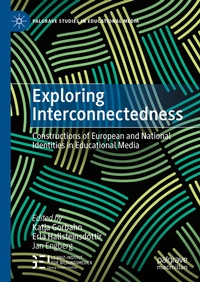
Exploring Interconnectedness
Description

This volume explores the socio-cultural and media background of a critical and ongoing political challenge: the complex entanglement between European integration and strong national agendas in the context of globalisation. It does so using educational media - both textbooks and digital media - as sites of cultural contestation to enquire into the intricate relationships around national and European identities and aspects of students' knowledge and reception. Using a variety of methods and technologies, the chapters analyse identity constructions present in educational media discourses, embedded as they are in their national and European contexts and as both the catalysts and products of their time. The book is a study of the post-digital condition in an educational context, exploring the potential of digital humanities and linguistic approaches for educational media research and employing methods such as eye-tracking or concept maps.
More details
Other editions
Additional editions
Persons
Katja Gorbahn is Associate Professor of German History and Social Studies at the School of Communication and Culture, University of Aarhus, Denmark, and Head of the research network Exploring Interconnectedness. Constructions of European and National Identities in Educational Media (EurEd), funded by the Independent Research Fund Denmark.
Erla Hallsteinsdóttir is Associate Professor of German Business Communication at the School of Communication and Culture, University of Aarhus, Denmark, and a board member of the European Society of Phraseology.
Jan Engberg is Professor of Knowledge Communication at the School of Communication and Culture, University of Aarhus, Denmark, and co-editor of the international journal Fachsprache - Journal of Professional and Scientific Communication .
Content
1. Introduction: European and National Identity Constructions in Educational Media.- 2. Europe and the Nation in Current Swiss Textbooks.- 3. A corpus-based discourse analysis of the frequency and co-occurrences of DANMARK and EUROPA in textbooks for Danish as a foreign language.- 4. Concepts of Europe in the Finnish Scholastic Curriculum and in German Textbooks for Finnish Secondary Schools.- 5. Constructions of European Identity, Crisis Stereotypes and the Discursive Embedding of the Subject in Textbook Assignments.- 6. Methodological Approaches to the Digital Analysis of Educational Media: Exploring Concepts of Europe and the Nation.- 7. Concepts of Europe in Danish and German Social Media: A Corpus-Linguistic Study.- 8. How to Strengthen Awareness of 'Europe': A Digital Analysis of Informational Material from the German Federal Agency for Civic Education.- 9. 'Europe' in our Minds: Identifying Knowledge Models Using Concept Maps.- 10. Eye-tracking as a Scientific Method for Analysing Educational Media: State of the Art and Potential.- 11. Images and Perceptions of Europe: Exploring a Multi-Perspective Design that Comprises Visual, Textual and Subjective Elements.
