

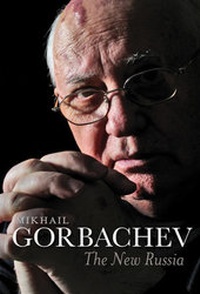
The New Russia
Description

Gorbachev's insightful analysis moves beyond internal politics to address wider problems in the region, including the Ukraine conflict, as well as the global challenges of poverty and climate change. Above all else, he insists that solutions are to be found by returning to the atmosphere of dialogue and cooperation which was so instrumental in ending the Cold War.
This book represents the summation of Gorbachev's thinking on the course that Russia has taken since 1991 and stands as a testament to one of the greatest and most influential statesmen of the twentieth century.
More details
Other editions
Additional editions
Persons
Content
To my readers
Preface: Perestroika and the future
Trying to bury me
I After Perestroika
The 1990s: Defending Perestroika
My last day in the Kremlin
A new beginning, without presidential immunity
Shock therapy
The search for a scapegoat, threats
The Gorbachev Foundation: its first reports
December 1991: politics and morality
Salvation in work
Attempts to ?destabilize? me
The ?Trial of the CPSU?
First results of shock therapy
A year after the coup
My stance
The slide towards social catastrophe
On the brink of crisis
Fateful decisions, fateful days
A state of emergency is not the way to stability
Defects of the new Constitution
1994 gets off to a bad start
Economists advise but the government is not listening
Nikita Khrushchev: lessons in courage and lessons from mistakes
The Union could have been saved
The economy: what now?
Meetings in the regions
Chechnya: a war that could have been avoided
1995: 10 years of Perestroika
The intelligentsia
Government and society
The need for an alternative
Breaking through the conspiracy of silence
Letters relating to the 1996 presidential election campaign
Discrediting elections
The final years of the millennium
The Gorbachev Foundation?s ?First Five-Year Plan?
The elections fail to bring stability
The storm breaks in 1998
How to come out of the crisis?
Letters of support
Raisa Gorbacheva
II Whither Russia?
Putin: the beginning
The new president: hopes, problems, fears
What is Glasnost?
The heavy burden of the presidency
My social-democratic choice
Russia needs social democracy
Issues and more issues
The zero years of the 2000s?
The Yukos affair
A party of new bureaucrats
A second presidential term: what for?
A new direction, or more of the same?
Full of contradictions: the first decade of the new millennium
New elections
Democracy in distress
Operation Successor
Ideas and people
Saakashvili?s adventure and the West: my reaction
Ordeal by global crisis
Defending the credo of Perestroika
Disturbing trends
My eightieth birthday
Russian politics in a quandary
A new Era of Stagnation?
The presidential ?reshuffle? and the Duma elections
For fair elections!
Society awakens
A decision to tighten the screws
Some letters of support in recent years
The need for dialogue between the government and society
III Today?s uneasy world
The relevance of New Thinking
Challenges of globalization
The challenge of security
Ban the bomb!
Consequences of NATO expansion
The world after 9/11
Poverty is a political problem
Responding to the environmental challenge
The water crisis
The threat of climate change
We need a new model of development
Meetings in America: George Shultz and Ronald Reagan
Partners should be equal
The role of the United States in the world
?America needs its own Perestroika?
The election of Obama
The future of Europe
Germany
On a solid foundation
Major figures in European politics
Looking East: China
Russia and Japan
A Simmering Region: Egypt and Syria
Russia and Ukraine
History Is Not Fated
Conclusion
Reflections of an optimist
Index
Trying To Bury Me
On 8 August 2013 the newswires of many agencies and media reported: 'Mikhail Gorbachev, the first and last Soviet president, has died, according to a message on the Twitter account of RIA Novosti. He was 82 years old. There is as yet no official confirmation of this information.'
The phone rang. It was Andrey Karplyuk. He reports now for the ITAR-TASS news agency but used to work for Interfax, and we have kept in touch for several years now.
'Mikhail Sergeyevich, I phone you quite often, but this call is not altogether routine.' I sensed he was smiling. 'What I mean is, the reason is a bit unusual.'
'Go on,' I said.
'Well, RIA Novosti is reporting that Gorbachev died during a visit to St Petersburg and I didn't believe it.'
'Neither do I', I said, and we burst out laughing.
The 'news' was taken off the wire within nine minutes, and the following day I had a letter from the agency staff:
Dear Mikhail Sergeyevich,
We are desperately sorry that hackers have exploited your name in their latest publicity-seeking attempt to discredit the media. Please accept our profound apologies for the shameful sensation caused by the hacking of our agency's accounts on social networks and the posting of hoax information about you.
We do not regard this as a straightforward practical joke or mere act of hooliganism but believe it is a crime that must be investigated. RIA Novosti is sending a statement to the law-enforcement agencies about this hacking of our Twitter channels and we will do everything in our power to ensure that the incident and all the previous hoax reports are thoroughly investigated.
This is not the first time mainstream media have been abused to spread false information, but the latest incident is just too serious, cynical and immoral to be ignored.
Mikhail Sergeyevich, you know how profoundly we respect you and we are deeply distressed that this attack on Novosti has involved you. No doubt attempts to falsify the news and hoax attempts will continue, but we wish to assure you and all our readers that we will do everything we can to quash them promptly.
My relationship with RIA Novosti goes back a long time, and in spring 2013 I gave a talk in their offices to a large number of young people, with the title, 'Does the individual change politics, or does politics change the individual?' I talked about my life, current concerns, and all the obstacles on the road to democracy that Russia has yet to travel. My audience listened attentively and asked plenty of questions. Meeting the young people left me with a good feeling. It always does. A day to remember.
And then this hoax. What was behind it? This was not the first time: Gorbachev has been 'buried' many times, and I know why.
Someone out there has a grudge against Perestroika, and lies are their weapon of choice. Libel, inexcusable fabrications and distortion of the facts. That is how it was all those years ago, and the same weapon is still being used today.
There is no shortage of examples. In December 1990, at the Congress of People's Deputies, Anatoly Lukianov, the speaker of the USSR Supreme Soviet, for some reason almost immediately gave the floor to a certain Sazha Umalatova, who called for a vote of no confidence in President Gorbachev to be put on the agenda. The delegates declined the invitation. In 1991, at the April plenum of the Communist Party's Central Committee, I was subjected to such venomous 'psychological warfare' that I said, 'I give up! How can anyone be the general secretary of two, three or even five Communist Parties at the same time?' The Politburo persuaded me to stay on.
Next, under the pretext of a meeting of representatives of Hero Cities of World War II, a whole gaggle of Party bosses of different levels decided to discuss the 'unresolved problem' of how to topple Gorbachev. In the summer of 1991, as I was meeting with leaders of the Soviet republics to finalize a draft new Union Treaty, three hardline ministers in charge of security and law-enforcement put a proposal to the USSR Supreme Soviet to reassign powers from the president to the prime minister and security ministries. Never a day passed without the warbling of 'anti-Perestroika nightingales' like Alexander Prokhanov.
To this day, insane rumours are spread, hoaxes manufactured for release onto the Internet, and 'documentaries' shown on TV which are a pack of lies and malign invention from start to finish.
From the Gorbachev Foundation website:
In late August 2008 an interview appeared in Komsomolskaya Pravda [Young Communist League Pravda] in which Pavel Borodin, who holds high office in the Union State of Russia and Belarus, made blatantly libellous allegations against M. S. Gorbachev and Helmut Kohl, former Chancellor of the Federal Republic of Germany.
After contacting Helmut Kohl, M. S. Gorbachev has received confirmation from him that Borodin's allegations were 'a complete fabrication'. The Gorbachev Foundation contacted its lawyers, who took necessary action, and Komsomolskaya Pravda has published the following:
Retraction
In Issue No. 127 (24154) of Komsomolskaya Pravda, dated 29 August 2008, and on the Internet at URL http://www.kp.ru/daily/24154/369892, an interview with P. P. Borodin, Secretary of State of the Union State of Russia and Belarus, was published under the title 'Pavel Borodin: "If South Ossetia and Abkhazia join the Union of Russia and Belarus, I too will down three litres of wine."' P. P. Borodin alleged that the former Chancellor of the Federal Republic of Germany, Helmut Kohl, had told him that 'for Eastern Europe' Mikhail Gorbachev asked for $100 million 'for his own foundation, 100 million for Shevardnadze's fund, and 100 million for the fund of another comrade'.
This information, as well as the claim that it was communicated to P. P. Borodin by Helmut Kohl, is at variance with the truth. Its intention was to impugn the integrity and reputation of M. S. Gorbachev.
Komsomolskaya Pravda, 28 January 2009
The authorities of the Russian state find me a hindrance. Today's political elite have set their sights on consolidating their right to govern in perpetuity, giving them material wealth and power without accountability. The media subservient to them defame Perestroika, vilifying those who undertook the huge and perilous task of bringing reform and elections to a country weighed down by problems that had not been addressed for decades.
Freedom of speech can be, and is, used not only by people who seek and want to report the truth, but by others who are ill-intentioned and whose consciences are unclean.
To this day I am stunned by the treachery of people I placed in positions of trust, with whom I was bound by years of joint endeavour. The most striking instance of that was the coup by the 'State Emergency Committee' that paved the way for the destruction of the Soviet Union.
By August 1991, after months of severe crises in the USSR, a plan had been devised and agreed by all parties, including the Baltic republics. We had completed work on a new Union Treaty, which was to be signed by the leaders of the republics on 20 August. In the autumn, an extraordinary congress was to move the Communist Party in the direction of reform and social democracy. We anticipated difficulties in the future, but I have no doubt that, but for the coup, the subsequent orgy of destruction could have been avoided.
Democracy is a hard taskmaster, and the free elections to the Congress of People's Deputies in 1989 produced unexpected results. On the one hand, 84 per cent of those elected were members of the Communist Party of the Soviet Union (CPSU), but, on the other, the voters withheld their trust from dozens of Party officials, who found themselves out on their ear. The reactionaries in the Party establishment initiated a campaign of furious resistance to Perestroika. Unable to achieve their goals in an open political fight, my opponents resorted to a coup d'état.
Their putsch failed, but gave the green light to separatists, radicals and extremists, with a string of disastrous consequences. The collapse of the Soviet Union; the rolling back of democracy in almost all the republics; chaos in the economy, exploited by the greediest and most unscrupulous, who succeeded in plunging almost everyone else into poverty; ethnic conflicts and bloodshed in Russia and other republics; and, finally, the shelling of the Supreme Soviet of Russia in October 1993.
People often ask me if I feel all this was my fault. They say that in late 1991, after the Belovezha collusion between Yeltsin and the leaders of Belarus and Ukraine to undermine the USSR and replace it with a 'Commonwealth of Independent States', I should have acted more decisively. My answer is that I fought for a Union State until the last, but it would have been unforgivable to allow a slide into civil conflict, and possibly civil war. We can imagine what that could have meant in a country bristling with weapons, not only conventional but also nuclear. That is why, after long deliberation, I took the decision that I still believe today was the only right one in the circumstances: I announced that I would cease to perform the duties of president of the USSR.
To the Citizens of the Soviet...
