

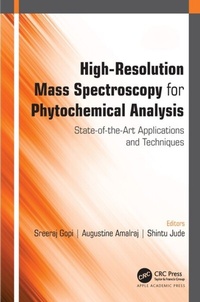
High-Resolution Mass Spectroscopy for Phytochemical Analysis
State-of-the-Art Applications and Techniques
1st Edition
Published on 30. September 2021
270 pages
978-1-000-35341-9 (ISBN)
Description

This new volume provides a bird's-eye view of the properties, utilization, and importance of high resolution mass spectrometry (HRMS) for phytochemical analysis. The book discusses the new and state-of-the-art technologies related to HRMS in phytochemical analysis for the food industry in a comprehensive manner.
Phytochemical characterization of plants is important in the food and nutraceutical industries and is also necessary in the procedures followed for drug development, toxicology determination, forensic studies, origin verification, quality assurance, etc. Easy determination of active compounds and isolation as well as purification of the same from natural matrices are required, and the possibilities and advantages of HRMS pave the way for improved analysis patterns in phytochemistry. This book is unique in that its sole consideration is on the importance of HRMS in the field of phytochemical analysis.
Along with an overview of basic instrumental information, the volume provides a detailed account of data processing and dereplication strategies. Technologies such as bioanalytical techniques and bioassays are considered also to provide support for the functions of the instruments used. In addition, a case study is presented to depict the complete phytochemical characterization of a matrix by HRMS. The book covers processing and computational techniques, dereplication, hyphenation, high-resolution bioassays, bioanalytical screening/purification techniques, applications of gas chromatography-high-resolution mass spectrometry, and more.
Key features:
Covers the fundamental instrumentation and techniques
Discusses HRMS-based phytochemical research details
Focuses strictly on the phytochemical considerations
High-Resolution Mass Spectroscopy for Phytochemical Analysis: State-of-the-Art Applications and Techniques will be a valuable reference guide and resource for researchers, faculty and students in related fields, as well as those in the phytochemical industries.
Phytochemical characterization of plants is important in the food and nutraceutical industries and is also necessary in the procedures followed for drug development, toxicology determination, forensic studies, origin verification, quality assurance, etc. Easy determination of active compounds and isolation as well as purification of the same from natural matrices are required, and the possibilities and advantages of HRMS pave the way for improved analysis patterns in phytochemistry. This book is unique in that its sole consideration is on the importance of HRMS in the field of phytochemical analysis.
Along with an overview of basic instrumental information, the volume provides a detailed account of data processing and dereplication strategies. Technologies such as bioanalytical techniques and bioassays are considered also to provide support for the functions of the instruments used. In addition, a case study is presented to depict the complete phytochemical characterization of a matrix by HRMS. The book covers processing and computational techniques, dereplication, hyphenation, high-resolution bioassays, bioanalytical screening/purification techniques, applications of gas chromatography-high-resolution mass spectrometry, and more.
Key features:
Covers the fundamental instrumentation and techniques
Discusses HRMS-based phytochemical research details
Focuses strictly on the phytochemical considerations
High-Resolution Mass Spectroscopy for Phytochemical Analysis: State-of-the-Art Applications and Techniques will be a valuable reference guide and resource for researchers, faculty and students in related fields, as well as those in the phytochemical industries.
More details
Edition
1. Auflage
Language
English
Place of publication
London
United Kingdom
Publishing group
Taylor & Francis Ltd
Target group
Professional and scholarly
College/higher education
Illustrations
5 Tables, black and white; 8 Line drawings, color; 24 Line drawings, black and white; 8 Illustrations, color; 24 Illustrations, black and white
ISBN-13
978-1-000-35341-9 (9781000353419)
Copyright in bibliographic data and cover images is held by Nielsen Book Services Limited or by the publishers or by their respective licensors: all rights reserved.
Schweitzer Classification
Other editions
Additional editions
Sreeraj Gopi | Augustine Amalraj | Shintu Jude
High-Resolution Mass Spectroscopy for Phytochemical Analysis
State-of-the-Art Applications and Techniques
Book
09/2023
1st Edition
Apple Academic Press Inc.
€123.49
Shipment within 3-4 weeks
Sreeraj Gopi | Augustine Amalraj | Shintu Jude
High-Resolution Mass Spectroscopy for Phytochemical Analysis
State-of-the-Art Applications and Techniques
Book
09/2021
1st Edition
Apple Academic Press Inc.
€154.50
Shipment within 3-4 weeks
High-Resolution Mass Spectroscopy for Phytochemical Analysis
State-Of-The Art Applications and Techniques
Book
07/2021
Apple Academic Press
Unfortunately, price unknown
Available (delivery time upon request)
Persons
Sreeraj Gopi, PhD, is an industrial scientist with a doctorate in organic chemistry, nanotechnology, and nanodrug delivery. He has been working in the area of natural products, isolation, and establishing biological activities. He has published more than 85 international articles and has filed more than 75 international patents. Dr. Gopi is a fellow of the Royal Society of Chemistry.
Augustine Amalraj, PhD, is a deputy manager in the Department of Research and Development at Plant Lipids Private Limited, Cochin, India. He obtained his doctoral degree in chemistry from Gandhigram Rural Institute - Deemed University, Gandhigram, Tamil Nadu, India. His research interests are in applied chemistry, food chemistry, natural product chemistry, environmental chemistry, chemosensors, and polymer and nanocomposite materials. He has published more than 50 research articles in international journals as well as 10 book chapters.
Shintu Jude is working as Assistant Manager in the Department of Research and Development at Plant Lipids Private Limited, Cochin, India. Mrs. Jude has completed her postgraduate degree at Mahatma Gandhi University, India. She is working on mass spectroscopic instruments for natural products and metabolites. She has published more than 20 research articles and 10 book chapters.
Augustine Amalraj, PhD, is a deputy manager in the Department of Research and Development at Plant Lipids Private Limited, Cochin, India. He obtained his doctoral degree in chemistry from Gandhigram Rural Institute - Deemed University, Gandhigram, Tamil Nadu, India. His research interests are in applied chemistry, food chemistry, natural product chemistry, environmental chemistry, chemosensors, and polymer and nanocomposite materials. He has published more than 50 research articles in international journals as well as 10 book chapters.
Shintu Jude is working as Assistant Manager in the Department of Research and Development at Plant Lipids Private Limited, Cochin, India. Mrs. Jude has completed her postgraduate degree at Mahatma Gandhi University, India. She is working on mass spectroscopic instruments for natural products and metabolites. She has published more than 20 research articles and 10 book chapters.
Content
1. High-Resolution Mass Spectrometry: Instrumentation in General 2. Data Processing and Computational Techniques 3. Dereplication: HRMS in Phytochemical Analysis 4. Hyphenation of HRMS with Instruments for Phytochemical Characterization 5. High-Resolution Bioassays as Preparation Screening Techniques 6. Bioanalytical Screening/Purification Techniques 7. Plant Metabolites, While Looking Through HRMS: Characterization of the Phenolic Profile of Lactuca sativa as a Case Study 8. Applications of Gas Chromatography-High-Resolution Mass Spectrometry (GC-HRMS) for Food Analysis
