

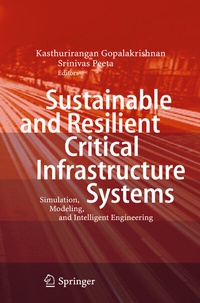
Sustainable and Resilient Critical Infrastructure Systems
Simulation, Modeling, and Intelligent Engineering
1st Edition
Published on 13. April 2010
X, 265 pages
978-3-642-11405-2 (ISBN)
Description

Sustainable and resilient critical infrastructure systems is an emerging paradigm in an evolving era of depleting assets in the midst of natural and man-made threats to provide a sustainable and high quality of life with optimized resources from social, economic, societal and environmental considerations. The increasing complexity and interconnectedness of civil and other interdependent infrastructure systems (electric power, energy, cyber-infrastructures, etc.) require inter- and multidisciplinary expertise required to engineer, monitor, and sustain these distributed large-scale complex adaptive infrastructure systems.
This edited book is motivated by recent advances in simulation, modeling, sensing, communications/information, and intelligent and sustainable technologies that have resulted in the development of sophisticated methodologies and instruments to design, characterize, optimize, and evaluate critical infrastructure systems, their resilience, and their condition and the factors that cause their deterioration.
Specific topics discussed in this book include, but are not limited to: optimal infrastructure investment allocation for sustainability, framework for manifestation of tacit critical infrastructure knowledge, interdependencies between energy and transportation systems for national long term planning, intelligent transportation infrastructure technologies, emergent research issues in infrastructure interdependence research, framework for assessing the resilience of infrastructure and economic systems, maintenance optimization for heterogeneous infrastructure systems, optimal emergency infrastructure inspection scheduling, and sustainable rehabilitation of deteriorated transportation infrastructure systems.
More details
Other editions
Additional editions
Kasthurirangan Gopalakrishnan | Srinivas Peeta
Sustainable and Resilient Critical Infrastructure Systems
Simulation, Modeling, and Intelligent Engineering
Book
04/2010
Springer
€160.49
Shipment within 7-9 days
Content
Synthesis of Modeling and Simulation Methods on Critical Infrastructure Interdependencies Research.- Interdependencies between Energy and Transportation Systems for National Long Term Planning.- A Framework for Assessing the Resilience of Infrastructure and Economic Systems.- Regional Infrastructure Investment Allocation for Sustainability.- A Framework for the Manifestation of Tacit Critical Infrastructure Knowledge.- Intelligent Transportation Infrastructure Technologies for Condition Assessment and Structural Health Monitoring of Highway Bridges.- Maintenance Optimization for Heterogeneous Infrastructure Systems: Evolutionary Algorithms for Bottom-Up Methods.- A Swarm Intelligence Approach for Emergency Infrastructure Inspection Scheduling.- Optimal Highway Infrastructure Maintenance Scheduling Considering Deterministic and Stochastic Aspects of Deterioration.- Sustainable Rehabilitation of Deteriorated Concrete Highways: Condition Assessment Using Shuffled Complex Evolution (SCE) Global Optimization Approach.
"A Framework for the Manifestation of Tacit Critical Infrastructure Knowledge (p. 139-140)
Ebrahim Bagheri * and Ali A. Ghorbani
Abstract. Critical infrastructure systems are tightly-coupled socio-technical systems with complicated behavior. They have emerged as an important focal point of research due to both their vital role in the normal conduct of societal activities as well as their inherent appealing complications for researchers. In this chapter, we will report on our experience in developing techniques, tools and algorithms for revealing and interpreting the hidden intricacies of such systems.
The chapter will include the description of several of our technologies that allow for the guided understanding of the current status quo of infrastructure systems through the Astrolabe methodology, the formal profiling of infrastructure systems using the UML-CI meta-modeling mechanism, and also observing the emergent behavior of these complex systems through the application of the agent-based AIMS simulation suite.
1 Introduction
Critical infrastructures are among the most significant technical systems that influence the ordinary life of any person or the normal operation of any industrial sector. Their importance is mainly due to the type of facilities/utilities that they provide. These facilities (either in the form of asset supply or service provisioning) serve as the building block for any other simple or complex functionality of the society. The outputs of the infrastructures although complex in nature, can be thought of as the essential atomic inputs to other more complex systems.
Apparently, without the proper operation of infrastructure systems, the function of other dependant systems would be disrupted. The very interesting fact is that throughout the years, infrastructure systems themselves have become dependent on each others’ outputs, turning the vertically integrated systems with only a few points of communication, into horizontally integrated systems with various points of interaction in many of their dimensions [1].
Analogous to the dependency of other systems on infrastructures, it can be observed that infrastructure systems themselves are inter-reliant or in other words tightly coupled. As has been extensively studied in the field of fault tolerant computing, a complex system built from interacting components is exposed to a high risk of failure derived from the possibility of mal-function in any of its components. The degree of effectiveness of the failing component in the overall architecture (e.g. in a digital circuit it can be thought of as the number of input/output connections of a specific component), suggests an estimate of the degree of damage or harm that its failure will cause."
Ebrahim Bagheri * and Ali A. Ghorbani
Abstract. Critical infrastructure systems are tightly-coupled socio-technical systems with complicated behavior. They have emerged as an important focal point of research due to both their vital role in the normal conduct of societal activities as well as their inherent appealing complications for researchers. In this chapter, we will report on our experience in developing techniques, tools and algorithms for revealing and interpreting the hidden intricacies of such systems.
The chapter will include the description of several of our technologies that allow for the guided understanding of the current status quo of infrastructure systems through the Astrolabe methodology, the formal profiling of infrastructure systems using the UML-CI meta-modeling mechanism, and also observing the emergent behavior of these complex systems through the application of the agent-based AIMS simulation suite.
1 Introduction
Critical infrastructures are among the most significant technical systems that influence the ordinary life of any person or the normal operation of any industrial sector. Their importance is mainly due to the type of facilities/utilities that they provide. These facilities (either in the form of asset supply or service provisioning) serve as the building block for any other simple or complex functionality of the society. The outputs of the infrastructures although complex in nature, can be thought of as the essential atomic inputs to other more complex systems.
Apparently, without the proper operation of infrastructure systems, the function of other dependant systems would be disrupted. The very interesting fact is that throughout the years, infrastructure systems themselves have become dependent on each others’ outputs, turning the vertically integrated systems with only a few points of communication, into horizontally integrated systems with various points of interaction in many of their dimensions [1].
Analogous to the dependency of other systems on infrastructures, it can be observed that infrastructure systems themselves are inter-reliant or in other words tightly coupled. As has been extensively studied in the field of fault tolerant computing, a complex system built from interacting components is exposed to a high risk of failure derived from the possibility of mal-function in any of its components. The degree of effectiveness of the failing component in the overall architecture (e.g. in a digital circuit it can be thought of as the number of input/output connections of a specific component), suggests an estimate of the degree of damage or harm that its failure will cause."
