

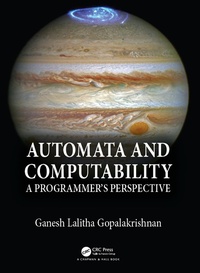
Automata and Computability
A Programmer's Perspective
1st Edition
Published on 4. March 2019
348 pages
978-1-351-37428-6 (ISBN)
Description

Automata and Computability is a class-tested textbook which provides a comprehensive and accessible introduction to the theory of automata and computation. The author uses illustrations, engaging examples, and historical remarks to make the material interesting and relevant for students. It incorporates modern/handy ideas, such as derivative-based parsing and a Lambda reducer showing the universality of Lambda calculus. The book also shows how to sculpt automata by making the regular language conversion pipeline available through a simple command interface. A Jupyter notebook will accompany the book to feature code, YouTube videos, and other supplements to assist instructors and students
Features
Uses illustrations, engaging examples, and historical remarks to make the material accessible
Incorporates modern/handy ideas, such as derivative-based parsing and a Lambda reducer showing the universality of Lambda calculus
Shows how to "sculpt" automata by making the regular language conversion pipeline available through simple command interface
Uses a mini functional programming (FP) notation consisting of lambdas, maps, filters, and set comprehension (supported in Python) to convey math through PL constructs that are succinct and resemble math
Provides all concepts are encoded in a compact Functional Programming code that will tesselate with Latex markup and Jupyter widgets in a document that will accompany the books. Students can run code effortlessly href="https://github.com/ganeshutah/Jove.git/"here.
Features
Uses illustrations, engaging examples, and historical remarks to make the material accessible
Incorporates modern/handy ideas, such as derivative-based parsing and a Lambda reducer showing the universality of Lambda calculus
Shows how to "sculpt" automata by making the regular language conversion pipeline available through simple command interface
Uses a mini functional programming (FP) notation consisting of lambdas, maps, filters, and set comprehension (supported in Python) to convey math through PL constructs that are succinct and resemble math
Provides all concepts are encoded in a compact Functional Programming code that will tesselate with Latex markup and Jupyter widgets in a document that will accompany the books. Students can run code effortlessly href="https://github.com/ganeshutah/Jove.git/"here.
Reviews / Votes
"I have taught formal languages and automata theory for decades, and I have seen many, perhaps most, students struggle with the material because it is so abstract. I've often thought that computer science students would learn it better by programming it. Indeed, that's how I really learned these topics -- by implementing constructions directly in practical compiler generation and formal verification tools to do my research. Prof. Gopalakrishnan's approach is to have students learn by doing, while still going into greater depth than some purely pencil-and-paper courses."-Prof. David L. Dill, Donald E. Knuth Professor, Emeritus, in the School of Engineering, Stanford University
"It is probably a safe assumption to make these days that many, if not most, computer science undergraduates have had programming experience, but few of them know the language of mathematics. Professor Gopalakrishnan's book builds on the student's experience in programming and animates the theory of automata, formal languages, and computability with actual programs which the student can easily modify and play with. Doing is the best way of learning. This book should enable the typical computer science student to acquire a more visceral, and therefore in the long run more useful, understanding of the theory."
-Dr. Ching-Tsun Chou, Silicon Architecture Engineer, Intel Corporation
"As a long-time researcher in programming languages and high-performance computing, I find the coverage of Automata and Computability in this book illuminating from a foundational perspective as well as timely from a practical perspective. In addition to classical topics such as automata theory and parsing, it allows a student to interactively study via Jupyter notebooks a wide range of topics including grammar disambiguation, Boolean satisfiability, Post Correspondence and Lambda Calculus --- all important topics for students who aspire to become proficient in c
More details
Edition
1. Auflage
Language
English
Place of publication
London
United Kingdom
Publishing group
Taylor & Francis Ltd
Target group
College/higher education
Primary & secondary/elementary & high school
Product notice
Reflowable
Illustrations
11 Tables, black and white; 114 Illustrations, black and white
File size
14,39 MB
ISBN-13
978-1-351-37428-6 (9781351374286)
Copyright in bibliographic data and cover images is held by Nielsen Book Services Limited or by the publishers or by their respective licensors: all rights reserved.
Schweitzer Classification
Other editions
Additional editions
Book
09/2020
1st Edition
Chapman & Hall/CRC
€56.98
Shipment within 15-20 days
Book
02/2019
1st Edition
CRC Press
€138.28
Shipment within 10-20 days
Person
Ganesh Gopalakrishnan is a professor in the Computer Science Department at the University of Utah.
Content
I Foundations
1 What Machines Think
2 Defining Languages: Patterns in Sets of Strings
3 Kleene Star: Basic Method of defining Repetitious Patterns
II Machines
4 Basics of DFAs
5 Designing DFA
6 Operations on DFA
7 Nondeterministic Finite Automata
8 Regular Expressions and NFA
9 NFA to RE conversion
10 Derivative-based Regular Expression Matching
11 Context-Free Languages and Grammars
12 Pushdown Automata
13 Turing Machines
III Concepts
14 Interplay Between Formal Languages
15 Post Correspondence, and Other Undecidability Proofs
16 NP-Completeness
17 Binary Decision Diagrams as Minimal DFA
18 Computability using Lambdas
1 What Machines Think
2 Defining Languages: Patterns in Sets of Strings
3 Kleene Star: Basic Method of defining Repetitious Patterns
II Machines
4 Basics of DFAs
5 Designing DFA
6 Operations on DFA
7 Nondeterministic Finite Automata
8 Regular Expressions and NFA
9 NFA to RE conversion
10 Derivative-based Regular Expression Matching
11 Context-Free Languages and Grammars
12 Pushdown Automata
13 Turing Machines
III Concepts
14 Interplay Between Formal Languages
15 Post Correspondence, and Other Undecidability Proofs
16 NP-Completeness
17 Binary Decision Diagrams as Minimal DFA
18 Computability using Lambdas
