

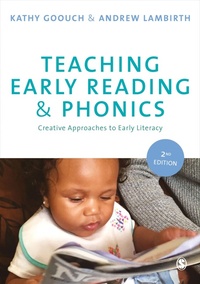
Teaching Early Reading and Phonics
Creative Approaches to Early Literacy
2nd Edition
Published on 18. October 2016
152 pages
978-1-4739-9843-8 (ISBN)
Description

Learning to read is an exciting and vital part of every child's development.
The new edition of this book continues to provide trainees and teachers with a broad understanding of teaching reading and phonics, and equip them with the skills necessary to face the reality of the early years classroom in order to meet the needs of individual children.
With vital information on constructing relationships with young readers, and how to plan phonics within a rich, interactive and playful literacy pedagogy, the second edition now includes:
A brand new chapter on babies and early reading
More information on language acquisition and how children learn
A discussion of children with SEN
An appreciation for the rise of digital technologies in relation to reading
Whether you're training to become a teacher, or already working in the classroom this book is ideal for those who wish to embed the teaching of phonics into carefully selected high quality materials - particularly in children's literature.
The new edition of this book continues to provide trainees and teachers with a broad understanding of teaching reading and phonics, and equip them with the skills necessary to face the reality of the early years classroom in order to meet the needs of individual children.
With vital information on constructing relationships with young readers, and how to plan phonics within a rich, interactive and playful literacy pedagogy, the second edition now includes:
A brand new chapter on babies and early reading
More information on language acquisition and how children learn
A discussion of children with SEN
An appreciation for the rise of digital technologies in relation to reading
Whether you're training to become a teacher, or already working in the classroom this book is ideal for those who wish to embed the teaching of phonics into carefully selected high quality materials - particularly in children's literature.
Reviews / Votes
I think these authors have done a splendid job and have managed to produce a book that speaks persuasively, directly and clearly to fellow researchers/academics and teachers. It is a fabulous up-to-date critical analysis of current literature on which excellent ideas for practice and policy are grounded. Personally, I think the emphasis these authors place on the learning and care of the very youngest children is particularly fresh - not enough analysis or conceptualising is happening in this area and these authors, especially Kathy Goouch, have been pioneering in this regard. This book will therefore encourage that line of inquiry and support developments in practice. I also think it will be an invaluable resource for fellow researchers, doctoral students and those tasked with shaping policy on literacy, especially in England where new thinking is overdue in the policy field. I hope it proves to be required reading for diverse groups: academics (especially those in childhood studies and teacher education) practitioners and policy makers. I will certainly be recommending it to my colleagues and students. -- Professor Kathy HallMore details
Edition
Second Edition
Language
English
Place of publication
London
United Kingdom
Target group
College/higher education
Product notice
Reflowable
File size
1,00 MB
ISBN-13
978-1-4739-9843-8 (9781473998438)
Copyright in bibliographic data and cover images is held by Nielsen Book Services Limited or by the publishers or by their respective licensors: all rights reserved.
Schweitzer Classification
Other editions
Additional editions
Kathy Goouch | Andrew Lambirth
Teaching Early Reading and Phonics
Creative Approaches to Early Literacy
Book
11/2016
2nd Edition
SAGE Publications Ltd
€128.80
Shipment within 15-20 days
Persons
Kathy Goouch is Professor of Early Education in the Research Centre for Children, Families and Communities at Canterbury Christ Church University. Kathy's career in education began in the 1970s as a teacher in London schools, later focusing on teaching very young children in school and kindergarten. She now enjoys teaching, researching and writing about babies and young children, their literacy and learning and the people who care for them and help them to learn. She has contributed to conferences across the world and is developing research collaborations to contribute to understandings of international discourses of care. Kathy's research and publications are particularly focused on very early communication and interactions between adults and infants and her current research projects are attempting to understand the nature of relationships in baby rooms in nurseries.
Andrew Lambirth is Professor of Education in The Faculty of Education and Health at The University of Greenwich. Before joining Higher Education, he was a Primary School teacher in Peckham and Bermondsey in South East London. Andrew has published widely in the field of the teaching of Literacy and English including: Primary English (2005, Learning Matters), Creativity and Writing: Developing Voice and Verve in the Classroom (2005, Routledge) with Grainger and Goouch. Understanding Reading and the Teaching of Phonics: Critical Perspectives (2007, Open University) Literacy on the Left: Reform and Revolution (2007 Bloomsbury); Making Poetry Matter (2013 Bloomsbury) with Dymoke and Wilson. Andrew is currently President of the United Kingdom Literacy Association
Andrew Lambirth is Professor of Education in The Faculty of Education and Health at The University of Greenwich. Before joining Higher Education, he was a Primary School teacher in Peckham and Bermondsey in South East London. Andrew has published widely in the field of the teaching of Literacy and English including: Primary English (2005, Learning Matters), Creativity and Writing: Developing Voice and Verve in the Classroom (2005, Routledge) with Grainger and Goouch. Understanding Reading and the Teaching of Phonics: Critical Perspectives (2007, Open University) Literacy on the Left: Reform and Revolution (2007 Bloomsbury); Making Poetry Matter (2013 Bloomsbury) with Dymoke and Wilson. Andrew is currently President of the United Kingdom Literacy Association
Content
Chapter 1: Introduction: Sensible Approaches to Teaching and Reading
Chapter 2: Beginning with Babies
Chapter3: Critical contexts
Chapter 4: The role of the teacher
Chapter 5: Knowledge for reading
Chapter 6: Environments for reading
Chapter 7: Resources for reading
Chapter 7: Resources for reading Chapter 8: Reading routines
Chapter 9: Talk, reading and writing
Chapter 10: Assessment of reading
Chapter 11: Conclusions: Principles and Practice
Chapter 2: Beginning with Babies
Chapter3: Critical contexts
Chapter 4: The role of the teacher
Chapter 5: Knowledge for reading
Chapter 6: Environments for reading
Chapter 7: Resources for reading
Chapter 7: Resources for reading Chapter 8: Reading routines
Chapter 9: Talk, reading and writing
Chapter 10: Assessment of reading
Chapter 11: Conclusions: Principles and Practice
