

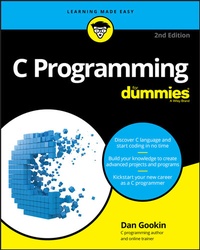
C Programming For Dummies
Description

As with any major language, mastery of C can take you to some very interesting new places. Almost 50 years after it first appeared, it's still the world's most popular programming language and is used as the basis of global industry's core systems, including operating systems, high-performance graphics applications, and microcontrollers. This means that fluent C users are in big demand at the sharp end in cutting-edge industries--such as gaming, app development, telecommunications, engineering, and even animation--to translate innovative ideas into a smoothly functioning reality.
To help you get to where you want to go with C, this 2nd edition of C Programming For Dummies covers everything you need to begin writing programs, guiding you logically through the development cycle: from initial design and testing to deployment and live iteration. By the end you'll be au fait with the do's and don'ts of good clean writing and easily able to produce the basic--and not-so-basic--building blocks of an elegant and efficient source code.
* Write and compile source code
* Link code to create the executable program
* Debug and optimize your code
* Avoid common mistakes
Whatever your destination: tech industry, start-up, or just developing for pleasure at home, this easy-to-follow, informative, and entertaining guide to the C programming language is the fastest and friendliest way to get there!
More details
Other editions
Additional editions
Person
Content
Introduction
When I was in school, I'd open a new math textbook and look in the back, marveling at the problems. Someday, I thought, I would understand all this nonsense.
You should do that with this book right now: Open it up to one of the final chapters. Look over the C programming code and think to yourself, "Someday soon, this will all make perfect sense to me."
Say "Hello, world" to C Programming For Dummies, 2nd Edition, the book that sets you on the path to become a computer programmer. Once despised vermin, banished to basement server rooms and suffering from a lack of personal hygiene, programmers are now valued and contributing members of society. Some are billionaires. And they all started their careers by learning to program.
The C language lets you master a number of electronic gizmos. You can craft your own programs, dictating your every whim and desire to computers, tablets, and cell phones. The electronics dutifully obey. Given the information offered in this book, you can pass that programming class, impress your friends, be admired by Hollywood, or even start your own software company. Truly, learning to program is a worthy investment of your time.
This book helps make learning how to program understandable and enjoyable. You don't need any programming experience - you don't even need to buy new software. You just need the desire to program in C and the ability to have fun while doing so.
Why the C Language?
An argument surfaces every few years that learning C is a road to nowhere. Newer, better programming languages exist, and it's far better to learn them than to waste time learning C.
Poppycock.
C continues to dominate the charts for best and most useful programming languages, often beating out the newer languages the cool programmers use. Further, C is like the Latin of computer languages: Just about every Johnny-come-lately programming language uses C syntax. C keywords and even certain functions find their way into other popular languages, from C++ to Java to Python to whatever the latest, trendy language might be.
My point is that once you learn C programming, all those other programming languages come easy. In fact, many of the books that teach those other languages often assume that you know a little C before you start out. This assumption is frustrating for a beginner - but not when you already know C.
So ignore the lofty pundits and know-it-all poohbahs. C is still relevant. Programming for microcontrollers, operating systems, and major software packages is still done using good ol' C. You are not wasting your time.
The C Programming For Dummies Approach
As a programmer, I've toiled through many programming books. I know what I really don't like to see, and, lamentably, I see it often - that is, where the author writes pages-long code or boasts about what he knows, impressing his fellow nerds and not really teaching anything. Too much of this type of training exists, which is probably why you've picked up this book.
My approach here is simple: Short programs. To-the-point demonstrations. Lots of examples. Plenty of exercises.
The best way to learn something is by doing it. Each concept presented in this book is coupled with sample code. The listings are short enough that you can quickly type them in - and I recommend that you do so. You can then build and run the code to see how things work. This immediate feedback is not only gratifying, it's also a marvelous learning tool.
Sample programs are followed by exercises you can try on your own, testing your skills and expanding your knowledge. Suggested answers to the exercises and all the source code can be found on this book's companion website:
https://c-for-dummies.com/cprog
How This Book Works
This book teaches the C programming language. It starts out by assuming that you know little to nothing about programming, and it finishes by covering some of the more advanced C operations.
To program in C, you need a computer. This book makes no assumptions about the computer you select: It can be a Windows PC, a Macintosh, or a Linux system. You can choose to use an integrated development environment (IDE) such as Code::Blocks, or you can compile and run the sample programs at a command prompt.
This book also wastes no time, getting you started immediately in Chapter 1. Nothing is introduced without a full explanation first. Due to the nature of programming, I've made a few exceptions; they're carefully noted in the text. Otherwise, the book flows from front to back, which is how best to read this book.
C language keywords and functions are shown in italic text, as in printf() and break. Some keywords, such as for and if, may make the sentence read in a goofy way, which is why those words are shown in italic.
Filenames and variable names are shown in monofont type, such as program.exe and loop.
If you need to type something, that text is shown in bold. For example, "Type the blorfus command" means that you should type blorfus at the keyboard. You're directed when to press the Enter key, if at all.
When working numbered steps, text to type appears in regular (roman) type:
- Type exit and press the Enter key.
You type the word exit and then press the Enter key.
Program samples are shown as snippets on the page, similar to this one:
if( i == 1)
 printf("eye won");
You don't need to type an example unless you're directed to do so.
Full program listings are shown and numbered in each chapter; for example:
LISTING 1-1 The Code::Blocks Skeleton
#include <stdio.h>
 #include <stdlib.h>

 int main()
 {
 printf("Hello world!\n");
 return(0);
 }
Because of this book's margins, text in a listing may occasionally wrap, extending from one line to the next. You do not need to split up your code in a similar manner, and I remind you whenever such a thing occurs.
The listings in this book don't contain line numbers, but your text editor might. This book references the sample code listings by using the line numbers, which you can also use in your editor to examine the code.
Exercises are numbered by chapter and then sequentially. So the third exercise in Chapter 13 is Exercise 13-3. You're directed in the text to work an exercise. Here's an example:
Exercise 1-1: Type the source code from Listing 1-1 into your editor. Save it under the filename ex0101.c. Build and run.
Answers for all exercises can be found on the web:
https://c-for-dummies.com/cprog
Go to this web page if you want to copy-and-paste the source code as well.
Icons Used in This Book
This icon flags information worthy enough to remember. Though I recommend remembering as much as you can, these icons flag the stuff you just can't forget.
A tip is a suggestion, a special trick, or something super fancy to help you out.
This icon marks something you need to avoid. It's advice that could also be flagged with a Tip or Remember icon but has dire consequences if ignored.
Face it: All of programming is technical. I reserve the use of this icon for extra-technical tidbits, asides, and anecdotes. Call it "nerd stuff."
Parting Thoughts
I enjoy programming. It's a hobby, and I find it incredibly relaxing, frustrating, and rewarding. I assume that you share these feelings, though you may also be a struggling student or someone who wants a career. Regardless, enjoy programming. If you can imagine the program you want to write on a screen, you can make it happen. It may not happen as fast as you like, but it can happen.
Please work the exercises in this book. Try some on your own, variations on a theme. Continue working at problems until you solve them. The amazing thing about programming is that no single, absolutely correct way to do something exists. Anytime you try, you're learning.
If possible, find a programming friend who can help you. Don't make them do the work or explain how things run, but rely on them as a resource. Programming can be a solo thing, but it's good to occasionally commiserate with others who also program in C - or in any language.
This book has a few companion websites. The primary one is found here:
https://c-for-dummies.com/cprog
You can also check out my C programming blog, which is updated every Saturday with new lessons and offers a monthly Exercise challenge:
https://c-for-dummies.com/blog
The publisher also features a companion website, which I'm obliged to mention here, though it's not updated as frequently as my own site. Visit www.dummies.com and type C...
