

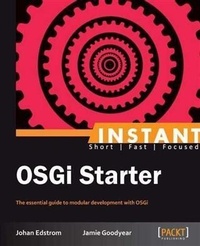
Instant OSGi Starter
The essential guide to modular development with OSGi
1st Edition
Published on 13. January 2025
58 pages
978-1-84951-993-9 (ISBN)
Description

The essential guide to modular development with OSGiKey Features - Learn something new in an Instant! A short, fast, focused guide delivering immediate results.
- Learn what can be done with OSGi and what it can bring to your development structure
- Build your first application and deploy to an OSGi runtime that simplifies your experience
- Discover an uncomplicated, conversational approach to learning OSGi for building and deploying modular applications
Book DescriptionOSGi is a tried and true modularity standard for Java. It has in recent years gained a lot of traction and tooling; becoming frequently used in Enterprise containers and distributed software systems. "Instant OSGi Starter" is where you should start before beginning your first OSGi based project. You'll be exposed to the core concepts, gain practical experience with the most important features, and learn about the basic tenets of modular code practices. This book begins with the fundamental tools needed for building modular applications, top features with basic tenets of modular core practices and provides useful insights into resources and the community.As this book progresses you will be able to get started programming in OSGi whilst looking at the default three layer design so the application will be architected towards modularity and simplicity.Through exploring several tools and technologies and browsing the communities you will be able to work towards modular programming in OSGi.What you will learn - Discover the basic tenets of the Open Services Gateway initiative and modular programming
- Deploy and manage your OSGi applications in a runtime container
- Gain familiarity with OSGi tooling
- Understand the Bundle as the most basic layer of OSGI modularity
- Master the OSGi Lifecycle model for modular code
- Gain exposure to key OSGi patterns such as Whiteboard and Extender
- Find more information and supporting communities for OSGi developers
Who this book is for"Instant OSGi Starter" is intended for the senior Java programmer whom will be joining OSGi based projects, or for Architects looking to broaden their exposure to OSGi as a beneficial framework and runtime software system.
- Learn what can be done with OSGi and what it can bring to your development structure
- Build your first application and deploy to an OSGi runtime that simplifies your experience
- Discover an uncomplicated, conversational approach to learning OSGi for building and deploying modular applications
Book DescriptionOSGi is a tried and true modularity standard for Java. It has in recent years gained a lot of traction and tooling; becoming frequently used in Enterprise containers and distributed software systems. "Instant OSGi Starter" is where you should start before beginning your first OSGi based project. You'll be exposed to the core concepts, gain practical experience with the most important features, and learn about the basic tenets of modular code practices. This book begins with the fundamental tools needed for building modular applications, top features with basic tenets of modular core practices and provides useful insights into resources and the community.As this book progresses you will be able to get started programming in OSGi whilst looking at the default three layer design so the application will be architected towards modularity and simplicity.Through exploring several tools and technologies and browsing the communities you will be able to work towards modular programming in OSGi.What you will learn - Discover the basic tenets of the Open Services Gateway initiative and modular programming
- Deploy and manage your OSGi applications in a runtime container
- Gain familiarity with OSGi tooling
- Understand the Bundle as the most basic layer of OSGI modularity
- Master the OSGi Lifecycle model for modular code
- Gain exposure to key OSGi patterns such as Whiteboard and Extender
- Find more information and supporting communities for OSGi developers
Who this book is for"Instant OSGi Starter" is intended for the senior Java programmer whom will be joining OSGi based projects, or for Architects looking to broaden their exposure to OSGi as a beneficial framework and runtime software system.
More details
Other editions
Additional editions
Content
- Intro
- Instant OSGi Starter
- Instant OSGi Starter
- Credits
- About the authors
- About the reviewer
- www.packtpub.com
- Support files, eBooks, discount offers and more
- packtLib.packtpub.com
- Why Subscribe?
- Free Access for Packt account holders
- 1. Instant OSGi Starter
- So, what is OSGi?
- What kind of things can you do with OSGi?
- How can you use OSGi within your existing applications?
- Installation
- Step 1 - what do I need?
- Step 2 - downloading an OSGi core
- Step 3 - starting up an OSGi core directly
- Step 4 - downloading Apache Karaf
- What does using Apache Karaf and Maven provide us with?
- Step 5 - starting Apache Karaf
- Step 6 - obtaining the BND tool (Maven Bundle plugin)
- Step 7 - obtaining Blueprint
- Step 8 - obtaining Pax Exam
- And that's it!!
- Quick start - your first OSGi bundles
- Step 1 - what do I need?
- Step 2 - analyzing the producer
- Step 3 - analyzing the consumer
- Step 4 - testing
- Top five features you'll want to know about
- 1 - OSGi headers
- Bundle-SymbolicName
- Bundle-Version
- Major
- Minor
- Micro
- Qualifier
- Import-Package
- Inclusive Minimum, Exclusive Maximum:
- Inclusive Minimum, Inclusive Maximum:
- Exclusive Minimum, Exclusive Maximum:
- Exclusive Minimum, Inclusive Maximum:
- Inclusive Minimum:
- Export-Package
- 2 - OSGi life cycle
- Installed
- Resolved
- Starting
- Active
- Updating
- Stopping
- Uninstalled
- BundleActivator
- 3 - OSGi core services
- Service Hooks
- 4 - OSGi Compendium Services
- Blueprint Container
- Configuration Admin
- 5 - OSGI and modular patterns
- Whiteboard pattern
- Idea
- Implementation
- Common uses
- Extender pattern
- Idea
- Implementation
- Common uses
- People and places you should get to know
- Official sites
- Articles and tutorials
- Community
- Blogs
