

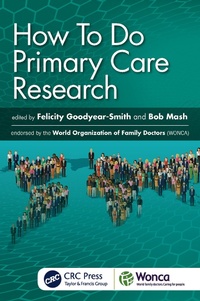
How To Do Primary Care Research
1st Edition
Published on 10. October 2018
348 pages
978-1-351-01450-2 (ISBN)
Description

This practical 'How To' guide talks the reader step-by-step through designing, conducting and disseminating primary care research, a growing discipline internationally. The vast majority of health care issues are experienced by people in community settings, who are not adequately represented by hospital-based research. There is therefore a great need to upskill family physicians and other primary care workers and academics to conduct community-based research to inform best practice. Aimed at emerging researchers, including those in developing countries, this book also addresses cutting edge and newly developing research methods, which will be of equal interest to more experienced researchers.
Reviews / Votes
"At a time when so many clinicians become overwhelmed with their everyday challenges and responsibilities, this book offers a respite to change one's thinking, expanding the scope in an additional area of thought. It is a well-written, easy-to-read text book brings a renewed thinking to research."Vincent F Carr, DO, MSA, FACC, FACP (Uniformed Services University of the Health Sciences)
More details
Series
Edition
1. Auflage
Language
English
Place of publication
London
United Kingdom
Publishing group
Taylor & Francis Ltd
Target group
College/higher education
Illustrations
22 Tables, black and white; 22 Line drawings, color; 5 Illustrations, color
ISBN-13
978-1-351-01450-2 (9781351014502)
Copyright in bibliographic data and cover images is held by Nielsen Book Services Limited or by the publishers or by their respective licensors: all rights reserved.
Schweitzer Classification
Other editions
Additional editions
Felicity Goodyear-Smith | Robert Mash
How To Do Primary Care Research
Book
10/2018
1st Edition
CRC Press
€57.90
Shipment within 10-20 days
Felicity Goodyear-Smith | Robert Mash
How To Do Primary Care Research
Book
08/2018
1st Edition
CRC Press
€260.41
Shipment within 10-20 days
Persons
Felicity Goodyear-Smith is a general practitioner and academic head of the Department of General Practice and Primary Health Care, University of Auckland, Auckland, New Zealand. She and Professor Bob Mash co-edited the companion book to this current title: 'International Perspectives in Primary Care Research', CRC Press, 2016. She is Chair of the WONCA (world family doctors) Working Party on Research, and both books have been written on behalf of WONCA. She also chairs the International Committee of the North American Primary Care Research Group. Felicity was the founding Editor-in-Chief of the Journal of Primary Health Care. She has published over 200 peer-reviewed papers as well as a number of books and book chapters.
Felicity is passionate about the importance of research underpinning clinical practice in primary care. As well as her own research projects and those of her graduate students, she is actively engaged in research capacitybuilding globally, especially in low- and middle-income countries. This current book is particularly for emerging researchers, written as a 'how to' guide to conducting primary care research.
Bob Mash graduated from The University of Edinburgh and trained as a general practitioner in Scotland before emigrating to South Africa in 1991. He worked in the townships outside Cape Town with community health workers, providing community based primary care in the final days of the apartheid era. Following the onset of democracy, he worked for 10 years in the public sector, providing primary care in Khayelitsha. During this period, he worked with Stellenbosch University to create the first learning opportunities in family medicine and primary care for undergraduate medical students. Subsequently, he also developed a new online master's degree programme for the training of family physicians.
He obtained his PhD on mental disorders in primary care in 2002 and has now published over 150 articles in peer reviewed scientific journals. He is currently the head of Family and Emergency Medicine at Stellenbosch responsible for research activities and training at both master's and doctoral levels. He is the editor-in-chief of the African Journal of Primary Health Care & Family Medicine and is a rated researcher with the National Research Foundation. He is a founding member of the Chronic Diseases Initiative for Africa (a network of researchers) and an active leader within the Primary Care and Family Medicine Education (Primafamed) Network, a group of departments of family medicine in sub-Saharan Africa. He is currently the President of the South African Academy of Family Physicians.
Felicity is passionate about the importance of research underpinning clinical practice in primary care. As well as her own research projects and those of her graduate students, she is actively engaged in research capacitybuilding globally, especially in low- and middle-income countries. This current book is particularly for emerging researchers, written as a 'how to' guide to conducting primary care research.
Bob Mash graduated from The University of Edinburgh and trained as a general practitioner in Scotland before emigrating to South Africa in 1991. He worked in the townships outside Cape Town with community health workers, providing community based primary care in the final days of the apartheid era. Following the onset of democracy, he worked for 10 years in the public sector, providing primary care in Khayelitsha. During this period, he worked with Stellenbosch University to create the first learning opportunities in family medicine and primary care for undergraduate medical students. Subsequently, he also developed a new online master's degree programme for the training of family physicians.
He obtained his PhD on mental disorders in primary care in 2002 and has now published over 150 articles in peer reviewed scientific journals. He is currently the head of Family and Emergency Medicine at Stellenbosch responsible for research activities and training at both master's and doctoral levels. He is the editor-in-chief of the African Journal of Primary Health Care & Family Medicine and is a rated researcher with the National Research Foundation. He is a founding member of the Chronic Diseases Initiative for Africa (a network of researchers) and an active leader within the Primary Care and Family Medicine Education (Primafamed) Network, a group of departments of family medicine in sub-Saharan Africa. He is currently the President of the South African Academy of Family Physicians.
Content
Foreword
Editors
Contributors
SECTION I: INTRODUCTION
1. What makes research primary care research?
Felicity Goodyear-Smith and Bob Mash
2. Ontology and epistemology, methodology and method, and research paradigms
Eric K. Shaw
3. How to choose your topic and define your research question
William R. Phillips
SECTION II: INNOVATIVE APPROACHES TO PRIMARY CARE RESEARCH
4. Interdisciplinary research approaches in primary care
Trish Greenhalgh
5. Combining quantitative and qualitative methods
Elizabeth Halcomb
6. Authentic engagement, co-creation and action research
Vivian R. Ramsden, Jackie Crowe, Norma Rabbitskin, Danielle Rolfe and Ann C. Macaulay
7. Development and use of primary care research networks
Emma Wallace and Tom Fahey
8. Using big data in primary care research
Daniel J. Exeter and Katherine E. Walesby
9. Conducting primary care research using social media
Charilaos Lygidakis, Ana Luisa Neves, Liliana Laranjo and Luis Pinho-Costa
10. Quality improvement research in primary care
Andrew W. Knight and Paresh Dawda
11. Programme evaluation in primary care
Lauren Siegmann, Robyn Preston and Bunmi Malau-Aduli
SECTION III: PRELIMINARY STEPS TO DOING PRIMARY CARE RESEARCH
12. How to prepare your research proposal
Bob Mash
13. How to ensure your research follows ethical principles
Christopher Barton, Sally Hall, Penelope Abbott, Chun Wah Michael Tam, Amanda Lyons and Siaw-Teng Liaw
14. How to search and critically appraise the literature
Celeste Naude and Taryn Young
SECTION IV: METHODS AND TECHNIQUES FOR DOING PRIMARY CARE RESEARCH
15. Taking stock of existing research: Approach to conducting a systematic review
Taryn Young and Celeste Naude
16. Statistics in primary care research
Richard Stevens
17. How to conduct a survey in primary care
Lauren Ball and Katelyn Barnes
18. Validation studies: Validating new tools and adapting old ones to new contexts
Sherina Mohd Sidik
19. Clinical and other diagnostic tests: Understanding their predictive value
Sarah Price, Robert Price and Willie Hamilton
20. How to conduct observational studies
Tibor Schuster
21. Randomised trials in primary care
Gillian Bartlett-Esquilant, Miriam Dickinson and Tibor Schuster
22. Grounded theory
David R. Thomas
23. Doing interpretive phenomenological primary care research
Valerie A. Wright-St Clair
24. Why ethnography is an important part of primary care research and how it is done
Carissa van den Berk-Clark
25. Case study
Robin Ray, Judy Taylor and Robyn Preston
26. Interactional analysis of primary care consultations
Maria Stubbe, Anthony Dowell, Kevin Dew and Lindsay Macdonald
SECTION V: HOW TO DISSEMINATE YOUR RESEARCH
27. How to write and how to publish
Felicity Goodyear-Smith and Katharine A. Wallis
28. How to create an effective poster
Katharine A. Wallis
29. Using social media to disseminate primary care research
Charilaos Lygidakis and Raquel Gomez Bravo
30. Reaching decision-makers and achieving social impact with your research
Bob Mash, Nasreen Jessani and Liesl Nicol
SECTION VI: BUILDING RESEARCH CAPACITY
31. How to supervise and mentor a less-experienced or novice researcher
Elizabeth Sturgiss and Lena Sanci
32. Creating the right environment for mentoring to flourish
Amanda Howe
33. A systems approach to building research capacity: Individuals, networks and culture
Grant Russell
34. Including primary care research in clinical practice
Chris van Weel
Index
Editors
Contributors
SECTION I: INTRODUCTION
1. What makes research primary care research?
Felicity Goodyear-Smith and Bob Mash
2. Ontology and epistemology, methodology and method, and research paradigms
Eric K. Shaw
3. How to choose your topic and define your research question
William R. Phillips
SECTION II: INNOVATIVE APPROACHES TO PRIMARY CARE RESEARCH
4. Interdisciplinary research approaches in primary care
Trish Greenhalgh
5. Combining quantitative and qualitative methods
Elizabeth Halcomb
6. Authentic engagement, co-creation and action research
Vivian R. Ramsden, Jackie Crowe, Norma Rabbitskin, Danielle Rolfe and Ann C. Macaulay
7. Development and use of primary care research networks
Emma Wallace and Tom Fahey
8. Using big data in primary care research
Daniel J. Exeter and Katherine E. Walesby
9. Conducting primary care research using social media
Charilaos Lygidakis, Ana Luisa Neves, Liliana Laranjo and Luis Pinho-Costa
10. Quality improvement research in primary care
Andrew W. Knight and Paresh Dawda
11. Programme evaluation in primary care
Lauren Siegmann, Robyn Preston and Bunmi Malau-Aduli
SECTION III: PRELIMINARY STEPS TO DOING PRIMARY CARE RESEARCH
12. How to prepare your research proposal
Bob Mash
13. How to ensure your research follows ethical principles
Christopher Barton, Sally Hall, Penelope Abbott, Chun Wah Michael Tam, Amanda Lyons and Siaw-Teng Liaw
14. How to search and critically appraise the literature
Celeste Naude and Taryn Young
SECTION IV: METHODS AND TECHNIQUES FOR DOING PRIMARY CARE RESEARCH
15. Taking stock of existing research: Approach to conducting a systematic review
Taryn Young and Celeste Naude
16. Statistics in primary care research
Richard Stevens
17. How to conduct a survey in primary care
Lauren Ball and Katelyn Barnes
18. Validation studies: Validating new tools and adapting old ones to new contexts
Sherina Mohd Sidik
19. Clinical and other diagnostic tests: Understanding their predictive value
Sarah Price, Robert Price and Willie Hamilton
20. How to conduct observational studies
Tibor Schuster
21. Randomised trials in primary care
Gillian Bartlett-Esquilant, Miriam Dickinson and Tibor Schuster
22. Grounded theory
David R. Thomas
23. Doing interpretive phenomenological primary care research
Valerie A. Wright-St Clair
24. Why ethnography is an important part of primary care research and how it is done
Carissa van den Berk-Clark
25. Case study
Robin Ray, Judy Taylor and Robyn Preston
26. Interactional analysis of primary care consultations
Maria Stubbe, Anthony Dowell, Kevin Dew and Lindsay Macdonald
SECTION V: HOW TO DISSEMINATE YOUR RESEARCH
27. How to write and how to publish
Felicity Goodyear-Smith and Katharine A. Wallis
28. How to create an effective poster
Katharine A. Wallis
29. Using social media to disseminate primary care research
Charilaos Lygidakis and Raquel Gomez Bravo
30. Reaching decision-makers and achieving social impact with your research
Bob Mash, Nasreen Jessani and Liesl Nicol
SECTION VI: BUILDING RESEARCH CAPACITY
31. How to supervise and mentor a less-experienced or novice researcher
Elizabeth Sturgiss and Lena Sanci
32. Creating the right environment for mentoring to flourish
Amanda Howe
33. A systems approach to building research capacity: Individuals, networks and culture
Grant Russell
34. Including primary care research in clinical practice
Chris van Weel
Index
