

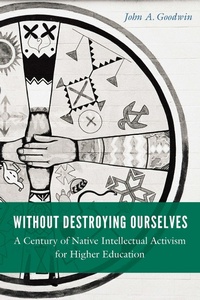
Without Destroying Ourselves
A Century of Native Intellectual Activism for Higher Education
Published on 1. March 2022
270 pages
978-1-4962-3104-8 (ISBN)
Description

Without Destroying Ourselves is an intellectual history of Native activism seeking greater access to and control of higher education in the twentieth century. John A. Goodwin traces themes of Henry Roe Cloud's (Ho-Chunk) vision for Native intellectual leadership and empowerment in the early 1900s to the later missions of tribal colleges and universities (TCUs) and education-based self-determination movements of the 1960s onward.
Vital to Cloud's work was the idea of how to build from Native identity and adapt without destroying that identity. As the central themes of the movement for Native control in higher education developed over the course of several decades, a variety of Native activists carried Cloud's vision forward. Goodwin explores how Elizabeth Bender Cloud (Ojibwe), D'Arcy McNickle (Salish Kootenai), Jack Forbes (Powhatan-RenapE, Delaware Lenape), and others built on and contributed to this common thread of Native intellectual activism.
Goodwin demonstrates that Native activism for self-determination was never snuffed out by the swing of the federal government's pendulum away from tribal governance and toward termination. Moreover, efforts for Native control in education remained a vital aspect of that activism. Without Destroying Ourselves documents this period through the full accreditation of TCUs in the late 1970s and reinforces TCUs' continuing relevance in confronting the unique needs and challenges of Native communities today.
Vital to Cloud's work was the idea of how to build from Native identity and adapt without destroying that identity. As the central themes of the movement for Native control in higher education developed over the course of several decades, a variety of Native activists carried Cloud's vision forward. Goodwin explores how Elizabeth Bender Cloud (Ojibwe), D'Arcy McNickle (Salish Kootenai), Jack Forbes (Powhatan-RenapE, Delaware Lenape), and others built on and contributed to this common thread of Native intellectual activism.
Goodwin demonstrates that Native activism for self-determination was never snuffed out by the swing of the federal government's pendulum away from tribal governance and toward termination. Moreover, efforts for Native control in education remained a vital aspect of that activism. Without Destroying Ourselves documents this period through the full accreditation of TCUs in the late 1970s and reinforces TCUs' continuing relevance in confronting the unique needs and challenges of Native communities today.
Reviews / Votes
"Without Destroying Ourselves provides readers with a well-written and thoroughly researched exploration of how Indigenous people in the United States have negotiated settler educational institutions to advance goals of their own making over the course of the twentieth century. . . . An outstanding history that deserves wide readership."-Daniel M. Cobb, American Historical Review "Goodwin's monograph goes above and beyond simple institutional histories of tribal colleges and universities by offering historical and intellectual contexts that led to their founding, growth, and development. His work gives attention and primacy to Native intellectual voices of the early and middle twentieth century by focusing on individuals whose names and work we are familiar with, but not perhaps in the context of higher education. Finally, Goodwin brings renewed attention to the intellectual activism that went alongside the Red Power Movement of the 1960s."-Majel Boxer, Journal of Arizona History "This thorough exploration of the intellectual foundation upon which the tribal colleges and universities have been created would be appropriate assigned reading for courses on the history of higher education, Indigenous education, American history, and Indigenous studies."-Jarita Greyeyes, American Indian Quarterly "Without Destroying Oursevles is an exceptional addition to the Indigenous Education Series alongside other works on American Indian experiences in settler colonial education."-Teagan Dreyer, South Dakota History "In the face of white colonialism, Native American leaders have long had to wrestle with the timeless question: how can we change without destroying ourselves? As John A. Goodwin demonstrates in this deeply researched and thoughtful study, answering this question has always been at the heart of Native intellectuals' efforts to create a model of higher education both by and for Indians. To understand the multiple struggles they encountered in this journey-a journey in which the issues of power and purpose were central-this study is must-reading."-David Wallace Adams, author of Education for Extinction: American Indians and the Boarding School Experience, 1875-1928 "Goodwin's sympathetic and insightful history underscores the importance of tribal colleges and universities as intellectual spaces that are educating, decolonizing, and sustaining the tribal communities they serve. This book fills a gaping void in American Indian historiography and will undoubtedly transform how scholars think about Indian education."-Bradley Shreve, editor of Tribal College Journal of American Indian Higher EducationMore details
Series
Language
English
Place of publication
Lincoln
United States
Target group
Professional and scholarly
Illustrations
8 photographs, index
File size
6,81 MB
ISBN-13
978-1-4962-3104-8 (9781496231048)
Copyright in bibliographic data and cover images is held by Nielsen Book Services Limited or by the publishers or by their respective licensors: all rights reserved.
Schweitzer Classification
Other editions
Additional editions
John A. Goodwin
Without Destroying Ourselves
A Century of Native Intellectual Activism for Higher Education
Book
03/2022
University of Nebraska Press
€79.42
Shipment within 15-20 days
Person
John A. Goodwin teaches U.S. history at BASIS Phoenix in Arizona.
Content
List of Illustrations
Acknowledgments
Introduction: How Can We Change without Destroying Ourselves?
1. By and for Indians: Henry Roe Cloud and Early Twentieth-Century Activism for Native-Driven Higher Education
2. A New Spirit of Leadership: Carrying the Threads of Cloud's Vision
3. Indian-Controlled and Indian-Centered: Driving Home the Argument for Native Control in Higher Education
4. An Exercise in Tribal Sovereignty: The Early Years of the Tribal-College Era
5. Embracing Pan-Indianism: Off-Reservation Institutions and Their Place in the Tribal-College Era
Conclusion: Ideas Have a Way of Living
Notes
Bibliography
Index
Acknowledgments
Introduction: How Can We Change without Destroying Ourselves?
1. By and for Indians: Henry Roe Cloud and Early Twentieth-Century Activism for Native-Driven Higher Education
2. A New Spirit of Leadership: Carrying the Threads of Cloud's Vision
3. Indian-Controlled and Indian-Centered: Driving Home the Argument for Native Control in Higher Education
4. An Exercise in Tribal Sovereignty: The Early Years of the Tribal-College Era
5. Embracing Pan-Indianism: Off-Reservation Institutions and Their Place in the Tribal-College Era
Conclusion: Ideas Have a Way of Living
Notes
Bibliography
Index
