

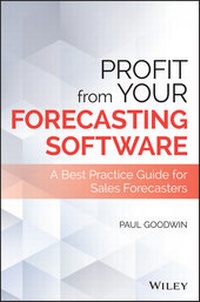
Profit From Your Forecasting Software
A Best Practice Guide for Sales Forecasters
1st Edition
Published on 13. March 2018
240 pages
978-1-119-41598-5 (ISBN)
Description

Go beyond technique to master the difficult judgement calls of forecasting
A variety of software can be used effectively to achieve accurate forecasting, but no software can replace the essential human component. You may be new to forecasting, or you may have mastered the statistical theory behind the software's predictions, and even more advanced "power user" techniques for the software itself--but your forecasts will never reach peak accuracy unless you master the complex judgement calls that the software cannot make. Profit From Your Forecasting Software addresses the issues that arise regularly, and shows you how to make the correct decisions to get the most out of your software.
Taking a non-mathematical approach to the various forecasting models, the discussion covers common everyday decisions such as model choice, forecast adjustment, product hierarchies, safety stock levels, model fit, testing, and much more. Clear explanations help you better understand seasonal indices, smoothing coefficients, mean absolute percentage error, and r-squared, and an exploration of psychological biases provides insight into the decision to override the software's forecast. With a focus on choice, interpretation, and judgement, this book goes beyond the technical manuals to help you truly grasp the more intangible skills that lead to better accuracy.
* Explore the advantages and disadvantages of alternative forecasting methods in different situations
* Master the interpretation and evaluation of your software's output
* Learn the subconscious biases that could affect your judgement toward intervention
* Find expert guidance on testing, planning, and configuration to help you get the most out of your software
Relevant to sales forecasters, demand planners, and analysts across industries, Profit From Your Forecasting Software is the much sought-after "missing piece" in forecasting reference.
A variety of software can be used effectively to achieve accurate forecasting, but no software can replace the essential human component. You may be new to forecasting, or you may have mastered the statistical theory behind the software's predictions, and even more advanced "power user" techniques for the software itself--but your forecasts will never reach peak accuracy unless you master the complex judgement calls that the software cannot make. Profit From Your Forecasting Software addresses the issues that arise regularly, and shows you how to make the correct decisions to get the most out of your software.
Taking a non-mathematical approach to the various forecasting models, the discussion covers common everyday decisions such as model choice, forecast adjustment, product hierarchies, safety stock levels, model fit, testing, and much more. Clear explanations help you better understand seasonal indices, smoothing coefficients, mean absolute percentage error, and r-squared, and an exploration of psychological biases provides insight into the decision to override the software's forecast. With a focus on choice, interpretation, and judgement, this book goes beyond the technical manuals to help you truly grasp the more intangible skills that lead to better accuracy.
* Explore the advantages and disadvantages of alternative forecasting methods in different situations
* Master the interpretation and evaluation of your software's output
* Learn the subconscious biases that could affect your judgement toward intervention
* Find expert guidance on testing, planning, and configuration to help you get the most out of your software
Relevant to sales forecasters, demand planners, and analysts across industries, Profit From Your Forecasting Software is the much sought-after "missing piece" in forecasting reference.
More details
Other editions
Additional editions
Book
06/2018
1st Edition
Wiley
€47.00
Article not available at the moment
Content
- Cover
- Title Page
- Copyright
- Contents
- Acknowledgments
- Prologue
- Chapter 1: Profit from Accurate Forecasting
- 1.1 The Importance of Demand Forecasting
- 1.2 When Is a Forecast Not a Forecast?
- 1.3 Ways of Presenting Forecasts
- 1.3.1 Forecasts as Probability Distributions
- 1.3.2 Point Forecasts
- 1.3.3 Prediction Intervals
- 1.4 The Advantages of Using Dedicated Demand Forecasting Software
- 1.5 Getting Your Data Ready for Forecasting
- 1.6 Trading-Day Adjustments
- 1.7 Overview of the Rest of the Book
- 1.8 Summary of Key Terms
- 1.9 References
- Chapter 2: How Your Software Finds Patterns in Past Demand Data
- 2.1 Introduction
- 2.2 Key Features of Sales Histories
- 2.2.1 An Underlying Trend
- 2.2.2 A Seasonal Pattern
- 2.2.3 Noise
- 2.3 Autocorrelation
- 2.4 Intermittent Demand
- 2.5 Outliers and Special Events
- 2.6 Correlation
- 2.7 Missing Values
- 2.8 Wrap-Up
- 2.9 Summary of Key Terms
- Chapter 3: Understanding Your Software's Bias and Accuracy Measures
- 3.1 Introduction
- 3.2 Fitting and Forecasting
- 3.2.1 Fixed-Origin Evaluations
- 3.2.2 Rolling-Origin Evaluations
- 3.3 Forecast Errors and Bias Measures
- 3.3.1 The Mean Error (ME)
- 3.3.2 The Mean Percentage Error (MPE)
- 3.4 Direct Accuracy Measures
- 3.4.1 The Mean Absolute Error (MAE)
- 3.4.2 The Mean Squared Error (MSE)
- 3.5 Percentage Accuracy Measures
- 3.5.1 The Mean Absolute Percentage Error (MAPE)
- 3.5.2 The Median Absolute Percentage Error (MDAPE)
- 3.5.3 The Symmetric Mean Absolute Percentage Error (SMAPE)
- 3.5.4 The MAD/MEAN Ratio
- 3.5.5 Percentage Error Measures When There Is a Trend or Seasonal Pattern
- 3.6 Relative Accuracy Measures
- 3.6.1 Geometric Mean Relative Absolute Error (GMRAE)
- 3.6.2 The Mean Absolute Scaled Error (MASE)
- 3.6.3 Bayesian Information Criterion (BIC)
- 3.7 Comparing the Different Accuracy Measures
- 3.8 Exception Reporting
- 3.9 Forecast Value-Added Analysis (FVA)
- 3.10 Wrap-Up
- 3.11 Summary of Key Terms
- 3.12 References
- Chapter 4: Curve Fitting and Exponential Smoothing
- 4.1 Introduction
- 4.2 Curve Fitting
- 4.2.1 Common Types of Curve
- 4.2.2 Assessing How Well the Curve Fits the Sales History
- 4.2.3 Strengths and Limitations of Forecasts Based on Curve Fitting
- 4.3 Exponential Smoothing Methods
- 4.3.1 Simple (or Single) Exponential Smoothing
- 4.3.2 Exponential Smoothing When There Is a Trend: Holt's Method
- 4.3.3 The Damped Holt's Method
- 4.3.4 Holt's Method with an Exponential Trend
- 4.3.5 Exponential Smoothing Where There Is a Trend and Seasonal Pattern: The Holt-Winters Method
- 4.3.6 Overview of Exponential Smoothing Methods
- 4.4 Forecasting Intermittent Demand
- 4.5 Wrap-Up
- 4.6 Summary of Key Terms
- Chapter 5: Box-Jenkins ARIMA Models
- 5.1 Introduction
- 5.2 Stationarity
- 5.3 Models of Stationary Time Series: Autoregressive Models
- 5.4 Models of Stationary Time Series: Moving Average Models
- 5.5 Models of Stationary Time Series: Mixed Models
- 5.6 Fitting a Model to a Stationary Time Series
- 5.7 Diagnostic Checks
- 5.7.1 Check 1: Are the Coefficients of the Model Statistically Significant?
- 5.7.2 Check 2: Overfitting-Should We Be Using a More Complex Model?
- 5.7.3 Check 3: Are the Residuals of the Model White Noise?
- 5.7.4 Check 4: Are the Residuals Normally Distributed?
- 5.8 Models of Nonstationary Time Series: Differencing
- 5.9 Should You Include a Constant in Your Model of a Nonstationary Time Series?
- 5.10 What If a Series Is Nonstationary in the Variance?
- 5.11 ARIMA Notation
- 5.12 Seasonal ARIMA Models
- 5.13 Example of Fitting a Seasonal ARIMA Model
- 5.14 Wrap-Up
- 5.15 Summary of Key Terms
- Chapter 6: Regression Models
- 6.1 Introduction
- 6.2 Bivariate Regression
- 6.2.1 Should You Drop the Constant?
- 6.2.2 Spurious Regression
- 6.3 Multiple Regression
- 6.3.1 Interpreting Computer Output for Multiple Regression
- 6.3.2 Refitting the Model
- 6.3.3 Multicollinearity
- 6.3.4 Using Dummy Predictor Variables in Your Regression Model
- 6.3.5 Outliers and Influential Observations
- 6.4 Regression Versus Univariate Methods
- 6.5 Dynamic Regression
- 6.6 Wrap-Up
- 6.7 Summary of Key Terms
- 6.8 Appendix: Assumptions of Regression Analysis
- 6.9 Reference
- Chapter 7: Inventory Control, Aggregation, and Hierarchies
- 7.1 Introduction
- 7.2 Identifying Reorder Levels and Safety Stocks
- 7.3 Estimating the Probability Distribution of Demand
- 7.3.1 Using Prediction Intervals to Determine Safety Stocks
- 7.4 What If the Probability Distribution of Demand Is Not Normal?
- 7.4.1 The Log-Normal Distribution
- 7.4.2 Using the Poisson and Negative Binomial Distributions
- 7.5 Temporal Aggregation
- 7.6 Dealing with Product Hierarchies and Reconciling Forecasts
- 7.6.1 Bottom-Up Forecasting
- 7.6.2 Top-Down Forecasting
- 7.6.3 Middle-Out Forecasting
- 7.6.4 Hybrid Methods
- 7.6.5 Issues and Future Developments
- 7.7 Wrap-Up
- 7.8 Summary of Key Terms
- 7.9 References
- Chapter 8: Automation and Choice
- 8.1 Introduction
- 8.2 How Much Past Data Do You Need to Apply Different Forecasting Methods?
- 8.3 Are More Complex Forecasting Methods Likely to Be More Accurate?
- 8.4 When It's Best to Automate Forecasts
- 8.5 The Downside of Automation
- 8.6 Wrap-Up
- 8.7 References
- Chapter 9: Judgmental Interventions: When Are They Appropriate?
- 9.1 Introduction
- 9.2 Psychological Biases That Might Catch You Out
- 9.2.1 Seeing Patterns in Randomness
- 9.2.2 Recency Bias
- 9.2.3 Hindsight Bias
- 9.2.4 Optimism Bias
- 9.3 Restrict Your Interventions
- 9.3.1 Large Adjustments Perform Better
- 9.3.2 Focus Your Efforts Where They'll Count
- 9.4 Making Effective Interventions
- 9.4.1 Divide and Conquer
- 9.4.2 Using Analogies
- 9.4.3 Counteracting Optimism Bias
- 9.4.4 Harnessing the Power of Groups of Managers
- 9.4.5 Record Your Rationale
- 9.5 Combining Judgment and Statistical Forecasts
- 9.6 Wrap-Up
- 9.7 Reference
- Chapter 10: New Product Forecasting
- 10.1 Introduction
- 10.2 Dangers of Using Unstructured Judgment in New Product Forecasting
- 10.3 Forecasting by Analogy
- 10.3.1 Structured Analogies
- 10.3.2 Applying Structured Analogies
- 10.4 The Bass Diffusion Model
- 10.4.1 Innovators and Imitators
- 10.4.2 Estimating a Bass Model
- 10.4.3 Limitations of the Basic Bass Model
- 10.5 Wrap-Up
- 10.6 Summary of Key Terms
- 10.7 References
- Chapter 11: Summary: A Best Practice Blueprint for Using Your Software
- 11.1 Introduction
- 11.2 Desirable Characteristics of Forecasting Software
- 11.2.1 Data Preparation
- 11.2.2 Graphical Displays
- 11.2.3 Method Selection
- 11.2.4 Implementing Methods
- 11.2.5 Hierarchies
- 11.2.6 Forecasting with Probabilities
- 11.2.7 Support for Judgment
- 11.2.8 Presentation of Forecasts
- 11.3 A Blueprint for Best Practice
- 11.4 References
- Index
- EULA
