

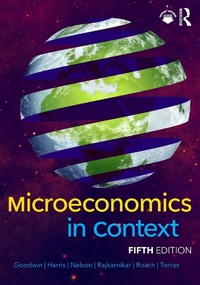
Microeconomics in Context
5th Edition
Published on 26. December 2022
654 pages
978-1-000-79110-5 (ISBN)
Description

Microeconomics in Context lays out the principles of microeconomics in a manner that is thorough, up to date, and relevant to students. Like its counterpart, Macroeconomics in Context, the book is uniquely attuned to economic, social, and environmental realities. The "In Context" books offer an engaging coverage of current research and policy issues from economic inequality and climate change, to taxes and globalization.
Key features include:
Up-to-date discussions of the impacts of the COVID-19 pandemic on inequality, labor markets, and beyond
Analysis of recent trade issues and the implications of Brexit
Presentation of policy issues in historical, environmental, institutional, social, political, and ethical contexts-an approach that fosters critical evaluation of the standard microeconomic models
Clear explanations of basic concepts and analytical tools, with advanced models presented in optional chapter appendices
A powerful graphical presentation of various measures of well-being in the United States and other countries, including income inequality, tax systems, educational attainment, and environmental quality
A focus on human well-being from a multidimensional perspective, including traditional economic metrics and factors such as health, equity, and political inclusion
A full complement of student and instructor support materials online.
The book combines real-world relevance with a thorough grounding in multiple economic paradigms. It is the ideal textbook for modern introductory courses in microeconomics. The book's companion website is available at: www.bu.edu/eci/micro
Key features include:
Up-to-date discussions of the impacts of the COVID-19 pandemic on inequality, labor markets, and beyond
Analysis of recent trade issues and the implications of Brexit
Presentation of policy issues in historical, environmental, institutional, social, political, and ethical contexts-an approach that fosters critical evaluation of the standard microeconomic models
Clear explanations of basic concepts and analytical tools, with advanced models presented in optional chapter appendices
A powerful graphical presentation of various measures of well-being in the United States and other countries, including income inequality, tax systems, educational attainment, and environmental quality
A focus on human well-being from a multidimensional perspective, including traditional economic metrics and factors such as health, equity, and political inclusion
A full complement of student and instructor support materials online.
The book combines real-world relevance with a thorough grounding in multiple economic paradigms. It is the ideal textbook for modern introductory courses in microeconomics. The book's companion website is available at: www.bu.edu/eci/micro
More details
Edition
5th edition
Language
English
Place of publication
London
United Kingdom
Publishing group
Taylor & Francis Ltd
Target group
College/higher education
Product notice
Reflowable
Illustrations
62 Tables, black and white; 156 Line drawings, color; 8 Line drawings, black and white; 156 Illustrations, color; 8 Illustrations, black and white
ISBN-13
978-1-000-79110-5 (9781000791105)
Copyright in bibliographic data and cover images is held by Nielsen Book Services Limited or by the publishers or by their respective licensors: all rights reserved.
Schweitzer Classification
Other editions
Additional editions
Neva Goodwin | Jonathan M. Harris | Julie A. Nelson
Microeconomics in Context
Book
12/2022
5th Edition
Routledge
€301.10
Shipment within 10-20 days
Neva Goodwin | Jonathan M. Harris | Julie A. Nelson
Microeconomics in Context
Book
08/2022
5th Edition
Routledge
€142.90
Shipment within 10-20 days
Persons
Neva Goodwin is Distinguished Fellow at the Economics in Context Initiative at Boston University's Global Development Policy Center and Co-Director of the Global Development and Environment Institute (GDAE) at Tufts University. Her current interests focus on ecological restoration and its potential for improving human health and helping to mitigate climate change.
Jonathan M. Harris is Visiting Scholar at the Global Development and Environment Institute (GDAE) at Tufts University and Senior Research Fellow at the Economics in Context Initiative at Boston University's Global Development Policy Center. His current research focuses on the implications of large-scale environmental problems, especially global climate change, for macroeconomic theory and policy.
Julie A. Nelson is Emeritus Professor of Economics at the University of Massachusetts Boston and Senior Research Fellow at the Global Development and Environment Institute (GDAE) at Tufts University. Many of her books and articles critique economic methodology from a feminist perspective. She has published in journals ranging from Econometrica and the Journal of Political Economy to Hypatia: Journal of Feminist Philosophy and Ecological Economics.
Pratistha Joshi Rajkarnikar is Assistant Director of the Economics in Context Initiative at Boston University's Global Development Policy Center and a lecturer at Boston University and Brandeis University. Her research covers topics on women's empowerment, economic development, and the impacts of globalization on developing economies.
Brian Roach is Director of the Theory and Education Program at the Global Development and Environment Institute (GDAE) at Tufts University and Senior Research Fellow at the Economics in Context Initiative at Boston University. He is a lecturer at Tufts University and has taught at Brandeis University, Brown University, and the University of Maine. He specializes in environmental economics and is the coauthor (with Jonathan Harris) of Environmental and Natural Resource Economics: A Contemporary Approach.
Mariano Torras teaches economics at Adelphi University in Garden City, New York, and is Chair of the Department of Finance and Economics. A heterodox economist with a background in ecological and development economics, his recent research has been in the areas of institutional economics, climate change, and financialization.
Jonathan M. Harris is Visiting Scholar at the Global Development and Environment Institute (GDAE) at Tufts University and Senior Research Fellow at the Economics in Context Initiative at Boston University's Global Development Policy Center. His current research focuses on the implications of large-scale environmental problems, especially global climate change, for macroeconomic theory and policy.
Julie A. Nelson is Emeritus Professor of Economics at the University of Massachusetts Boston and Senior Research Fellow at the Global Development and Environment Institute (GDAE) at Tufts University. Many of her books and articles critique economic methodology from a feminist perspective. She has published in journals ranging from Econometrica and the Journal of Political Economy to Hypatia: Journal of Feminist Philosophy and Ecological Economics.
Pratistha Joshi Rajkarnikar is Assistant Director of the Economics in Context Initiative at Boston University's Global Development Policy Center and a lecturer at Boston University and Brandeis University. Her research covers topics on women's empowerment, economic development, and the impacts of globalization on developing economies.
Brian Roach is Director of the Theory and Education Program at the Global Development and Environment Institute (GDAE) at Tufts University and Senior Research Fellow at the Economics in Context Initiative at Boston University. He is a lecturer at Tufts University and has taught at Brandeis University, Brown University, and the University of Maine. He specializes in environmental economics and is the coauthor (with Jonathan Harris) of Environmental and Natural Resource Economics: A Contemporary Approach.
Mariano Torras teaches economics at Adelphi University in Garden City, New York, and is Chair of the Department of Finance and Economics. A heterodox economist with a background in ecological and development economics, his recent research has been in the areas of institutional economics, climate change, and financialization.
Content
Part I: The Context for Economics Analysis 0. Microeconomics and Well-Being 1. Economic Activity in Context 2. Markets and Society Part II: Basic Economic Analysis 3. Supply and Demand 4. Elasticity 5. Welfare Analysis 6. International Trade and Trade Policy 7. Economic Behavior and Rationality 8. Consumption and The Consumer Society 9. Markets for Labor Part IV: Essential Topics for Contemporary Economics 10. Economic and Social Inequality 11. Taxes and Tax Policy 12. The Economics of the Environment 13. Common Property Resources and Public Goods Part V: Resources, Production, and Market Organization 14. Capital Stocks and Resource Management 15. Production Costs 16. Perfectly Competitive Markets 17. Markets with Market Power
