

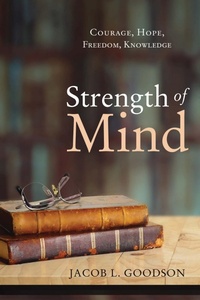
Strength of Mind
Courage, Hope, Freedom, Knowledge
Published on 19. September 2018
304 pages
978-1-4982-8381-6 (ISBN)
Description

Higher education in the twenty-first century should bring together freedom and knowledge with courage and hope. Why these four concepts? As Goodson argues in Strength of Mind, higher education in the twenty-first century offers preparation for ordinary life. Freedom and knowledge serve as the conditions for cultivating courage and hope within one's ordinary life. More specifically, courage and hope ought to be understood as the virtues required for enjoying ordinary life. If college-educated citizens wish to hold onto the concepts of courage and hope, however, then both courage and hope need to be understood as intellectual virtues. As a moral virtue, courage has become outdated. As a theological virtue, hope violates the logic of the golden mean. Focusing on intellectual virtues also requires shifting from moral perfectionism to rational perfectionism. Rational perfectionism involves keeping impossible demands in view for oneself while constantly and continually striving for one's "unattained but attainable self." Goodson defends these arguments by learning from the bits of wisdom found within American Transcendentalism (Emerson, Cavell), German Idealism (Kant, Hegel), Jewish philosophy (Maimonides, Spinoza, Putnam), neo-pragmatism (Putnam, Rorty, West), post-modern theories about pedagogy (Nietzsche, Foucault, Rorty), and secular accounts of perfectionism (Murdoch, Cavell).
More details
Other editions
Additional editions
Book
09/2018
Wipf & Stock Publishers
€56.90
Shipment within 15-20 days
Book
09/2018
Wipf & Stock Publishers
€34.10
Shipment within 15-20 days
Person
Jacob L. Goodson (University of Virginia) is Assistant Professor of Philosophy at Southwestern College in Winfield, Kansas. Previously, he was a Visiting Assistant Professor at the College of William & Mary in Williamsburg, Virginia. He serves as General Editor for the Journal of Scriptural Reasoning. He researches and writes on American philosophy, the ethics of warfare, sexual ethics, sports ethics, and virtue theory.
Content
- Intro
- Title Page
- Acknowledgments
- Abbreviations
- Preface: Writing as Teaching, Teaching as Writing
- Introduction: The Pillars Project
- Part 1: Freedom and Knowledge in the Twenty-First Century
- Chapter 1: From Moral Perfectionism to Rational Perfectionism
- Chapter 2: Freedom and Knowledge in American Transcendentalism
- Chapter 3: Freedom and Knowledge in Jewish Philosophy
- Chapter 4: How Rational Perfectionism Guides the Professorial Task
- Part 2: Courage as an Intellectual Virtue
- Chapter 5: Shifting Courage from a Moral Virtue to an Intellectual Virtue
- Chapter 6: Pity the College That Teaches Heroism
- Chapter 7: Courage as an Intellectual Virtue and the Professorial Task
- Part 3: Hope as an Intellectual Virtue
- Chapter 8: From Imaginative Hope to Intellectual Hope
- Chapter 9: Shame on Christian Colleges That Teach Students to Laugh at the World
- Chapter 10: Hope as an Intellectual Virtue and the Professorial Task
- Conclusion: From Freedom and Knowledge to Courage and Hope
- Appendix: Beauty and the Purpose of Higher Education
- Bibliography
