

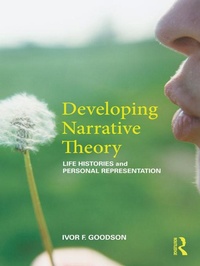
Developing Narrative Theory
Life Histories and Personal Representation
1st Edition
Published on 2. October 2012
160 pages
978-1-136-73101-3 (ISBN)
Description

We live in an age of narrative: life stories are a crucial ingredient in what makes us human and, in turn, what kind of human they make us. In recent years, narrative analysis has grown and is used across many areas of research. Interest in this rapidly developing approach now requires the firm theoretical underpinning that would allow researchers to both approach such research in a reliably structured way, and to interpret the results more effectively.
Developing Narrative Theory looks at the contemporary need to study life narratives, considers the emergence and salience of life narratives in contemporary culture, and discusses different forms of narrativity. It shows in detail how life story interviews are conducted, and demonstrates how the process often begins with relatively unstructured life story collection but moves to a more collaborative exchange, where sociological themes and historical patterns are scrutinised and mutually explored.
At the core of this book, the author shows that, far from there being a singular form of narrative or an infinite range of unique and idiosyncratic narratives, there are in fact clusters of narrativity and particular types of narrative style. These can be grouped into four main areas:
Focussed Elaborators;
Scripted Describers;
Armchair Elaborators; and
Focussed Describers.
Drawing on data from several large-scale studies from countries across the world, Professor Goodson details how theories of narrativity and life story analysis can combine to inform learning potential.
Timely and innovative, this book will be of use to all of those employing narrative and life history methods in their research. It will also be of interest to those working in lifelong learning and with professional and self development practices.
Developing Narrative Theory looks at the contemporary need to study life narratives, considers the emergence and salience of life narratives in contemporary culture, and discusses different forms of narrativity. It shows in detail how life story interviews are conducted, and demonstrates how the process often begins with relatively unstructured life story collection but moves to a more collaborative exchange, where sociological themes and historical patterns are scrutinised and mutually explored.
At the core of this book, the author shows that, far from there being a singular form of narrative or an infinite range of unique and idiosyncratic narratives, there are in fact clusters of narrativity and particular types of narrative style. These can be grouped into four main areas:
Focussed Elaborators;
Scripted Describers;
Armchair Elaborators; and
Focussed Describers.
Drawing on data from several large-scale studies from countries across the world, Professor Goodson details how theories of narrativity and life story analysis can combine to inform learning potential.
Timely and innovative, this book will be of use to all of those employing narrative and life history methods in their research. It will also be of interest to those working in lifelong learning and with professional and self development practices.
Reviews / Votes
"This book is invaluable reading for those engaged in or interested in narrative methodology. It provides an in-depth discussion of the development of narrative portrayals and the significance of different patterns of narrative. The process of narrative portrayal is also exemplified through examples drawn from the repertoire of Goodson's various life history projects, which he uses to provide the reader with insights into how people employ different patterns and forms of narrativity and action to 'provide an anchor, a sense of stability, continuity and coherence in a world of fast and often bemusing change' (p.115). But Goodson is not positing a utopian vision here, rather he suggests that the meta-narratives of modern life will pose 'seismic challenges for people's identity projects and life politics' (p.120) and perhaps most acutely for the youngest generations coming through. The final chapters of this book will leave readers in no doubt of the significance of narrative in modern life, and provide a fitting antithesis to critics of narrative methodologies tempted to discard them as 'just stories.'" - Keith Turvey, Research in EducationMore details
Language
English
Place of publication
London
United Kingdom
Publishing group
Taylor & Francis Ltd
Target group
College/higher education
Product notice
Reflowable
Illustrations
5 s/w Zeichnungen
5 Line drawings, black and white
File size
2,12 MB
ISBN-13
978-1-136-73101-3 (9781136731013)
Copyright in bibliographic data and cover images is held by Nielsen Book Services Limited or by the publishers or by their respective licensors: all rights reserved.
Schweitzer Classification
Other editions
Additional editions
Book
09/2012
1st Edition
Routledge
€207.10
Shipment within 15-20 days
Book
09/2012
1st Edition
Routledge
€59.70
Shipment within 15-20 days
Person
Ivor F. Goodson is International Professor of Sociology at the University of Tallinn, Estonia and Professor of Learning Theory in the School of Education at the University of Brighton, UK.
Content
Section 1 Studying Life Narratives 1. Introduction: studying life stories and life histories 2. The growth of individual life stories in contemporary life 3. Contemporary patterns in life stories 4. Studying Storylines: life history and personal representations 5. Developing narrative portrayals Section 2 On Forms of Narrativity 6. Studying Storylines 7. Scripted describers 8. Armchair elaborators 9. Multiple describers 10. Focussed elaborators 11. Re-selfing, reflexivity and hybridity 12. Narrativity, learning and reflexibility
