

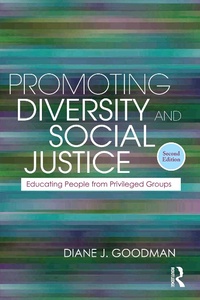
Promoting Diversity and Social Justice
Educating People from Privileged Groups, Second Edition
1st Edition
Published on 15. May 2011
232 pages
978-1-136-81740-3 (ISBN)
Description

Promoting Diversity and Social Justice provides theories, perspectives, and strategies that are useful for working with adults from privileged groups-those who are in a more powerful position in any given type of oppression. The thoroughly revised edition of this accessible and practical guide offers tools that allow educators to be more reflective and intentional in their work-helping them to consider who they're working with, what they're doing, why they're doing it and how to educate more effectively.
New features include:
A new chapter, "The Joy of Unlearning Privilege/Oppression," highlights specific ways people from privileged groups benefit from unlearning privilege/oppression and from creating greater equity
A new chapter, "Allies and Action," gives focus and guidance on how people from privileged groups can constructively and appropriately be involved in social change efforts
Updated Appendix of additional resources
The theories and approaches discussed can be applied to a range of situations and audiences. This book is an excellent resource for professors, diversity trainers, teachers in classrooms and workshops, counselors, organizers, student affairs personnel, community educators, advocates, group facilitators, and any others involved with educating about diversity and equity.
New features include:
A new chapter, "The Joy of Unlearning Privilege/Oppression," highlights specific ways people from privileged groups benefit from unlearning privilege/oppression and from creating greater equity
A new chapter, "Allies and Action," gives focus and guidance on how people from privileged groups can constructively and appropriately be involved in social change efforts
Updated Appendix of additional resources
The theories and approaches discussed can be applied to a range of situations and audiences. This book is an excellent resource for professors, diversity trainers, teachers in classrooms and workshops, counselors, organizers, student affairs personnel, community educators, advocates, group facilitators, and any others involved with educating about diversity and equity.
Reviews / Votes
"This new edition improves upon what was already an indispensable tool for educators, trainers, and activists. Written in an accessible and sympathetic voice, with concrete strategies and support, this is a text I find myself turning to again and again. If you are committed to dismantling privilege and oppression, you need this book!"--Abby L. Ferber, Director of the Matrix Center for the Advancement of Social Equity and Inclusion, Professor of Sociology, and Women's and Ethnic Studies, University of Colorado at Colorado Springs
"Updating and extending her foundational work for a newly emerging social climate in a clear, personable, accessible, and yes, joyous style, Diane J. Goodman maintains a laser focus upon members of socially privileged groups. By so doing, she provides readers the tools they need to envision not only the concept, but most importantly, the reality of social justice."
--Warren J. Blumenfeld, Associate Professor, Department of Curriculum and Instruction, Iowa State University
More details
Series
Language
English
Place of publication
London
United Kingdom
Publishing group
Taylor & Francis Ltd
Target group
College/higher education
Illustrations
1 s/w Zeichnung
1 Line drawings, black and white
File size
1,38 MB
ISBN-13
978-1-136-81740-3 (9781136817403)
Copyright in bibliographic data and cover images is held by Nielsen Book Services Limited or by the publishers or by their respective licensors: all rights reserved.
Schweitzer Classification
Other editions
Additional editions
Diane J. Goodman
Promoting Diversity and Social Justice
Educating People from Privileged Groups, Second Edition
Book
03/2011
1st Edition
Routledge
€262.00
Shipment within 15-20 days
Diane J. Goodman
Promoting Diversity and Social Justice
Educating People from Privileged Groups, Second Edition
Book
03/2011
1st Edition
Routledge
€72.30
Shipment within 15-20 days
Person
Diane J. Goodman, Ed.D., is a trainer, college teacher, author, speaker, and consultant on diversity and social justice issues. For more information, see her website: http://www.dianegoodman.com.
Content
Chapter 1: Introduction
Update oppression chart: add gender oppression; change "Anti-Semitism" to "Anti-Semitism and religious oppression" and list other religious minorities; discuss "border identities" (Adams, Bell and Griffin)
New graphic to depict the intersectionality of our identities
Chapter 2: About Privileged Groups
Update statistics
Elaborate discussion of characteristics of privileged groups and individuals
Chapter 3: Perspectives on Individual Change and Development
p. 51- correct typo, change multiplicity or subjective to relativism/procedural
Update social identity models
Chapter 4: Understanding Resistance
Add to reasons for resistance
Chapter 5: Preventing and Reducing Resistance
Refine chart on intervention strategies
Chapter 6: The Costs of Oppression to People from Privileged Groups
Add to costs of oppression
Chapter 7: The Joy of Unlearning Racism and the Benefits of Social Justice
New chapter. Describe the psychological, intellectual, interpersonal, spiritual, professional and other benefits white people experience when they have worked to unlearn racism.
Address the similarities to and relevance for unlearning other forms of oppression as a member of the privileged group
Move section on Benefits of Social Justice (p. 198-202) from current Chapter 10 to this chapter. Expand this section.
Chapter 8: Why People from Privileged Groups Support Social Justice
Chapter 9: Developing and Enlisting Support for Social Justice
Move revised versions of the sections "Shifting the Paradigm" and "The Appeal of Partnership Relations and Social Justice to People from Privileged Groups" (pp. 190-198) from current Chapter 10 to end of this chapter.
Chapter 10: Allies and Action
New Chapter. Discuss options for action, blocks to action, accountability, what it means to be an ally, challenges of being an ally, and particular issues for white men.
Incorporate section on "From Motivation to Action: Allies and Activism" (p. 163-167) in current Chapter 8 and section on "The Need for Both Individual and Societal Change" from Chapter. 10.
Chapter 11: Issues for Educators
Add greater discussion of the differences for educators from dominant or subordinate groups
Add more about dealing with triggers
Discuss "mindful facilitation" (Lee Mun Wah)
Update oppression chart: add gender oppression; change "Anti-Semitism" to "Anti-Semitism and religious oppression" and list other religious minorities; discuss "border identities" (Adams, Bell and Griffin)
New graphic to depict the intersectionality of our identities
Chapter 2: About Privileged Groups
Update statistics
Elaborate discussion of characteristics of privileged groups and individuals
Chapter 3: Perspectives on Individual Change and Development
p. 51- correct typo, change multiplicity or subjective to relativism/procedural
Update social identity models
Chapter 4: Understanding Resistance
Add to reasons for resistance
Chapter 5: Preventing and Reducing Resistance
Refine chart on intervention strategies
Chapter 6: The Costs of Oppression to People from Privileged Groups
Add to costs of oppression
Chapter 7: The Joy of Unlearning Racism and the Benefits of Social Justice
New chapter. Describe the psychological, intellectual, interpersonal, spiritual, professional and other benefits white people experience when they have worked to unlearn racism.
Address the similarities to and relevance for unlearning other forms of oppression as a member of the privileged group
Move section on Benefits of Social Justice (p. 198-202) from current Chapter 10 to this chapter. Expand this section.
Chapter 8: Why People from Privileged Groups Support Social Justice
Chapter 9: Developing and Enlisting Support for Social Justice
Move revised versions of the sections "Shifting the Paradigm" and "The Appeal of Partnership Relations and Social Justice to People from Privileged Groups" (pp. 190-198) from current Chapter 10 to end of this chapter.
Chapter 10: Allies and Action
New Chapter. Discuss options for action, blocks to action, accountability, what it means to be an ally, challenges of being an ally, and particular issues for white men.
Incorporate section on "From Motivation to Action: Allies and Activism" (p. 163-167) in current Chapter 8 and section on "The Need for Both Individual and Societal Change" from Chapter. 10.
Chapter 11: Issues for Educators
Add greater discussion of the differences for educators from dominant or subordinate groups
Add more about dealing with triggers
Discuss "mindful facilitation" (Lee Mun Wah)
