

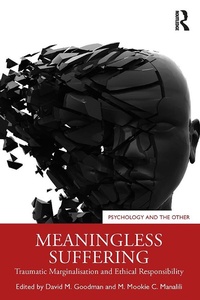
Meaningless Suffering
Traumatic Marginalisation and Ethical Responsibility
1st Edition
Published on 25. March 2024
264 pages
978-1-003-86286-4 (ISBN)
Description

Does suffering have meaning? The leading scholars and practitioners in Meaningless Suffering engage with this haunting human question through the lenses of psychoanalytic, phenomenological and ethical discourse, all the while holding contemporary social concerns in full view.
The authors seek to find ways of speaking about the lived realities and historical moments that make up our social narratives - from the murder of George Floyd to the bird watching incident in Central Park - in order to render visible the entangled forms of the effects of embodiment, ideology, race, social practice, and intersectionality. Meaningless Suffering is bookended by powerful pieces by Mari Ruti and Homi K. Bhabha and, in the intervening chapters, the reader traverses the ideas of Augustine, Judith Butler, Fanon, Foucault, Freud, Gendlin, Heidegger, Lacan, Levinas, and Wittgenstein to pass through the realms of classical thought, affect theory, phenomenology, linguistic studies, relational psychoanalysis, somatic studies, intersubjectivity theory, gender studies, critical theory, and philosophical hermeneutics.
This book is essential reading for postgraduate students, scholars, and practitioners working at the intersection of psychoanalysis, race, politics, and culture, as well as students of cultural studies, the humanities, politics, psychology, psychosocial studies, sociology, and social work.
The authors seek to find ways of speaking about the lived realities and historical moments that make up our social narratives - from the murder of George Floyd to the bird watching incident in Central Park - in order to render visible the entangled forms of the effects of embodiment, ideology, race, social practice, and intersectionality. Meaningless Suffering is bookended by powerful pieces by Mari Ruti and Homi K. Bhabha and, in the intervening chapters, the reader traverses the ideas of Augustine, Judith Butler, Fanon, Foucault, Freud, Gendlin, Heidegger, Lacan, Levinas, and Wittgenstein to pass through the realms of classical thought, affect theory, phenomenology, linguistic studies, relational psychoanalysis, somatic studies, intersubjectivity theory, gender studies, critical theory, and philosophical hermeneutics.
This book is essential reading for postgraduate students, scholars, and practitioners working at the intersection of psychoanalysis, race, politics, and culture, as well as students of cultural studies, the humanities, politics, psychology, psychosocial studies, sociology, and social work.
Reviews / Votes
"It is gratifying to discover, just as the field of the Psychological Humanities establishes itself, that there is a book, which in its scope, richness and intellectual rigor, serves to foreground all that this domain of scholarship is capable of. The editors have assembled a remarkable array of contributors, each of whom brings genuine insight and ethical urgency to questions pertaining to the myriad forms of suffering that characterize our contemporary world. Meaningless Suffering is a visionary collection, one which enables us to think anew the possibilities that the intersections of psychological, literary, ethical, philosophical and anthropological thought might bring about."Derek Hook, Duquesne University, USA
"Goodman and Manalili have curated an urgent, timely and ambitious volume that uses a psychoanalytic register to grapple with the most pressing questions of our world. The effect is a stunningly rich collection that holistically attunes us to the clinical and ethical imperative to contend with the conditions of oppression. Perhaps more importantly, the volume movingly orients us to the ways in which acts of acknowledgement, remembering, witnessing, and life-making are central to alleviating suffering."
Lara Sheehi, The George Washington University, USA
"Meaningless Suffering is a needed text. Featuring an impressive array of scholars at the forefront of their fields, it addresses the perennial question of human suffering through ethical engagement with contemporary forms of discriminatory inequality. With admirable clarity and penetrating insight, essays demonstrate suffering's ability to make and remake the subjective self, while also disambiguating such productive suffering from the social distresses highlighted by the recent pandemic and increased visibility of police violence. It is toward the task of combating these meaningless forms of suffering that the collection urgently calls its readers."
Sheldon George, Simmons University, USA
More details
Series
Edition
1. Auflage
Language
English
Place of publication
London
United Kingdom
Publishing group
Taylor & Francis Ebooks
Target group
College/higher education
Professional and scholarly
ISBN-13
978-1-003-86286-4 (9781003862864)
Copyright in bibliographic data and cover images is held by Nielsen Book Services Limited or by the publishers or by their respective licensors: all rights reserved.
Schweitzer Classification
Other editions
Additional editions
David Goodman | M. Mookie C. Manalili
Meaningless Suffering
Traumatic Marginalisation and Ethical Responsibility
Book
03/2024
1st Edition
Routledge
€51.30
Shipment within 10-20 days
David Goodman | M. Mookie C. Manalili
Meaningless Suffering
Traumatic Marginalisation and Ethical Responsibility
Book
03/2024
1st Edition
Routledge
€206.60
Shipment within 10-20 days
Persons
David Goodman is the Associate Dean for Strategic Initiatives and External Relations, Director of the Center for Psychological Humanities and Ethics, and an Associate Professor of the Practice in Counseling, Developmental, and Educational Psychology in the Lynch School of Education and Human Development at Boston College, USA. He is also an Associate Professor of the Practice in the Philosophy department in Boston College's Morrissey College of Arts and Sciences.
M. Mookie C. Manalili is a psychotherapist, professor, and researcher with particular interest in suffering, embodiment, meaning-making, narratives, memory, and ethics. He is a psychotherapist in a private group practice, utilising narrative therapy, psychoanalytic approaches, mindfulness traditions, and body-based techniques. He is also Part-Time Faculty at the School of Social Work and Research Consultant for the Morality Lab and the Center for Psychological Humanities and Ethics at Boston College, USA.
M. Mookie C. Manalili is a psychotherapist, professor, and researcher with particular interest in suffering, embodiment, meaning-making, narratives, memory, and ethics. He is a psychotherapist in a private group practice, utilising narrative therapy, psychoanalytic approaches, mindfulness traditions, and body-based techniques. He is also Part-Time Faculty at the School of Social Work and Research Consultant for the Morality Lab and the Center for Psychological Humanities and Ethics at Boston College, USA.
Content
Introduction: Problematizing 'Meaningful Suffering' 1. When the Cure Is That There Is No Cure: Melancholia, Mourning, Creativity 2. Open Wounds of Racial Terror: The Elaine Race Massacre 3. Reparation: Discussion of Roger Frie's 'Open Wounds of Racial Terror: The Elaine Race Massacre' 4. Ethical Labor: A Step Towards Reparations Within Psychoanalysis 5. Some Fanonian Insights on Racism's Challenges to Psychoanalytical Practice 6. Unthought, Concealment & the Problem of the Lacanian Unconscious 7. Confessions and Quantum Uncertainties: The Violence of Language, Organismic Cells, and the Incarnation of Words 8. Anti-Black Racism in the Anthropocene: A Lacanian Reading of a Birder and a Dog-lover in Central Park 9. A Colonial Symptom: The Puerto Rican Syndrome 10. White Panic and the Rhetoric of Exposure: Confronting the Uncanny in our New Racial Times 11. Being-At-The-Intersections: Dwelling in Ambiguity, Vulnerability, and Responsibility 12. On Approaching Race, Class, and the Unconscious: A Case Study of Ataque De Nervios 13. An Intersectional Feminist Exploration of the Working Lives of Women During COVID-19: Approaching Dignified Work Through a Spirituality of Resistance Framework 14. Traumatic Racism
