

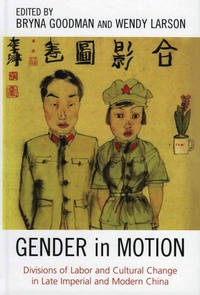
Gender in Motion
Divisions of Labor and Cultural Change in Late Imperial and Modern China
1st Edition
Published on 12. May 2005
360 pages
979-8-216-23835-5 (ISBN)
Description

Bringing together the work of distinguished China historians, anthropologists, and literary and film scholars, Gender in Motion raises provocative questions about the diversity of gender practices during the late imperial society and the persistence and transformation of older gender ideologies under the conditions of modernity in China.
While several studies have investigated gender or labor in late imperial and twentieth century China, this book brings these two concepts together, asking how these two categories interacted and produced new social practices and theories. Individual chapters examine agricultural and urban work, travel within China, overseas study, polyandry, the acting profession, courtesan culture, female politicians, Maoist work culture, and the boundaries of virtue and respectability.
Governing notions of the social order (and interrelated constructions of gender) changed radically in the modern era-initially with the questioning of the imperial, dynastic order and the creation of a Chinese republic in the early twentieth century, later with the creation of a Communist government and, most recently, with China's political and cultural transformations in the post-Mao era. As ideas and practices of gender have changed, the persistence of older rhetorical signs in the interstices of new political visions has complicated the social projects and understandings of modernity, especially in terms of the creation of new public spaces, new concepts of work and virtue, and new configurations of gender.
Contributions by: Madeleine Yue Dong, Bryna Goodman, Gail Hershatter, Ellen R. Judd, Joan Judge, Wendy Larson, Susan Mann, Kenneth L. Pomeranz, Tze-lan Deborah Sang, Matthew H. Sommer, Luo Suwen, Catherine Vance Yeh, and Wang Zheng.
While several studies have investigated gender or labor in late imperial and twentieth century China, this book brings these two concepts together, asking how these two categories interacted and produced new social practices and theories. Individual chapters examine agricultural and urban work, travel within China, overseas study, polyandry, the acting profession, courtesan culture, female politicians, Maoist work culture, and the boundaries of virtue and respectability.
Governing notions of the social order (and interrelated constructions of gender) changed radically in the modern era-initially with the questioning of the imperial, dynastic order and the creation of a Chinese republic in the early twentieth century, later with the creation of a Communist government and, most recently, with China's political and cultural transformations in the post-Mao era. As ideas and practices of gender have changed, the persistence of older rhetorical signs in the interstices of new political visions has complicated the social projects and understandings of modernity, especially in terms of the creation of new public spaces, new concepts of work and virtue, and new configurations of gender.
Contributions by: Madeleine Yue Dong, Bryna Goodman, Gail Hershatter, Ellen R. Judd, Joan Judge, Wendy Larson, Susan Mann, Kenneth L. Pomeranz, Tze-lan Deborah Sang, Matthew H. Sommer, Luo Suwen, Catherine Vance Yeh, and Wang Zheng.
More details
Other editions
Additional editions
Bryna Goodman | Wendy Larson
Gender in Motion
Divisions of Labor and Cultural Change in Late Imperial and Modern China
Book
05/2005
Rowman & Littlefield Publishers
€160.50
Shipment within 10-20 days
Persons
Bryna Goodman is associate professor of history at the University of Oregon. Wendy Larson is professor of East Asian languages and literatures at the University of Oregon.
Content
Introduction: Axes of Gender: Divisions of Labor and Spatial Separation
Part I: Patterns of Mobility
Chapter 1: Making Sex Work: Polyandry as a Survival Strategy in Qing Dynasty China
Chapter 2: The Virtue of Travel for Women in the Late Empire
Chapter 3: Gender on Stage: Actresses in an Actors' World (1895-1930)
Chapter 4: Women on the Move: Women's Kinship, Residence, and Networks in Rural Shandong
Part II: Spatial Transformations
Chapter 5: Between Nei and Wai: Chinese Women Students in Japan in the Early Twentieth Century
Chapter 6: Playing with the Public: Late Qing Courtesans and Their Opera Singer Lovers
Chapter 7: Unofficial History and Gender Boundary Crossing in the Early Chinese Republic: Shen Peizhen and Xiaofengxian
Chapter 8: Gender and Maoist Urban Reorganization
Chapter 9: He Yi's The Postman: The Workspace of a New Age Maoist
Part III: Boundaries
Chapter 10: Women's Work and the Economics of Respectability
Chapter 11: The Vocational Woman and the Elusiveness of "Personhood" in Early Republican China
Chapter 12: Women's Work and Boundary Transgression in Wang Dulu's Popular Novels
Chapter 13: Virtue at Work: Rural Shaanxi Women Remember the 1950s
Part I: Patterns of Mobility
Chapter 1: Making Sex Work: Polyandry as a Survival Strategy in Qing Dynasty China
Chapter 2: The Virtue of Travel for Women in the Late Empire
Chapter 3: Gender on Stage: Actresses in an Actors' World (1895-1930)
Chapter 4: Women on the Move: Women's Kinship, Residence, and Networks in Rural Shandong
Part II: Spatial Transformations
Chapter 5: Between Nei and Wai: Chinese Women Students in Japan in the Early Twentieth Century
Chapter 6: Playing with the Public: Late Qing Courtesans and Their Opera Singer Lovers
Chapter 7: Unofficial History and Gender Boundary Crossing in the Early Chinese Republic: Shen Peizhen and Xiaofengxian
Chapter 8: Gender and Maoist Urban Reorganization
Chapter 9: He Yi's The Postman: The Workspace of a New Age Maoist
Part III: Boundaries
Chapter 10: Women's Work and the Economics of Respectability
Chapter 11: The Vocational Woman and the Elusiveness of "Personhood" in Early Republican China
Chapter 12: Women's Work and Boundary Transgression in Wang Dulu's Popular Novels
Chapter 13: Virtue at Work: Rural Shaanxi Women Remember the 1950s
