

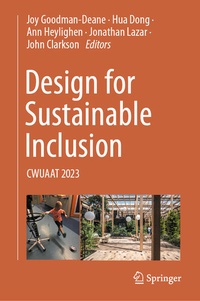
Design for Sustainable Inclusion
Description

This book, Design for Sustainable Inclusion, was inspired and informed by the United Nations Sustainable Development Goals. These include, among others, 'good health and well-being', 'reduced inequalities' and 'sustainable cities and communities'. Addressing this challenge requires a cross-disciplinary approach and close collaboration with many stakeholders. The Cambridge Workshop on Universal Access and Assistive Technology (CWUAAT) 2023 invited participants from a wide variety of disciplines to contribute to the discussion on this topic.
This book represents the papers presented at this conference, chosen by peer review by an international panel of currently active researchers. The chapters within the book provide a unique insight into current national and international research in the fields of inclusive design, universal access, and assistive and rehabilitative technology. The main sections of the book reflect the following key themes:
Understanding people
Designing for an ageing population
Inclusive built environments
Healthcare
Assistive technology
Design methodsEducation and training
We hope that this book will be useful to researchers, teachers, students and the general public who are interested in inclusive design and sustainable development.
More details
Other editions
Additional editions
Persons
Joy Goodman-Deane is a Senior Research Associate in the Inclusive Design group at the EDC. She gained a Ph.D. in Computing Science from Glasgow University in 2002 and worked as Research Associate there investigating the design of computer-based technology for older people. For the last 18 years, she has worked at the Engineering Design Centre (EDC) at the University of Cambridge where her research has focused on inclusive design. Her interests focus on developing tools and methods to help support designers in putting inclusive design into practice. Joy helped to develop and author the Inclusive Design Toolkit as well as tools such as the Exclusion Calculator, Cambridge impairment simulators, and digital personas.
