

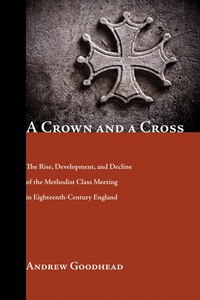
A Crown and a Cross
The Rise, Development, and Decline of the Methodist Class Meeting in Eighteenth-Century England
Published on 9. April 2010
362 pages
978-1-4982-7168-4 (ISBN)
Description

This book critically reviews the origins, development, and decline of the Class Meeting. Beginning with an overview of the religious and societal milieu from the sixteenth century, and examining the heritage of John and Charles Wesley, the inheritance John Wesley took from the past is studied. The rise of the Anglican Unitary Societies is considered and Wesley's active work within those societies drawn out. The arrival of the Moravians in London in 1738 to form a group for Germans resident in London influenced many of the Anglican society members, not least the Wesley brothers. These influences are also considered before the Methodist movement, and particularly the Class Meeting are considered in detail.
This book is unique in its drawing together the manner of religious association experienced in the Evangelical Revival and aims to show how Methodism was a fusion of pre-existing ideas, formed into a new working model of religious association. Paramount to the success of the early Methodist was the Class Meeting. This book draws on testimony, diary, and journal records to provide first-hand accounts of people's lives being changed through attendance at the Class Meeting and its making possible growth in grace and holiness. In the early period of Methodism the Class Meeting was the crown to Methodist identity. An analysis of the primary aims of this meeting, which gave the Methodist people their distinct characteristics, is followed by a study of the social identity and group processes that occurred when prospective members considered joining the Methodists.
The decline of the Class Meeting to 1791 forms the concluding chapters, and, using three classic sociological models-Weber (routinisation), Durkheim (totemism), and Troeltsch (primary/secondary religion)-as themes, the reasons why the class became a cross are examined. Journal, diary, and testimonial material support the Methodists' declining interest in the class that led to its irrelevance for a people seeking respectability rather than an immediate encounter with God.
More details
Other editions
Additional editions
Andrew Goodhead
A Crown and a Cross
The Rise, Development, and Decline of the Methodist Class Meeting in Eighteenth-Century England
Book
04/2010
Wipf & Stock Publishers
€41.20
Shipment within 3-4 weeks
Andrew Goodhead
A Crown and a Cross
The Rise, Development, and Decline of the Methodist Class Meeting in Eighteenth-Century England
Book
04/2010
Wipf & Stock Publishers
€68.60
Shipment within 15-20 days
Person
Andrew Goodhead is a British Methodist Minister. He is presently Spiritual Care Lead at St Christopher's Hospice, Sydenham, London. He has served as a Circuit Minister and Superintendent Minister in Circuits in England and Scotland.
Content
- Intro
- Title Page
- Abbreviations
- Introduction
- Part One: Introductory Comments
- Chapter 1: Religion and Society at the Turn of the Eighteenth Century
- Chapter 2: The Heritage of John and Charles Wesley
- Chapter 3: Religious Societies in England from 1678
- Chapter 4: The Fetter Lane Society
- Part Two: Introductory Comments
- Chapter 5: The Classes of Methodism
- Part Three: Introductory Comments
- Chapter 6: Routinization
- Chapter 7: Totemism
- Chapter 8: The One-Generational Meeting
- Chapter 9: Conclusion
- Appendix 1
- Appendix 2
- Appendix 3
- Appendix 4
- Appendix 5
- Appendix 6 (Rules A)
- Appendix 7 (Rules B)
- Appendix 8 (Rules C)
- Appendix 9
- Appendix 10
- Appendix 11
- Appendix 12
- Appendix 13
- Bibliography
