

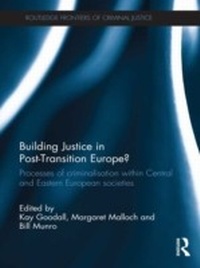
Building Justice in Post-Transition Europe?
Processes of Criminalisation within Central and Eastern European Societies
1st Edition
Published on 21. August 2012
208 pages
978-1-136-27172-4 (ISBN)
Description

After the collapse of the Berlin wall in 1989 and disintegration of the Soviet Union, scholars focused on the problems of legal transitions within the newly emerging democracies. Two decades on, these states are in 'post-transition' conditions; having undergone and continuing to experience political, economic and constitutional upheavals to varying degrees. This book provides an interdisciplinary perspective on this largely unexamined topic.
Part I of the book sets the scene with a socio-historical overview and a theoretical chapter; both of which contextualise the book within current debates and provide the theoretical direction of the book as a whole. The later chapters set out contrasting perspectives and consist of themed essays on individual legal systems, investigating these through approaches ranging from socio-legal study to political economy. The book aims to refine important directions for the comparative conceptual study of criminal law policy and processes of criminalisation in emerging democratic states. The result is a significant contribution to the understanding of this subject in the fields of criminology, law, philosophy and political science.
The book will appeal to academics, policy-makers and practitioners who are attempting to grapple with the area of "transitions" in the fields of criminology, law, philosophy and political science. As a distinctively interdisciplinary text, it brings together analysis of both the social processes of creating (and abandoning) criminal law and a philosophical reflection. The book provides a comprehensive and critical analysis which points to future directions in criminalisation in the emerging democratic states of Eastern Europe.
Part I of the book sets the scene with a socio-historical overview and a theoretical chapter; both of which contextualise the book within current debates and provide the theoretical direction of the book as a whole. The later chapters set out contrasting perspectives and consist of themed essays on individual legal systems, investigating these through approaches ranging from socio-legal study to political economy. The book aims to refine important directions for the comparative conceptual study of criminal law policy and processes of criminalisation in emerging democratic states. The result is a significant contribution to the understanding of this subject in the fields of criminology, law, philosophy and political science.
The book will appeal to academics, policy-makers and practitioners who are attempting to grapple with the area of "transitions" in the fields of criminology, law, philosophy and political science. As a distinctively interdisciplinary text, it brings together analysis of both the social processes of creating (and abandoning) criminal law and a philosophical reflection. The book provides a comprehensive and critical analysis which points to future directions in criminalisation in the emerging democratic states of Eastern Europe.
More details
Series
Language
English
Place of publication
London
United Kingdom
Publishing group
Taylor & Francis Ltd
Target group
College/higher education
Illustrations
4 s/w Tabellen
4 Tables, black and white
File size
1,59 MB
ISBN-13
978-1-136-27172-4 (9781136271724)
Copyright in bibliographic data and cover images is held by Nielsen Book Services Limited or by the publishers or by their respective licensors: all rights reserved.
Schweitzer Classification
Other editions
Additional editions
Kay Goodall | Margaret Malloch | Bill Munro
Building Justice in Post-Transition Europe?
Processes of Criminalisation within Central and Eastern European Societies
Book
03/2014
1st Edition
Routledge
€63.40
Shipment within 15-20 days
Kay Goodall | Margaret Malloch | Bill Munro
Building Justice in Post-Transition Europe?
Processes of Criminalisation within Central and Eastern European Societies
Book
07/2012
1st Edition
Routledge
€222.84
Shipment within 15-20 days
Persons
Kay Goodall is a Senior Lecturer at the School of Law at the University of Stirling. Her main research interests at the moment lie in conceptualising sectarianism, racism and "hate" in criminal law, and new conflicts among the strands of discrimination law.
Margaret Malloch is a Senior Research Fellow in the Scottish Centre for Crime and Justice Research at the University of Stirling. Research interests cover a wide range of topics within the field of crime and social justice but key areas include: gender and justice, criminal justice responses to social issues, critical criminology.Bill Munro is a Lecturer in Criminology at the School of Applied Social Science at the University of Stirling. Research interests cover a wide range of topics within the field of critical social theory and critical criminology: key areas include: transitional justice, criminalisation and theories of punishment.
Margaret Malloch is a Senior Research Fellow in the Scottish Centre for Crime and Justice Research at the University of Stirling. Research interests cover a wide range of topics within the field of crime and social justice but key areas include: gender and justice, criminal justice responses to social issues, critical criminology.Bill Munro is a Lecturer in Criminology at the School of Applied Social Science at the University of Stirling. Research interests cover a wide range of topics within the field of critical social theory and critical criminology: key areas include: transitional justice, criminalisation and theories of punishment.
Content
Part I: Socio-Historical Overview, 1. Social and Legal Transitions and Criminalisation, Kay Goodall, Margaret Malloch and Bill Munro, 2. The Legitimacy of Legal Order: Criminalisation and Social Integration in Post-Transition Societies, Bill Munro, Part II: Criminalisation and Decriminalisation: Modernising Criminal Law and Regulatory Strategies, 3. Building Justice through Criminal Law: Issues of Criminalisation and Trust Nina Persak, 4. Exodus from Lithuania: State, Social Disenfranchisement and Resistance in an Era of Austerity, Arunas Juska and Charles Woolfson 5. The Reform Story of the Finnish Penal Code: Ideological Turns and Waves of Modernisation, Kimmo Nuotio, 6. Criminalisation and Decriminalisation and Post-Communist Transition: The Case of the Russian Federation, Peter Solomon, 7. Decriminalising Sex Between Men in the Former Soviet Union, 1991-2003: Conditionality and the Council of Europe, Benjamin H. Noble Part III: Policing, Justice and Transformation, 8. Reforming the Ukrainian Police: The Challenges of Understanding and Addressing Violence, Yulia Chistyakova, 9. Police Reform and Building Justice in Russia: Problems and Prospects, Annette Robertson, Part IV: Conclusion, 10. Beyond Domestic Law: Themes and Prospects, Kay Goodall, Margaret Malloch and Bill Munro
