

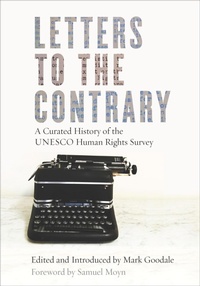
Letters to the Contrary
A Curated History of the UNESCO Human Rights Survey
Published on 24. April 2018
376 pages
978-1-5036-0535-0 (ISBN)
Description

This remarkable collection of letters reveals the debate over universal human rights. Prominent mid-twentieth-century intellectuals and leaders-including Gandhi, T.S. Eliot, W.H. Auden, Aldous Huxley, Jawaharlal Nehru, and Arnold Schoenberg-engaged with the question of universal human rights. Letters to the Contrary presents the foundation of the intellectual struggles and ideological doubts still present in today's human rights debates.
Since its adoption in 1948, historians and human rights scholars have claimed that the Universal Declaration of Human Rights was influenced by UNESCO's 1947-48 global survey of intellectuals, theologians, and cultural and political leaders, that supposedly demonstrated a truly universal consensus on human rights. Based on meticulous archival research, Letters to the Contrary provides a curated history of the UNESCO human rights survey and demonstrates its relevance to contemporary debates over the origins, legitimacy, and universality of human rights. In collecting, annotating, and analyzing these responses, including letters and responses that were omitted and polite refusals to respond, Mark Goodale shows that the UNESCO human rights survey was much less than supposed, but also much more. In many ways, the intellectual struggles, moral questions, and ideological doubts among the different participants who both organized and responded to the survey reveal a strikingly critical and contemporary orientation, raising similar questions at the center of current debates surrounding human rights scholarship and practice.
This volume contains letters and survey responses from Jacques Havet, Jacques Maritain, Arnold J. Lien, Richard P. Mckeon, Quincy Wright, Levi Carneiro, Arthur H. Compton, Charles E. Merriam, Lewis Mumford, E. H. Carr, John Lewis, Harold J. Laski, Serge Hessen, John Somerville, Boris Tchechko, Luc Somerhausen, Hyman Levy, Ture Nerman, R. Palme Dutt, Maurice Dobb, Pierre Teilhard De Chardin, Marcel De Corte, Pedro Troncoso Sanchez, Mahatma Gandhi, Chung-Shu Lo, Kurt Riezler, Inocenc Arnost Blaha, Hubert Frere, M. Nicolay, W. Albert Noyes, Jr., Aldous Huxley, Ralph W. Gerard, Johannes M. Burgers, Humayun Kabir, A. P. Elkin, S. V. Puntambekar, Leonard Barnes, Benedetto Croce, Jean Haesart, F. S. C. Northrop, Peter Skov, Emmanuel Mounier, Maurice Webb, John Macmurray, Julius Moor, L. Horvath, Alfred Weber, Don Salvador De Madariaga, Frank R. Scott, Jawaharlal Nehru, Margery Fry, Isaac Leon Kandel, Rene Maheu, Albert Szent-Gyoergyi, Morris L. Ernst, Arnold Schoenberg, W. H. Auden, Melville Herskovits, Theodore Johannes Haarhoff, Ernest Henry Burgmann, Herbert Read, and T. S. Eliot.
Since its adoption in 1948, historians and human rights scholars have claimed that the Universal Declaration of Human Rights was influenced by UNESCO's 1947-48 global survey of intellectuals, theologians, and cultural and political leaders, that supposedly demonstrated a truly universal consensus on human rights. Based on meticulous archival research, Letters to the Contrary provides a curated history of the UNESCO human rights survey and demonstrates its relevance to contemporary debates over the origins, legitimacy, and universality of human rights. In collecting, annotating, and analyzing these responses, including letters and responses that were omitted and polite refusals to respond, Mark Goodale shows that the UNESCO human rights survey was much less than supposed, but also much more. In many ways, the intellectual struggles, moral questions, and ideological doubts among the different participants who both organized and responded to the survey reveal a strikingly critical and contemporary orientation, raising similar questions at the center of current debates surrounding human rights scholarship and practice.
This volume contains letters and survey responses from Jacques Havet, Jacques Maritain, Arnold J. Lien, Richard P. Mckeon, Quincy Wright, Levi Carneiro, Arthur H. Compton, Charles E. Merriam, Lewis Mumford, E. H. Carr, John Lewis, Harold J. Laski, Serge Hessen, John Somerville, Boris Tchechko, Luc Somerhausen, Hyman Levy, Ture Nerman, R. Palme Dutt, Maurice Dobb, Pierre Teilhard De Chardin, Marcel De Corte, Pedro Troncoso Sanchez, Mahatma Gandhi, Chung-Shu Lo, Kurt Riezler, Inocenc Arnost Blaha, Hubert Frere, M. Nicolay, W. Albert Noyes, Jr., Aldous Huxley, Ralph W. Gerard, Johannes M. Burgers, Humayun Kabir, A. P. Elkin, S. V. Puntambekar, Leonard Barnes, Benedetto Croce, Jean Haesart, F. S. C. Northrop, Peter Skov, Emmanuel Mounier, Maurice Webb, John Macmurray, Julius Moor, L. Horvath, Alfred Weber, Don Salvador De Madariaga, Frank R. Scott, Jawaharlal Nehru, Margery Fry, Isaac Leon Kandel, Rene Maheu, Albert Szent-Gyoergyi, Morris L. Ernst, Arnold Schoenberg, W. H. Auden, Melville Herskovits, Theodore Johannes Haarhoff, Ernest Henry Burgmann, Herbert Read, and T. S. Eliot.
Reviews / Votes
"In this clever and timely book, Mark Goodale complicates the presumed universality of human rights, providing an alternative history of the UNESCO process. Besides representing a fabulous archival 'find,' Letters to the Contrary provides vital historical and anthropological analysis to illuminate these texts. This stellar book is novel in its focus on a largely overlooked episode in the history of UNESCO and rights and classic in the sense that rights and internationalism continue to be central to so many disciplines today. Unearthed letters from the likes of Eliot, Auden, Schoenberg, Carr, and Huxley form a veritable who's who of twentieth-century political thought. Lively, eminently readable, and utterly stimulating."-Lynn Meskell, Stanford University "Goodale's superb reconstruction of the history surrounding the UNESCO-sponsored survey of human rights demonstrates perfectly the political and contingent nature of the origins of the international human rights enterprise. It reveals both the centrality of philosophy to that enterprise, and the virtual impossibility of seeking a conception of human rights that is universal in philosophical analysis rather than political compromise."-Philip Alston, New York University "Human rights might survive our age of rupture if we cease to delude ourselves with myth-making about their historical origins. In this outstanding book, Mark Goodale shows unequivocally that the creation moment of 'the age of rights' was in no sense universal at all. Letters to the Contrary makes it impossible to defend the triumphalist vision of the postwar human rights story with the blithe assertion that everybody agreed human rights were now the only game in town."-Stephen Hopgood, SOAS, University of London "All international human rights lawyers concerned with the universality of human rights should read this book. Mark Goodale reveals how human rights comparison and distinction, not identification of a common denominator, were at the core of the UNESCO human rights survey and the resulting examination of the grounds of an international declaration of human rights. Rediscovering a differentiated and culturally sensitive philosophical discussion of human rights is not only humbling, it allows us to hope for reinvigorated universal debate."-Samantha Besson, University of FribourgAll prices
More details
Series
Edition
New edition
Language
English
Place of publication
Palo Alto
United States
Target group
Professional and scholarly
Edition type
New edition
File size
1,36 MB
ISBN-13
978-1-5036-0535-0 (9781503605350)
Copyright in bibliographic data and cover images is held by Nielsen Book Services Limited or by the publishers or by their respective licensors: all rights reserved.
Schweitzer Classification
Other editions
Additional editions
Book
04/2018
Stanford University Press
€131.50
Shipment within 15-20 days
Book
04/2018
Stanford University Press
€30.50
Shipment within 15-20 days
Persons
Mark Goodale is Professor of Cultural and Social Anthropology at the University of Lausanne and Series Editor of Stanford Studies in Human Rights. The author or editor of 12 other volumes, his most recent book is Anthropology and Law: A Critical Introduction (2017).
Content
History: UNESCO in the Paradigmatic Transition
Interpretations: From a "Hollow Sham" to a "Plurality of Cultural Values"
Memorandum and Questionnaire Circulated by UNESCO on the Theoretical Bases of the Rights of Man
The Grounds of an International Declaration of Human Rights
Foreword and Introduction to Human Rights, Comments and Interpretations, UNESCO 1949
Liberalism from the Ashes
Beyond Egotistic Man: Communist, Socialist, and Social Democratic Challenges
Rights in a Sacred Universe
The Universal Declaration of Human Duties
The Technological Society of the Future
Universal Human Rights in a Colonial World
Human Rights as History and Practice
Specific Freedoms
From Repudiation to the Play of Fancy
Interpretations: From a "Hollow Sham" to a "Plurality of Cultural Values"
Memorandum and Questionnaire Circulated by UNESCO on the Theoretical Bases of the Rights of Man
The Grounds of an International Declaration of Human Rights
Foreword and Introduction to Human Rights, Comments and Interpretations, UNESCO 1949
Liberalism from the Ashes
Beyond Egotistic Man: Communist, Socialist, and Social Democratic Challenges
Rights in a Sacred Universe
The Universal Declaration of Human Duties
The Technological Society of the Future
Universal Human Rights in a Colonial World
Human Rights as History and Practice
Specific Freedoms
From Repudiation to the Play of Fancy

