

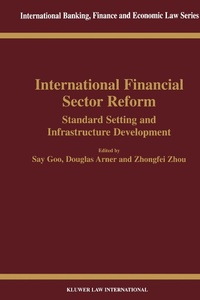
International Financial Sector Reform: Standard Setting and Infrastructure Development
Published on 1. June 2002
536 pages
978-90-411-7303-4 (ISBN)
Description

In the wake of the Asian financial crisis that erupted in 1997, an intense scrutiny of the principles and standards of the world's financial system was inevitable. This new book, a major milestone in the progressive development of the new financial architecture arising from the debacle, represents the penetrating insight and practical proposals of twenty-five experts, including economists, lawyers, bankers, academics, and officials from international financial institutions.
The important contributions offered here were originally presented at a series of conferences sponsored in 1999 and 2000 by the Asian Institute of International Financial Law of the University of Hong Kong in collaboration with leading law faculties from five continents. The issues boldly confronted in International Financial Sector Reform include the following:
- reform of domestic securities regulation;
- investment insurance and risk management;
- the role of pension funds;
- accounting standards;
- financing real estate and construction projects;
- global competitiveness in the financial sector;
- responsibiiity of private lenders;
- effective anti-money laundering measures;
- protection of emerging market economies;
- corporate governance; and
- institutional investors.
All professionals and policymakers interested in sustainable economic recovery, not only in Asia but throughout the world, will benefit enormously from these authors' fully informed and carefully formulated views. Although the new architecture they suggest will find its most immediate application in assisting emerging markets to withstand future shocks, the nature of the interdependent world in which we now live will ensure increased global financial stability as a result of this invaluable work.
The important contributions offered here were originally presented at a series of conferences sponsored in 1999 and 2000 by the Asian Institute of International Financial Law of the University of Hong Kong in collaboration with leading law faculties from five continents. The issues boldly confronted in International Financial Sector Reform include the following:
- reform of domestic securities regulation;
- investment insurance and risk management;
- the role of pension funds;
- accounting standards;
- financing real estate and construction projects;
- global competitiveness in the financial sector;
- responsibiiity of private lenders;
- effective anti-money laundering measures;
- protection of emerging market economies;
- corporate governance; and
- institutional investors.
All professionals and policymakers interested in sustainable economic recovery, not only in Asia but throughout the world, will benefit enormously from these authors' fully informed and carefully formulated views. Although the new architecture they suggest will find its most immediate application in assisting emerging markets to withstand future shocks, the nature of the interdependent world in which we now live will ensure increased global financial stability as a result of this invaluable work.
More details
Other editions
Additional editions
Book
06/2002
1st Edition
Kluwer Law International
€192.60
Shipment within 10-20 days
Content
- Cover
- Half Title Page
- Editorial Board
- Title Page
- Copyright Page
- Table of Contents
- Preface
- Foreword
- List of Contributors
- Part I New Architecture: International Financial Standard Setting
- 1. The New International Architecture: Is There a Workable Solution?
- 1 GLOBAL CRISIS-NATIONAL LAWS
- 2 MACRO-ECONOMICS VS MICRO-STRUCTURE OF MARKETS
- 3 THE LEGITIMACY OF THE INTERNATIONAL ARCHITECTURE
- 4 WHO GAINS? WHO PAYS IN GLOBALISATION?
- 5 GAPS IN GLOBAL MARKETS
- 6 THE POLITICAL ECONOMY OF GLOBAL MARKETS
- 7 CONCLUSION
- 2. The New International Financial Architecture and Global Banking Institutions
- 1 INTRODUCTION
- 2 THE SETTING
- 3 THE PUBLIC-PRIVATE PARTNERSHIP
- 4 THE DYNAMIC PARAMETERS OF THE PARTNERSHIP
- 5 GENERAL PRINCIPLES: ENFORCEMENT OF RISK MANAGEMENT AND INTERNAL CONTROL PROCESSES
- 6 RELATIONSHIPS AND LINKAGES IN THE BALANCE
- 7 CONCLUSION
- 3. Ongoing Challenges for Setting and Establishing International Banking Standards
- 1 THE BACKGROUND TO BANKING REFORM
- 2 BIS CAPITAL ACCORD
- 3 CORE PRINCIPLES METHODOLOGY
- 4 LEGAL ISSUES RELATED TO IMPROVING BANKING STANDARDS
- 5 CONCLUSION
- 4. Legal Reform and the Importance of Robust Securities Markets
- 1 EMERGING CAPITAL MARKETS: FACTORS FOR CONSIDERATION
- 2 GOVERNMENT REGULATOR OR "SRO"?
- 3 MONEY AND RESOURCES-SEEMINGLY ALWAYS A KEY DILEMMA
- 4 GOVERNMENT ENFORCEMENT-CIVIL VERSUS CRIMINAL
- 5 PRIVATE ATTORNEY GENERAL-PUBLIC BENEFIT OR SOCIETAL WASTE?
- 6 REGULATION OF OFFERINGS-DISCLOSURE VERSUS MERIT REGULATION
- 7 FACILITATING ACCESS TO CAPITAL MARKETS
- 8 OVERSEEING FINANCIAL INTERMEDIARY CONDUCT
- 9 CONCLUSION
- 5. The Capital Adequacy of Insurance: Reviewing the Current Global Standards
- 1 INTRODUCTION
- 2 THE CONCEPT OF INSURANCE CAPITAL
- 3 THE CAPITAL ADEQUACY STANDARD IN THE EU
- 4 THE CAPITAL ADEQUACY STANDARD IN THE US
- 5 INTERIM SUMMATION
- 6 A CASE STUDY: THE REGULATORY INEFFICIENCY IN TAIWAN
- 7 SUGGESTIONS
- 6. Internationalisation of Accounting Standards
- 1 HARMONISATION OF ACCOUNTING STANDARDS IN THE EUROPEAN UNION
- 2 THE DEVELOPMENT OF CORE INTERNATIONAL ACCOUNTING STANDARDS: IOSCO AND THE IASC
- 3 THE RECONCILIATION QUESTION AND CORE RECONCILIATION ISSUES
- 4 INTERNATIONAL COOPERATIVE EFFORTS IN THE REALM OF AUDITING
- 5 CONCLUDING OBSERVATIONS
- 7. The Role of Pension Funds in the Stabilization of the Domestic Financial Sector
- 1 INTRODUCTION
- 2 THE IMPACT ON FINANCIAL SECTOR INFRASTRUCTURE AND THE QUALITY OF SERVICES
- 3 PENSION FUNDS, SECURITIZATION AND THE IMPACT ON FINANCIAL INTERMEDIATION
- 4 PENSION FUNDS, INVESTMENT BEHAVIOR AND ASSET PRICE VOLATILITY
- 5 PENSION FUNDS AND CORPORATE GOVERNANCE
- 6 CONCLUSIONS AND POLICY IMPLICATIONS
- 8. Insolvency Law Reform: International Financial Insolvencies
- 1 BACKGROUND INSOLVENCY LAW ISSUES
- 2 INTERNATIONAL INSOLVENCIES: THE FINANCIAL SECTOR
- 3 CONCLUSION
- 9. Financial Conglomerates: European Responses to Internationalisation and Multifunctionalism
- 1 INTRODUCTION
- 2 THE SCOPE OF FINANCIAL CONGLOMERATES
- 3 EVIDENCE FOR THE INCREASING INTERNATIONALISATION OF FINANCIAL CONGLOMERATES
- 4 EVIDENCE OF MULTIFUNCTIONALISM
- 5 SUPERVISORY AND REGULATORY ISSUES
- 6 CONCLUSION
- 10. International Financial Crisis and the Financial Stability Forum
- 1 FINANCIAL CRISES
- 2 POLICY RESPONSE
- 3 INTERNATIONAL FINANCIAL STABILITY
- 4 THE FINANCIAL STABILITY FORUM
- 5 COMMENT AND CONCLUSIONS
- Part II Domestic Implementation of International Financial Standards
- 11. The New Financial Architecture and its Implications for Hong Kong
- 1 INTRODUCTION
- 2 NEW FINANCIAL ARCHITECTURE: BACKGROUND AND ANALYSIS
- 3 IMPLICATIONS FOR HONG KONG
- 4 CONCLUDING REMARKS
- APPENDIX. G7 TIMETABLE FOR REFORM OF THE INTERNATIONAL FINANCIAL SYSTEM
- 12. A Comment on the Basic Law as the Constitutional Foundation of Hong Kong's Economic Future
- 13. Restoring Social Equity, Financial Stability and Global Competitiveness to the HKSAR: A Reform of the Property Tax System
- 1 THE TAX BASE FOR INCOME FROM PROPERTY
- 2 LEGISLATIVE HISTORY: FROM EQUITABLE TAX BASE TO REGRESSIVE SYSTEM
- 3 THE BLACK LETTER LAW OF PROPERTY TAX
- 4 A TREATISE ON HKSAR PROPERTY TAX
- 5 ECONOMIC DEVELOPMENT OF THE HKSAR
- 6 A BROAD TAX BASE
- 7 CONCLUSION
- 14. Implementation of International Standards: Some Observations from China
- 1 INTRODUCTION
- 2 INTERNATIONAL STANDARDS
- 3 BANKING LAWS OF CHINA AND THE BASLE PRINCIPLES
- 4 SECURITIES LAWS OF CHINA AND THE IOSCO STANDARDS
- 5 CHINA'S PROBLEMS IN EFFECTIVE IMPLEMENTATION OF INTERNATIONAL STANDARDS
- 6 CONCLUSION
- 15. Application of International Financial Standards to China's Bank Management
- 1 RISK MANAGEMENT
- 2 INTERNAL CONTROLS
- 3 PUBLIC DISCLOSURE
- 4 CONCLUDING REMARKS: IMPROVE BANK MANAGEMENT IN CHINA
- 16. Structuring a Modern Capital Market: The Swiss Example
- 1 INTRODUCTION
- 2 EXISTING LEGISLATION IN SWITZERLAND
- 3 INSTITUTIONS OF THE CAPITAL MARKET
- 4 TRANSACTIONAL RULES IN THE CAPITAL MARKET
- 17. Global Importance of Financial Sector Reform in Japan
- 1 INTRODUCTION
- 2 OVERVIEW OF JAPAN'S BIG BANG PROGRAM
- 3 IMPACT ON THE LEGAL SYSTEM IN JAPAN
- 4 GLOBAL IMPLICATIONS
- 5 CONCLUSION
- Part III Crisis, Corruption and Corporate Governance
- 18. Using Money Laundering Control to Fight Corruption: An Extraterritorial Instrument
- 1 INTRODUCTION
- 2 CORRUPTION: DEFINITION AND OVERVIEW
- 3 MONEY LAUNDERING: DEFINITION AND OVERVIEW
- 4 USING MONEY LAUNDERING CONTROL TO CURB CORRUPTION
- 5 CONCLUSION
- 19. Combating Money Laundering: The South African Solution
- 1 INTRODUCTION
- 2 THE PROCESS
- 3 LEGISLATIVE OVERVIEW
- 4 THE MONEY LAUNDERING CONTROL BILL
- 5 CONCLUSION
- 20. Private Lenders' Responsibilities in Times of Crisis
- 1 INTRODUCTION
- 2 STUDIES ON THE RESPONSIBILITIES OF LENDERS
- 3 A MODEL
- 4 KOREAN EXPERIENCE
- 5 CONCLUDING REMARKS
- 21. The New Financial Architecture and Effective Corporate Governance
- 1 THE NEED FOR A NEW GLOBAL FINANCIAL ARCHITECTURE AND EFFECTIVE CORPORATE GOVERNANCE
- 2 GLOBALISATION, REGIONALISM AND NATIONAL CORPORATE LAW MODELS-MARKETS OR HARMONISATION?
- 3 THE CHARACTERISTICS OF THE GLOBAL CORPORATE LANDSCAPE
- 4 THE EVOLUTION OF MODERN CORPORATE GOVERNANCE AND ITS PLACE IN A NEW FINANCIAL ARCHITECTURE
- 5 THE RECENT INITIATIVE OF THE OECD
- 6 THE CONTRIBUTION OF GLOBAL CORPORATE GOVERNANCE TO NEW FINANCIAL ARCHITECTURE
- APPENDIX A. NATIONAL CORPORATE GOVERNANCE MATERIALS
- APPENDIX B. COMMON CONTENT OF NATIONAL REPORTS
- APPENDIX C. THE OECD PRINCIPLES OF CORPORATE GOVERNANCE
- 22. Institutional Investors, Corporate Governance and the New International Financial Architecture
- 1 INTRODUCTION
- 2 IMPROVING THE INTERNATIONAL FINANCIAL ARCHITECTURE AND THE ROLE OF CORPORATE GOVERNANCE
- 3 INSTITUTIONAL INVESTORS AND CORPORATE GOVERNANCE
- 4 AUSTRALIAN INSTITUTIONAL INVESTORS' VIEWS ON CORPORATE GOVERNANCE
- 5 CONCLUSION
- 23. Improving Corporate Governance: Role of Shareholders and Regulators in Hong Kong
- 1 ROLE OF SHAREHOLDERS
- 2 ROLE OF THE STOCK EXCHANGE
- 3 ROLE OF THE SECURITIES AND FUTURES COMMISSION
- 4 CONCLUSIONS
- INDEX
- Back Cover
