

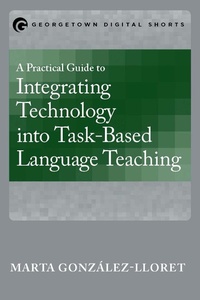
A Practical Guide to Integrating Technology into Task-Based Language Teaching
Description

However exciting new technologies and educational tools may seem, they can become solely for entertainment unless their design, use, and evaluation are guided by principles of education and language development. Task-based Language Teaching (TBLT) provides an excellent approach for teachers who want to realize the potential of technology to engage learners and improve language learning inside and outside the classroom.
This practical guide shows teachers how to successfully incorporate technology into TBLT in the classroom and to develop technology-mediated materials. Whether the goal is to conduct a needs analysis, to develop classroom or homework materials, or to implement a new approach of student assessment, A Practical Guide to Integrating Technology into Task-Based Language Teaching will be a welcome resource for language teachers at all levels.
Designed for use in the classroom as well as for independent study, the book includes reflective questions, activities, and further reading at the end of each chapter. Examples of units in Chinese, Spanish, ESL, and the hospitality industry are provided.
Georgetown Digital Shorts-longer than an article, shorter than a book-deliver timely works of peer-reviewed scholarship for a fast-paced world. They present new ideas and original content that are easily digestable for students, scholars, and general readers.
More details
Other editions
Additional editions
Person
Marta González-Lloret is an associate professor in Spanish at the University of Hawai'i. She has published widely on task-based learning, including the recent coedited book Technology-Mediated TBLT: Researching Technology and Tasks.
Content
Introduction
1. What Is Technology-Mediated TBLT?
2. How to Conduct a Needs Analysis of Tasks and Technologies
3. Creating, Organizing, and Sequencing Tasks
4. Performance-Based Assessment and Curriculum Evaluation
References
About the Author
Figures and Tables
