

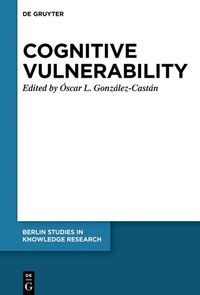
Cognitive Vulnerability
Description

Vulnerability has become part of our everyday vocabulary. We are used to hearing that we ought to act so as to protect the highly vulnerable; the qualifier suggests that we are all vulnerable. In addition to being of contemporary relevance, the notion of vulnerability has also been at the heart of philosophical reflection since the birth of the discipline, playing a vital role across many different traditions. Its prevalence is unsurprising. Vulnerability, which partially defines us as human beings, has appeared in many guises: mortality, finitude, sin, ignorance, etc.
However, no attempt has yet been made to fully apply the notion of vulnerability to the domains of epistemology and the philosophy of science, to relate it to our general human vulnerability, and to explore the wide range of consequences that derive from it. The contributors of this book fill this gap; they present new approaches to classical problems. They highlight different aspects of our cognitive vulnerability, from issues related to the realism/antirealism debate to reflections on epistemic success and trust.
More details
Other editions
Additional editions
Person
Óscar L. González-Castán , Complutense University of Madrid, Madrid, Spain.
Content
- Intro
- Table of Contents
- List of Abbreviations
- Cognitive Vulnerability in Philosophical Perspective
- Part I: Shaping Our Cognitive Vulnerability
- Cognitive Vulnerability, Repetition, and Truth
- How Negative Knowledge Relates to Negative Certainty: An Instance of Cognitive Vulnerability
- The Epistemology of "Successibility": An Optimistic Point of View
- Heuristics as a Source of Cognitive Vulnerability in Philosophy
- The Virtuous Circle of Fallibilism, Realism, and Intersubjectivity: Peirce's Antidote to Cognitive Vulnerability
- Part II: Consequences of Cognitive Vulnerability
- Cognitive Vulnerability: Fallibilism, Distrust, and Disagreements
- Bounded Normativity: The Principle of Reflective Equilibrium as a Principle of Rationality
- Cognitive Vulnerability and the Post-Truth Challenge
- Understanding, Vulnerability, and Risk
- Defeasible Knowledge of Dispositions: A Survey from Wittgenstein's Epistemic Pluralism
- Notes on Contributors
- Index of Names
- Subject Index
