

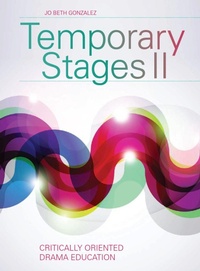
Temporary Stages II
Critically Oriented Drama Education
1st Edition
Published on 1. May 2013
175 pages
978-1-78320-090-0 (ISBN)
Description

Theatre teachers are forced to adapt constantly. Whether responding to advancing technologies, cuts to (or the growth of) their programme or ever-changing governmental mandates, they struggle to serve both their students and their craft. Using a theatre arts programme at one Midwestern high school, this book explores how change, good or ill, directly impacts students as well as teachers. Building on the work of the previous edition of Temporary Stages, Jo Beth Gonzalez shows teachers how to sustain confidence and outlines 'critically conscious' teaching, a technique that encourages students to practise self-agency and critical awareness. Essential reading for all theatre teachers, this indispensable resource is a font of innovative classroom and production practices.
Reviews / Votes
'Temporary Stages offers powerful ideas for pre-service and practicing theatre teachers-as well as teachers of teachers-to contemplate. Directly relevant to teaching methods, yet far from a "how-to" text, the book inspires all readers with its fresh, provocative and accessible ideas.' -- Joan Lazarus, Head, BFA Theatre Studies Program, The University of Texas at Austin 'I was pleasantly surprised to read that teaching artists were engaged in the bold goal of developing a critical model of collaborative leadership for high school musical theatre. This kind of aim hardly ever shows up in strategic plans, mission statements, or on school websites. As Gonzalez makes clear, the infrastructure must be put in place to invite students to engage with the pedagogical and the aesthetic, but also to make them feel comfortable and validated.' -- Dr. Lorenzo Garcia, Associate Professor of Theatre for Young Audiences, University of North Texas 'Temporary Stages integrates practice with research in ways both compelling and honest. Jo Beth Gonzalez's integrity, passion and forthright prose make this a useful addition for teachers interested in exploring social justice and identity through performance.' -- Dr. Stephani Etheridge Woodson, Associate Director, School of Theatre & Film, Arizona State University 'This volume is an essential addition to the literature on high school theatre teaching. I believe it will take high school production and classroom practice into the twenty-first century and respond to shifts both in demographics and curriculum reform. It is essential reading for any student considering working in secondary education, whether in a formal classroom context, as a teaching artist, or in applied theatre. ' -- Drew Chappell,Youth Theatre JournalMore details
Series
Edition
1. Auflage
Language
English
Place of publication
Bristol
United Kingdom
Publishing group
Intellect
Target group
Professional and scholarly
ISBN-13
978-1-78320-090-0 (9781783200900)
Copyright in bibliographic data and cover images is held by Nielsen Book Services Limited or by the publishers or by their respective licensors: all rights reserved.
Schweitzer Classification
Other editions
Additional editions
Book
10/2013
Intellect Books
€33.40
Shipment within 3-4 weeks
Person
Jo Beth Gonzalez has been a classroom teacher of speech, English and theatre for 27 years, the past nineteen at Bowling Green High School in Ohio, where she also directs the theatre program.
Content
- Cover
- Half Title
- Tilte
- Copyright
- Contents
- Foreword
- Acknowledgments
- SECTION ONE: Critically Oriented Drama EducationShapes Growth
- Chapter 1: Stepping From Temporary Stages to Temporary Stages II
- Rethinking Power Relationships in the Theatre Classroom and Rehearsal
- Sections of the Book
- Promoting Critical Consciousness: The CODE Classroom and Rehearsal
- National Trends Demonstrate Need for Critical Investigation of Secondary Theatre Education
- Seven Guiding Concepts of Temporary Stages II
- Power
- Authority
- Student Artistry
- Incomplete Understandings
- Change
- Privilege
- Place
- The Adventure of Teaching Theatre for Self-Agency and Critical Consciousness
- Chapter 2: Characterizing CODE Classrooms and Rehearsal Spaces
- Self-Reflection: The Gateway to Critically Conscious Classrooms and Rehearsals
- Qualities of a CODE Classroom
- Positioning the Listening Ear
- Reflection as Evaluation: What About Grades?
- Chapter 3: Balancing Passion and Censorship
- Promoting Critical Consciousness Through Drama/Theatre Education
- Daily Demands and Tradition Hinder Change
- Language and Homosexuality Prompt Censorship
- Plays With Themes of War Prompt Censorship
- Treading the Divides of Partial Understanding
- Personal Commitment to the Social Cause Contributes Conditions for Change
- Chapter 4: Discovering CODE in Musical Theatre
- Critical Directing Challenges Conventional Hierarchies in Musical Theatre
- Challenge #1: Asking "Where Are the Stars?"
- Challenge #2: Involving Students in All Aspects of Artistry and Production to Strengthen the Whole
- Challenge #3: Securing Confidence in Collaborative Leadership
- Challenge #4: Steering Away from Stereotypes by Designing Rehearsals that Foster Critical Consciousness
- Challenge #5: Questioning Assumptions of Privilege: Dramaturgy Unveils Identity
- Challenge #6: Contemplating Complexities of Cultural Border-Crossing
- Postscript
- SECTION TWO: Critically Oriented Drama Education Alters Traditional Power Dynamics
- Chapter 5: Examining Power Dynamics in a CODE Theatre Design Classroom
- Perpetuating Dominance In Spite of Principles
- Evolution of a Design
- Resisting Authority and Authorizing Resistance: Students and Teachers Negotiate Control
- Whose Vision Is This? On Artistry and Compromise
- Co-Authored Vision: The Winter's Tale
- Teacher's Vision: Much Ado About Nothing
- Artistic Compromise and Compromising Artistry
- Much Ado About Trees
- The Winter's Tale of Trees
- A Midsummer Night's Nightmare
- Binaries Blend When Students Exercise Power
- The Teacher/Student Binary
- The Actor/Crew Binary
- The Leader/Follower Binary
- Chapter 6: Emerging Conflict, Paradox, and Social Change When Students Exercise Power
- Multiple Perspectives Fuel Power Struggles
- Paradox: Democratic Teacher and Director Authority
- Conflict Arises from Paradox: Democratic Teacher or Authoritative Director?
- Social Change Evolves from Conflict: Democratic Teaching Strengthens the Co-curricular Theatre Program
- Conventional Mindsets Rear Heads When New Ideas Depart From Tradition
- Chapter 7: Shaping an Ensemble Approach to Casting Understudies with a Mindset for CODE
- Critical Partnership versus Conventional Substitution
- Conditions for Understudy/Principal Critical Partnership
- Technique #1: Play Selection
- Technique #2: Terminology
- Technique #3: Shadowing
- Technique #4: Ensemble Roles
- Technique #5: Ensemble Improvisations and Workshops
- Technique #6: Switching Out
- Technique #7: Added Time
- Chapter 8: Adjusting to a New Theatre with Critical Awareness
- Adjusting With Unease to a Place of Privilege
- Effective Power Dynamics Manage Transition into a Performing Arts Center
- Scheduling Activities in the New Performing Arts Center: Feminist Leadership Involves All
- Top-Down Management Seeps In
- The Politics of Danger: Technology Presents New Cautions
- Evaluating Co-Governance in a Technological Environment
- A State-of-the-Art Space: The Creativity/Technology Binary
- Technology and the Spirit of Theatre
- Technology: The Science/Theatre Binary
- Performing Arts Center-Turned-Classroom Engages Science Students in a Fresh Way
- SECTION THREE: Critically Oriented Drama Education Examines Controversy and Oppression
- Chapter 9: Establishing a Foundation for Examining Tough Issues
- Evolution of Original Scripts with Controversial Themes
- Leading Discussions of Controversial Subject Matter
- Exploring What Works . And What Doesn't: Sometimes Traditional Teaching Methods Are Best
- Testimonies Contribute Substance to Research
- Chapter 10: Unfolding Ongoing Reflective Practice Through Five CODE Strategies
- Students Resist Teacher-Fed Script
- CODE Conditions in a Classroom Support Student-Written Scenes on Hot Topics
- Strategy #1: The Spoonful of Sugar-Incorporate Satire to Advance Serious Work
- Scene 1: "The Best Drunk Driver"
- Scene 2: "Fagzilla"
- Strategy #2: Invite Self-Disclosure
- Strategy #3: Build Trust to Raise Social Consciousness and Express Emotion Honestly
- Strategy #4: Integrate Teacher Voice to Model Vulnerability as Strength
- Strategy #5: Involve Tempered Teacher Authority as Process Evolves into Product
- Chapter 11: Investigating Student and Teacher Identity
- Positioning Student Identity in the Classroom
- Positioning Teacher Identity in Rehearsal
- The CODE Classroom: A "Safe Space" With Consequences
- Seeing the Opposite Reveals Identity
- Strong Critical Classroom Experience is an Ongoing Process
- Unveiling Whiteness in a "Safe Space With Consequences"
- Positioning Whiteness in Performance When the Joke is on Who?
- Chapter 12: Preparing for the Audience
- Working Through the Audience "Fear Factor"
- When Emotions Aren't Enough: Integrating Facts for Healthy Digestion of Controversial Material
- The Responsibilities of Democratic Teaching Include Preparing for the Audience
- Postscript
- Epilogue
- Works Cited
- Index
- Back Cover
