

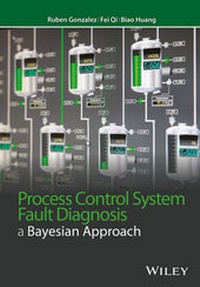
Process Control System Fault Diagnosis
Description

More details
Other editions
Additional editions
Persons
Content
Preface xiii
Acknowledgements xvii
List of Figures xix
List of Tables xxiii
Nomenclature xxv
Part I FUNDAMENTALS
1 Introduction 3
1.1 Motivational Illustrations 3
1.2 Previous Work 4
1.2.1 Diagnosis Techniques 4
1.2.2 Monitoring Techniques 7
1.3 Book Outline 12
1.3.1 Problem Overview and Illustrative Example 12
1.3.2 Overview of Proposed Work 12
References 16
2 Prerequisite Fundamentals 19
2.1 Introduction 19
2.2 Bayesian Inference and Parameter Estimation 19
2.2.1 Tutorial on Bayesian Inference 24
2.2.2 Tutorial on Bayesian Inference with Time Dependency 27
2.2.3 Bayesian Inference vs. Direct Inference 32
2.2.4 Tutorial on Bayesian Parameter Estimation 33
2.3 The EM Algorithm 38
2.4 Techniques for Ambiguous Modes 44
2.4.1 Tutorial on T Parameters in the Presence of Ambiguous Modes 46
2.4.2 Tutorial on Probabilities Using T Parameters 47
2.4.3 Dempster-Shafer Theory 48
2.5 Kernel Density Estimation 51
2.5.1 From Histograms to Kernel Density Estimates 52
2.5.2 Bandwidth Selection 54
2.5.3 Kernel Density Estimation Tutorial 55
2.6 Bootstrapping 56
2.6.1 Bootstrapping Tutorial 57
2.6.2 Smoothed Bootstrapping Tutorial 57
2.7 Notes and References 60
References 61
3 Bayesian Diagnosis 62
3.1 Introduction 62
3.2 Bayesian Approach for Control Loop Diagnosis 62
3.2.1 Mode M 62
3.2.2 Evidence E 63
3.2.3 Historical Dataset D 64
3.3 Likelihood Estimation 65
3.4 Notes and References 67
References 67
4 Accounting for Autodependent Modes and Evidence 68
4.1 Introduction 68
4.2 Temporally Dependent Evidence 68
4.2.1 Evidence Dependence 68
4.2.2 Estimation of Evidence-transition Probability 70
4.2.3 Issues in Estimating Dependence in Evidence 74
4.3 Temporally Dependent Modes 75
4.3.1 Mode Dependence 75
4.3.2 Estimating Mode Transition Probabilities 77
4.4 Dependent Modes and Evidence 81
4.5 Notes and References 82
References 82
5 Accounting for Incomplete Discrete Evidence 83
5.1 Introduction 83
5.2 The Incomplete Evidence Problem 83
5.3 Diagnosis with Incomplete Evidence 85
5.3.1 Single Missing Pattern Problem 86
5.3.2 Multiple Missing Pattern Problem 92
5.3.3 Limitations of the Single and Multiple Missing Pattern Solutions 93
5.4 Notes and References 94
References 94
6 Accounting for Ambiguous Modes: A Bayesian Approach 96
6.1 Introduction 96
6.2 Parametrization of Likelihood Given Ambiguous Modes 96
6.2.1 Interpretation of Proportion Parameters 96
6.2.2 Parametrizing Likelihoods 97
6.2.3 Informed Estimates of Likelihoods 98
6.3 Fagin-Halpern Combination 99
6.4 Second-order Approximation 100
6.4.1 Consistency of T Parameters 101
6.4.2 Obtaining a Second-order Approximation 101
6.4.3 The Second-order Bayesian Combination Rule 103
6.5 Brief Comparison of Combination Methods 104
6.6 Applying the Second-order Rule Dynamically 105
6.6.1 Unambiguous Dynamic Solution 105
6.6.2 The Second-order Dynamic Solution 106
6.7 Making a Diagnosis 107
6.7.1 Simple Diagnosis 107
6.7.2 Ranged Diagnosis 107
6.7.3 Expected Value Diagnosis 107
6.8 Notes and References 111
References 111
7 Accounting for Ambiguous Modes: A Dempster-Shafer Approach 112
7.1 Introduction 112
7.2 Dempster-Shafer Theory 112
7.2.1 Basic Belief Assignments 112
7.2.2 Probability Boundaries 114
7.2.3 Dempster's Rule of Combination 114
7.2.4 Short-cut Combination for Unambiguous Priors 115
7.3 Generalizing Dempster-Shafer Theory 116
7.3.1 Motivation: Difficulties with BBAs 117
7.3.2 Generalizing the BBA 119
7.3.3 Generalizing Dempster's Rule 122
7.3.4 Short-cut Combination for Unambiguous Priors 123
7.4 Notes and References 124
References 125
8 Making Use of Continuous Evidence Through Kernel Density Estimation 126
8.1 Introduction 126
8.2 Performance: Continuous vs. Discrete Methods 127
8.2.1 Average False Negative Diagnosis Criterion 127
8.2.2 Performance of Discrete and Continuous Methods 129
8.3 Kernel Density Estimation 132
8.3.1 From Histograms to Kernel Density Estimates 132
8.3.2 Defining a Kernel Density Estimate 134
8.3.3 Bandwidth Selection Criterion 135
8.3.4 Bandwidth Selection Techniques 136
8.4 Dimension Reduction 137
8.4.1 Independence Assumptions 138
8.4.2 Principal and Independent Component Analysis 139
8.5 Missing Values 139
8.5.1 Kernel Density Regression 140
8.5.2 Applying Kernel Density Regression for a Solution 141
8.6 Dynamic Evidence 142
8.7 Notes and References 143
References 143
9 Accounting for Sparse Data Within a Mode 144
9.1 Introduction 144
9.2 Analytical Estimation of the Monitor Output Distribution Function 145
9.2.1 Control Performance Monitor 145
9.2.2 Process Model Monitor 146
9.2.3 Sensor Bias Monitor 148
9.3 Bootstrap Approach to Estimating Monitor Output Distribution Function 150
9.3.1 Valve Stiction Identification 150
9.3.2 The Bootstrap Method 153
9.3.3 Illustrative Example 156
9.3.4 Applications 160
9.4 Experimental Example 164
9.4.1 Process Description 164
9.4.2 Diagnostic Settings and Results 167
9.5 Notes and References 170
References 170
10 Accounting for Sparse Modes Within the Data 172
10.1 Introduction 172
10.2 Approaches and Algorithms 172
10.2.1 Approach for Component Diagnosis 173
10.2.2 Approach for Bootstrapping New Modes 176
10.3 Illustration 181
10.3.1 Component-based Diagnosis 184
10.3.2 Bootstrapping for Additional Modes 188
10.4 Application 194
10.4.1 Monitor Selection 195
10.4.2 Component Diagnosis 195
10.5 Notes and References 198
References 199
Part II APPLICATIONS
11 Introduction to Testbed Systems 203
11.1 Simulated System 203
11.1.1 Monitor Design 203
11.2 Bench-scale System 205
11.3 Industrial Scale System 207
References 207
12 Bayesian Diagnosis with Discrete Data 209
12.1 Introduction 209
12.2 Algorithm 210
12.3 Tutorial 213
12.4 Simulated Case 216
12.5 Bench-scale Case 217
12.6 Industrial-scale Case 219
12.7 Notes and References 220
References 220
13 Accounting for Autodependent Modes and Evidence 221
13.1 Introduction 221
13.2 Algorithms 222
13.2.1 Evidence Transition Probability 222
13.2.2 Mode Transition Probability 226
13.3 Tutorial 228
13.4 Notes and References 231
References 231
14 Accounting for Incomplete Discrete Evidence 232
14.1 Introduction 232
14.2 Algorithm 232
14.2.1 Single Missing Pattern Problem 232
14.2.2 Multiple Missing Pattern Problem 236
14.3 Tutorial 238
14.4 Simulated Case 241
14.5 Bench-scale Case 242
14.6 Industrial-scale Case 244
14.7 Notes and References 246
References 246
15 Accounting for Ambiguous Modes in Historical Data: A Bayesian Approach 247
15.1 Introduction 247
15.2 Algorithm 248
15.2.1 Formulating the Problem 248
15.2.2 Second-order Taylor Series Approximation of p(E|M,T) 248
15.2.3 Second-order Bayesian Combination 250
15.2.4 Optional Step: Separating Monitors into Independent Groups 252
15.2.5 Grouping Methodology 253
15.3 Illustrative Example of Proposed Methodology 254
15.3.1 Introduction 254
15.3.2 Offline Step 1: Historical Data Collection 255
15.3.3 Offline Step 2: Mutual Information Criterion (Optional) 255
15.3.4 Offline Step 3: Calculate Reference Values 256
15.3.5 Online Step 1: Calculate Support 257
15.3.6 Online Step 2: Calculate Second-order Terms 258
15.3.7 Online Step 3: Perform Combinations 260
15.3.8 Online Step 4: Make a Diagnosis 262
15.4 Simulated Case 265
15.5 Bench-scale Case 268
15.6 Industrial-scale Case 269
15.7 Notes and References 270
References 271
16 Accounting for Ambiguous Modes in Historical Data: A Dempster-Shafer Approach 272
16.1 Introduction 272
16.2 Algorithm 272
16.2.1 Parametrized Likelihoods 272
16.2.2 Basic Belief Assignments 273
16.2.3 The Generalized Dempster's Rule of Combination 275
16.3 Example of Proposed Methodology 276
16.3.1 Introduction 276
16.3.2 Offline Step 1: Historical Data Collection 277
16.3.3 Offline Step 2: Mutual Information Criterion (Optional) 277
16.3.4 Offline Step 3: Calculate Reference Value 278
16.3.5 Online Step 1: Calculate Support 279
16.3.6 Online Step 2: Calculate the GBBA 280
16.3.7 Online Step 3: Combine BBAs and Diagnose 283
16.4 Simulated Case 283
16.5 Bench-scale Case 284
16.6 Industrial System 286
16.7 Notes and References 287
References 287
17 Making use of Continuous Evidence through Kernel Density Estimation 288
17.1 Introduction 288
17.2 Algorithm 289
17.2.1 Kernel Density Estimation 289
17.2.2 Bandwidth Selection 289
17.2.3 Adaptive Bandwidths 290
17.2.4 Optional Step: Dimension Reduction by Multiplying Independent Likelihoods 291
17.2.5 Optional Step: Creating Independence via Independent Component Analysis 291
17.2.6 Optional Step: Replacing Missing Values 292
17.3 Example of Proposed Methodology 293
17.3.1 Offline Step 1: Historical Data Collection 295
17.3.2 Offline Step 3: Mutual Information Criterion (Optional) 296
17.3.3 Offline Step 4: Independent Component Analysis (Optional) 298
17.3.4 Offline Step 5: Obtain Bandwidths 298
17.3.5 Online Step 1: Calculate Likelihood of New Data 301
17.3.6 Online Step 2: Calculate Posterior Probability 302
17.3.7 Online Step 3: Make a Diagnosis 302
17.4 Simulated Case 302
17.5 Bench-scale Case 304
17.6 Industrial-scale Case 304
17.7 Notes and References 307
References 307
Appendix 308
17.A Code for Kernel Density Regression 308
17.A.1 Kernel Density Regression 308
17.A.2 Three-dimensional Matrix Toolbox 310
18 Dynamic Application of Continuous Evidence and Ambiguous Mode Solutions 313
18.1 Introduction 313
18.2 Algorithm for Autodependent Modes 313
18.2.1 Transition Probability Matrix 314
18.2.2 Review of Second-order Method 314
18.2.3 Second-order Probability Transition Rule 315
18.3 Algorithm for Dynamic Continuous Evidence and Autodependent Modes 316
18.3.1 Algorithm for Dynamic Continuous Evidence 316
18.3.2 Combining both Solutions 318
18.3.3 Comments on Usefulness 319
18.4 Example of Proposed Methodology 320
18.4.1 Introduction 320
18.4.2 Offline Step 1: Historical Data Collection 320
18.4.3 Offline Step 2: Create Temporal Data 320
18.4.4 Offline Step 3: Mutual Information Criterion (Optional, but Recommended) 321
18.4.5 Offline Step 5: Calculate Reference Values 322
18.4.6 Online Step 1: Obtain Prior Second-order Terms 322
18.4.7 Online Step 2: Calculate Support 323
18.4.8 Online Step 3: Calculate Second-order Terms 323
18.4.9 Online Step 4: Combining Prior and Likelihood Terms 324
18.5 Simulated Case 325
18.6 Bench-scale Case 326
18.7 Industrial-scale Case 326
18.8 Notes and References 327
References 327
Index 329
Preface
Background
Control performance monitoring (CPM) has been and continues to be one of the most active research areas in the process control community. A number of CPM technologies have been developed since the late 1980s. It is estimated that several hundred papers have been published in this or related areas. CPM techniques have also been widely applied in industry. A number of commercial control performance assessment software packages are available off the shelf.
CPM techniques include controller monitoring, sensor monitoring, actuator monitoring, oscillation detection, model validation, nonlinearity detection and so on. All of these techniques have been designed to target a specific problem source in a control system. The common practice is that one monitoring technique (or monitor) is developed for a specific problem source. However, a specific problem source can show its signatures in more than one monitor, thereby inducing alarm flooding. There is a need to consider all monitors simultaneously in a systematic manner.
There are a number of challenging issues:
- There are interactions between monitors. A monitor cannot be designed to just monitor one problem source in isolation from other problem sources. While each monitor may work well when only the targeted problem occurs, relying on a single monitor can be misleading when other problems also occur.
- The causal relations between a problem source and a monitor are not obvious for industrial-scale problems. First-principles knowledge, including the process flowchart, cannot always provide an accurate causal relation.
- Disturbances and uncertainties exist everywhere in industrial settings.
- Most monitors are either model-based or data-driven; it is uncommon for monitor results to be combined with prior process knowledge.
Clearly, there is a need to develop a systematic framework, including theory and practical guidelines, to tackle the these monitoring problems.
Control Performance Diagnosis and Control System Fault Diagnosis
Control systems play a critical role in modern process industries. Malfunctioning components in control systems, including sensors, actuators and other components, are not uncommon in industrial environments. Their effects introduce excess variation throughout the process, thereby reducing machine operability, increasing costs and emissions, and disrupting final product quality control. It has been reported in the literature that as many as 60% of industrial controllers may have some kind of problem.
The motivation behind this book arises from the important task of isolating and diagnosing control performance abnormalities in complex industrial processes. A typical modern process operation consists of hundreds or even thousands of control loops, which is too many for plant personnel to monitor. Even if poor performance is detected in some control loops, because a problem in a single component can invoke a wide range of control problems, locating the underlying problem source is not a trivial task. Without an advanced information synthesis and decision-support system, it is difficult to handle the flood of process alarms to determine the source of the underlying problem. Human beings' inability to synthesize high-dimensional process data is the main reason behind these problems. The purpose of control performance diagnosis is to provide an automated procedure that aids plant personnel to determine whether specified performance targets are being met, evaluate the performance of control loops, and suggest possible problem sources and a troubleshooting sequence.
To understand the development of control performance diagnosis, it is necessary to review the historical evolution of CPM. From the 1990s and 2000s, there was a significant development in CPM and, from the 2000s to the 2010s, control performance diagnosis. CPM focuses on determining how well the controller is performing with respect to a given benchmark, while CPD focuses on diagnosing the causes of poor performance. CPM and CPD are of significant interest for process industries that have growing safety, environmental and efficiency requirements. The classical method of CPM was first proposed in 1989 by Harris, who used the minimum variance control (MVC) benchmark as a general indicator of control loop performance. The MVC benchmark can be obtained using the filtering and correlation (FCOR) algorithm, as proposed by Huang et al. in 1997; this technique can be easily generalized to obtain benchmarks for multivariate systems. Minimum variance control is generally aggressive, with potential for poor robustness, and is not a suitable benchmark for CPM of model predictive control, as itdoes not take input action into account. Thus the linear quadratic Gaussian (LQG) benchmark was proposed in the PhD dissertation of Huang in 1997. In order to extend beyond simple benchmark comparisons, a new family of methods was developed to monitor specific instruments within control loops for diagnosing poor performance (by Horch, Huang, Jelali, Kano, Qin, Scali, Shah, Thornhill, etc). As a result, various CPD approaches have appeared since 2000.
To address the CPD problem systematically, Bayesian diagnosis methods were introduced by Huang in 2008. Due to their ability to incorporate both prior knowledge and data, Bayesian methods are a powerful tool for CPD. They have been proven to be useful for a variety of monitoring and predictive maintenance purposes. Successful applications of the Bayesian approach have also been reported in medical science, image processing, target recognition, pattern matching, information retrieval, reliability analysis and engineering diagnosis. It provides a flexible structure for modelling and evaluating uncertainties. In the presence of noise and disturbances, Bayesian inference provides a good way to solve the monitoring and diagnosis problem, providing a quantifiable measure of uncertainty for decision making. It is one of the most widely applied techniques in statistical inference, as well being used to diagnose engineering problems.
The Bayesian approach was applied to fault detection and diagnosis (FDI) in the mechanical components of transport vehicles by Pernestal in 2007, and Huang applied it to CPD in 2008. CPD techniques bear some resemblance to FDI. Faults usually refer to failure events, while control performance abnormality does not necessarily imply a failure. Thus, CPD is performance-related, often focusing on detecting control related problems that affect control system performance, including economic and environmental performance, while FDI focuses on the failure of components. Under the Bayesian framework, both can be considered as an abnormal event or fault diagnosis for control systems. Thus control system fault diagnosis is a more appropriate term that covers both.
Book Objective, Organization and Readership
The main objectives of this book are to establish a Bayesian framework for control system fault diagnosis, to synthesize observations of different monitors with prior knowledge, and to pinpoint possible abnormal sources on the basis of Bayesian theory. To achieve these objectives, this book provides comprehensive coverage of various Bayesian methods for control system fault diagnosis. The book starts with a tutorial introduction of Bayesian theory and its applications for general diagnosis problems, and an introduction to the existing control loop performance-monitoring techniques. Based upon these fundamentals, the book turns to a general data-driven Bayesian framework for control system fault diagnosis. This is followed by presentation of various practicalproblems and solutions. To extend beyond traditional CPM with discrete outputs, this book also explores how control loop performance monitors with continuous outputs can be directly incorporated into the Bayesian diagnosis framework, thus improving diagnosis performance. Furthermore, to deal with historical data taken from ambiguous operating conditions, two approaches are explored:
- Dempster-Shafer theory, which is often used in other applications when ambiguity is present
- a parametrized Bayesian approach.
Finally, to demonstrate the practical relevance of the methodology, the proposed solutions are demonstrated through a number of practical engineering examples.
This book attempts to consolidate results developed or published by the authors over the last few years and to compile them together with their fundamentals in a systematic way. In this respect, the book is likely to be of use for graduate students and researchers as a monograph, and as a place to look for basic as well as state-of-the-art techniques in control system performance monitoring and fault diagnosis. Since several self-contained practical examples are included in the book, it also provides a place for practising engineers to look for solutions to their daily monitoring and diagnosis problems. In addition, the book has comprehensive coverage of Bayesian theory and its application in fault diagnosis, and thus it will be of interest to mathematically oriented readers who are interested in applying theory to practice. On the other hand, due to the combination of theory and applications, it will also be beneficial to applied researchers and practitioners who are interested in giving themselves a sound theoretical foundation. The readers of this book will include graduate students and researchers in chemical engineering, mechanical engineering and electrical engineering, specializing in process control, control systems and process systems engineering. It is expected that readers will be acquainted with some fundamental knowledge of undergraduate...
