

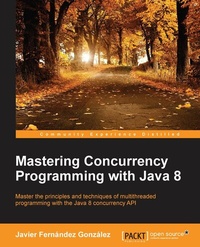
Mastering Concurrency Programming with Java 8
Master the principles and techniques of multithreaded programming with the Java 8 Concurrency API
Published on 8. July 2025
430 pages
978-1-78588-546-4 (ISBN)
Description

Master the principles and techniques of multithreaded programming with the Java 8 Concurrency API
Key Features
[*] Implement concurrent applications using the Java 8 Concurrency API and its new components
[*] Improve the performance of your applications or process more data at the same time, taking advantage of all of your resources.
[*] Construct real-world examples related to machine learning, data mining, image processing, and client/server environments
Book DescriptionConcurrency programming allows several large tasks to be divided into smaller sub-tasks, which are further processed as individual tasks that run in parallel. All the sub-tasks are combined together once the required results are achieved; they are then merged to get the final output. The whole process is very complex. This process goes from the design of concurrent algorithms to the testing phase where concurrent applications need extra attention. Java includes a comprehensive API with a lot of ready-to-use components to implement powerful concurrency applications in an easy way, but with a high flexibility to adapt these components to your needs. The book starts with a full description of design principles of concurrent applications and how to parallelize a sequential algorithm. We'll show you how to use all the components of the Java Concurrency API from basics to the most advanced techniques to implement them in powerful concurrency applications in Java. You will be using real-world examples of complex algorithms related to machine learning, data mining, natural language processing, image processing in client / server environments. Next, you will learn how to use the most important components of the Java 8 Concurrency API: the Executor framework to execute multiple tasks in your applications, the phaser class to implement concurrent tasks divided into phases, and the Fork/Join framework to implement concurrent tasks that can be split into smaller problems (using the divide and conquer technique). Toward the end, we will cover the new inclusions in Java 8 API, the Map and Reduce model, and the Map and Collect model. The book will also teach you about the data structures and synchronization utilities to avoid data-race conditions and other critical problems. Finally, the book ends with a detailed description of the tools and techniques that you can use to test a Java concurrent application.What you will learn
[*] Design concurrent applications by converting a sequential algorithm into a concurrent one
[*] Discover how to avoid all the possible problems you can get in concurrent algorithms
[*] Use the Executor framework to manage concurrent tasks without creating threads
[*] Extend and modify Executors to adapt their behavior to your needs
[*] Solve problems using the divide and conquer technique and the Fork/Join framework
[*] Process massive data sets with parallel streams and Map/Reduce implementation
[*] Control data-race conditions using concurrent data structures and synchronization mechanisms
[*] Test and monitor concurrent applications
Who this book is forIf you are a competent Java developer with a good understanding of concurrency but have no knowledge of how to effectively implement concurrent programs or use streams to make processes more efficient, then this book is for you.
Key Features
[*] Implement concurrent applications using the Java 8 Concurrency API and its new components
[*] Improve the performance of your applications or process more data at the same time, taking advantage of all of your resources.
[*] Construct real-world examples related to machine learning, data mining, image processing, and client/server environments
Book DescriptionConcurrency programming allows several large tasks to be divided into smaller sub-tasks, which are further processed as individual tasks that run in parallel. All the sub-tasks are combined together once the required results are achieved; they are then merged to get the final output. The whole process is very complex. This process goes from the design of concurrent algorithms to the testing phase where concurrent applications need extra attention. Java includes a comprehensive API with a lot of ready-to-use components to implement powerful concurrency applications in an easy way, but with a high flexibility to adapt these components to your needs. The book starts with a full description of design principles of concurrent applications and how to parallelize a sequential algorithm. We'll show you how to use all the components of the Java Concurrency API from basics to the most advanced techniques to implement them in powerful concurrency applications in Java. You will be using real-world examples of complex algorithms related to machine learning, data mining, natural language processing, image processing in client / server environments. Next, you will learn how to use the most important components of the Java 8 Concurrency API: the Executor framework to execute multiple tasks in your applications, the phaser class to implement concurrent tasks divided into phases, and the Fork/Join framework to implement concurrent tasks that can be split into smaller problems (using the divide and conquer technique). Toward the end, we will cover the new inclusions in Java 8 API, the Map and Reduce model, and the Map and Collect model. The book will also teach you about the data structures and synchronization utilities to avoid data-race conditions and other critical problems. Finally, the book ends with a detailed description of the tools and techniques that you can use to test a Java concurrent application.What you will learn
[*] Design concurrent applications by converting a sequential algorithm into a concurrent one
[*] Discover how to avoid all the possible problems you can get in concurrent algorithms
[*] Use the Executor framework to manage concurrent tasks without creating threads
[*] Extend and modify Executors to adapt their behavior to your needs
[*] Solve problems using the divide and conquer technique and the Fork/Join framework
[*] Process massive data sets with parallel streams and Map/Reduce implementation
[*] Control data-race conditions using concurrent data structures and synchronization mechanisms
[*] Test and monitor concurrent applications
Who this book is forIf you are a competent Java developer with a good understanding of concurrency but have no knowledge of how to effectively implement concurrent programs or use streams to make processes more efficient, then this book is for you.
All prices
More details
Edition
Digital original
Language
English
Place of publication
Birmingham
United Kingdom
Target group
US School Grade: College Graduate Student
Edition type
Digital original
File size
6,46 MB
ISBN-13
978-1-78588-546-4 (9781785885464)
Copyright in bibliographic data and cover images is held by Nielsen Book Services Limited or by the publishers or by their respective licensors: all rights reserved.
Schweitzer Classification
Other editions
Additional editions
Javier Fernández González
Mastering Concurrency Programming with Java 8
Book
02/2016
Packt Publishing
€70.10
Shipment within 3-4 weeks
Person
Gonzalez Javier Fernandez :
Javier Fernandez is a software architect with almost 15 years experience with Java technologies. He has worked as a teacher, researcher, programmer, analyst, writer and now as an architect in all types of projects related to Java, especially J2EE. As a teacher, has taught over 1000 hours of training in basic Java, J2EE and Struts framework. As a researcher, has worked in the field of information retrieval developing applications for processing large amounts of data in Java and has participated as co-author on several journal articles and conference presentations. In recent years, has worked on developing J2EE web applications for various clients from different sectors (public administration, insurance, healthcare, transportation, ...). Currently he works as a software architect at Capgemini developing and maintaining applications for an insurance company. He is the author of the book Java 7 Concurrency Cookbook.
Javier Fernandez is a software architect with almost 15 years experience with Java technologies. He has worked as a teacher, researcher, programmer, analyst, writer and now as an architect in all types of projects related to Java, especially J2EE. As a teacher, has taught over 1000 hours of training in basic Java, J2EE and Struts framework. As a researcher, has worked in the field of information retrieval developing applications for processing large amounts of data in Java and has participated as co-author on several journal articles and conference presentations. In recent years, has worked on developing J2EE web applications for various clients from different sectors (public administration, insurance, healthcare, transportation, ...). Currently he works as a software architect at Capgemini developing and maintaining applications for an insurance company. He is the author of the book Java 7 Concurrency Cookbook.
Content
Table of Contents
The first step: Concurrency design principles
Managing lots of threads: Executors
Getting the maximum from Executors
Getting data from the tasks: The Callable and Future interfaces
Running tasks divided into phases: The Phaser class
Optimizing Divide and Conquer solutions: The Fork / Join
Processing massive data sets with parallel Streams: The Map and Reduce model
Processing massive data sets with parallel Streams: The Map and Collect model
Diving into Concurrent Data Structures and Synchronization utilities
Integration of Fragments and Implementation of Alternatives
Testing and Monitoring concurrent applications
The first step: Concurrency design principles
Managing lots of threads: Executors
Getting the maximum from Executors
Getting data from the tasks: The Callable and Future interfaces
Running tasks divided into phases: The Phaser class
Optimizing Divide and Conquer solutions: The Fork / Join
Processing massive data sets with parallel Streams: The Map and Reduce model
Processing massive data sets with parallel Streams: The Map and Collect model
Diving into Concurrent Data Structures and Synchronization utilities
Integration of Fragments and Implementation of Alternatives
Testing and Monitoring concurrent applications

