

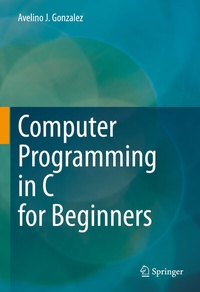
Computer Programming in C for Beginners
Description

This textbook is an ideal introduction in college courses or self-study for learning computer programming using the C language. Written for those with minimal or no programming experience, Computer Programming in C for Beginners offers a heavily guided, hands-on approach that enables the reader to quickly start programming, and then progresses to cover the major concepts of C programming that are critical for an early stage programmer to know and understand. While the progression of topics is conventional, their treatment is innovative and designed for rapid understanding of the many concepts in C that have traditionally proven difficult for beginners, such as variable typing and scope, function definition, passing by value, pointers, passing by reference, arrays, structures, basic memory management, dynamic memory allocation, and linked lists, as well as an introductory treatment of searching and sorting algorithms.
Written in an informal but clear narrative, the book uses extensive examples throughout and provides detailed guidance on how to write the C code to achieve the objectives of the example problems. Derived from the author's many years of teaching hands-on college courses, it encourages the reader to follow along by programming the progressively more complex exercise programs presented. In some sections, errors are purposely inserted into the code to teach the reader about the common pitfalls of programming in general, and the C language in particular.
More details
Other editions
Additional editions
Person
Avelino Gonzalez is Professor Emeritus in the Computer Science Department at the University of Central Florida. He was previously a Professor in the same department, and had a joint appointment with the ECE department. Prior to that he was a Senior Engineer with the Westinghouse Electric Corporation, where he was instrumental in the development of the GenAID system, the first commercially available AI product. He received his BS and MS degrees in Electrical Engineering from the University of Miami, and his PhD in Electrical Engineering from the University of Pittsburgh. His area of research is Artificial Intelligence, the role of context in modeling intelligent behavior, and machine learning from observation of human actions. He has co-authored nearly 300 research articles, as well as three text books and one edited volume (in contextual reasoning). He is a Fellow of the IEEE.
