

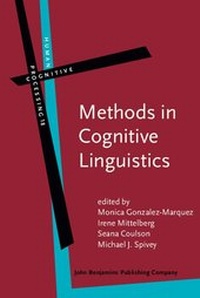
Methods in Cognitive Linguistics
1st Edition
Published on 28. June 2007
XXVIII, 452 pages
978-90-272-9249-0 (ISBN)
Description

Methods in Cognitive Linguistics is an introduction to empirical methodology for language researchers. Intended as a handbook to exploring the empirical dimension of the theoretical questions raised by Cognitive Linguistics, the volume presents guidelines for employing methods from a variety of intersecting disciplines, laying out different ways of gathering empirical evidence. The book is divided into five sections. Methods and Motivations provides the reader with the preliminary background in scientific methodology and statistics. The sections on Corpus and Discourse Analysis, and Sign Language and Gesture describe different ways of investigating usage data. Behavioral Research describes methods for exploring mental representation, simulation semantics, child language development, and the relationships between space and language, and eye movements and cognition. Lastly, Neural Approaches introduces the reader to ERP research and to the computational modeling of language.
More details
Other editions
Additional editions
Monica Gonzalez-Marquez | Irene Mittelberg | Seana Coulson
Methods in Cognitive Linguistics
Book
06/2007
John Benjamins Publishing Co
€137.80
Shipment within 10-15 days
Persons
Content
- Methods in Cognitive Linguistics
- Editorial page
- Title page
- LCC data
- dedication page
- Table of contents
- Contributors
- Acknowledgements
- Foreword
- 1. Introduction
- 2. Introspection
- 2.1. First condition of attending
- 2.2. Second condition of attending
- 2.3. Third condition of attending
- 2.4. Profile of introspection
- 3. Audio- and videographic analysis
- 4. Corpus analysis
- 5. Experimental method
- References
- Introduction
- 1. Introduction
- 2. Volume organization
- 2.1. Methods and motivations
- 2.2. Corpus and discourse analysis
- 2.3. Sign language and gesture
- 2.4. Behavioral experiments
- 2.5. Neural approaches
- I. Methods and motivations
- Why cognitive linguists should care more about empirical methods
- 1. Introduction
- 2. The problem with introspection
- 3. Do cognitive linguists use empirical methods?
- 4. Challenges for cognitive linguistics
- 5. Examples of relevant methods
- 5.1. Mental imagery
- 5.2. Context-sensitive judgments about metaphorical meaning
- 5.3. Embodied intuitions and metaphorical inferences
- 5.4. Not all methods work!
- 6. Bodily movement and metaphor comprehension
- 7. Conclusion: Cognitive linguists need not do experiments
- References
- They actually said that?
- 1. Introduction
- 2. Language, cognition, and social interaction: Cognitive-functionalist approaches to discourse
- 2.1. Emergent Grammar
- 2.2. Discourse and Grammar
- 2.3. Social Interaction and Grammar
- 2.4. Different degrees of contextualization: Discourse pragmatics and ethnography
- 2.5. Language and the body: Multimodal communication and sign language discourse
- 2.6. Mediated situatedness: A look at recent accounts of metaphor in (public) written discourse
- 3. Introduction to corpus-based approaches
- 3.1. Corpus-based research for the cognitive linguist
- 3.2. Terminology
- 3.3. Annotated list of popular corpora, plus a brief caveat
- 3.4. Summary
- 4. Concluding remarks
- References
- An introduction to experimental methods for language researchers
- 1. Introduction
- 2. Experimenting with experimentation
- 3. Reading the research article
- 3.1. Title
- 3.2. Authors and affiliations
- 3.3. Place of publication
- 3.4. Year of publication
- 3.5. Abstract
- 3.6. Introduction
- 3.7. Methods
- 3.8. Results
- 3.9. Discussion
- 3.10. References
- 4. Other types of articles
- 5. The scientific method
- 6. Conducting research
- 6.1. Part one: The introduction - the thinking and reading steps
- 6.2. Part two: The practical steps
- 7. Then there is the rest of the planet.
- 7.1. Types of human groupings
- 7.2. Linguistic ability
- 8. Endemic bias in the interpretation of cognitive phenomena
- 8.1. The evaluative bias of language
- 8.2. Differentiating dichotomous variables from continuous ones
- 8.3. The Barnum effect
- 8.4. The assimilation bias
- 8.5. Fundamental attribution error
- 8.6. Correlation does not prove causation
- 9. Conclusion
- References
- Inferential statistics in the context of empirical cognitive linguistics
- 1. Introduction
- 2. What counts as "empirical'' in cognitive linguistics?
- 3. Descriptive vs. inferential statistics
- 4. Variables and experiments
- 5. Measuring and measurement scales
- 5.1. Nominal scale
- 5.2. Ordinal measurement
- 5.3. Interval measurements
- 5.4. Ratio measurement
- 6. Samples and populations
- 7. Probabilities and the logic of hypothesis testing
- 8. Parametric vs. non-parametric inferential statistics
- 8.1. t-test, a parametric test
- 8.2. Analysis of Variance (ANOVA), a parametric test
- 8.3. chi2 (Chi-Square), a non-parametric test
- 9. Epilogue
- References
- Part II. Corpus and discourse analysis
- Multiple empirical approaches to a complex analysis of discourse
- 1. Introduction
- 2. Conversation and pronouns: Linguistic approaches to discourse
- 3. Discourse and interactional accommodation: CCCA
- 4. Interactional patterns of international students: Triangulation
- 5. Conclusion: Discourse and cognition
- References
- A case for a Cognitive corpus linguistics
- 1. Introduction
- 2. The case
- 3. Preliminary analysis
- 3.1. The evidence revisited: A regression analysis of four factors
- 3.2. Materials
- 3.3. Dependent and independent variables
- 3.4. Results and logistic regression analysis
- 4. Reference points and (in)accessibility markers
- 5. Corpus parameters of er's inaccessibility marking function
- 6. Conclusion
- References
- Part III. Sign language and gesture
- Empirical methods in signed language research
- 1. Background on signed languages and cognitive linguistics
- 1.1. Linguistic research on signed languages
- 1.2. Cognitive linguistics
- 2. Signed language research in a cognitive linguistics framework
- 2.1. Iconicity
- 2.2. Metaphor
- 2.3. Mental spaces and blends
- 2.4. Gesture and grammaticization
- 2.5. Evolution of language
- 3. Empirical methods in signed language research
- 3.1. Recording and storage of signed language data
- 3.2. Transcription
- 3.3. Historical
- 3.4. Survey and questionnaire
- 3.5. Corpus
- 3.6. Experimental
- 3.7. Narrative
- 3.8. Multiple methods
- 4. Conclusion
- References
- Looking at space to study mental spaces
- 1. Introduction
- 2. Gesture as a back door to cognition
- 3. Transcription
- 4. Gesture, iconicity and levels of abstraction
- 5. Gesture and levels of content
- 6. Gesture, viewpoint and deixis
- 7. Conclusions
- References
- Methodology for multimodality
- 1. Introduction
- 2. Preliminary considerations: Motivations, subject matter, and genre
- 3. Equipment, physical setting, speaker activities, and videotaping
- 4. Assessing and editing video data
- 5. Discourse transcription
- 6. Transcribing gesture-speech synchrony
- 7. Physical gesture features
- 7.1. Hand shape and palm orientation
- 7.2. Location in gesture space
- 7.3. Movement
- 8. Semantic and pragmatic functions of gestures
- 9. Concluding remarks
- Acknowledgments
- References
- Part IV. Behavioral research
- Experimental methods for studying language and space
- 1. Introduction
- 2. Acceptability ratings
- 2.1. Description of the method and illustrative studies
- 2.2. Critical design issues
- 2.3. Strengths and weaknesses
- 3. Speeded verification
- 3.1. Description of the method and illustrative studies
- 3.2. Critical design issues
- 3.3. Strengths and weaknesses
- 4. Placement tasks
- 4.1. Description of the method and illustrative studies
- 4.2. Critical design issues
- 4.3. Strengths and weaknesses
- 5. Parsing space tasks
- 5.1. Description of the method and illustrative studies
- 5.2. Critical design issues
- 5.3. Strengths and weaknesses
- 6. Production
- 6.1. Description of the method and illustrative studies
- 6.2. Critical design issues
- 6.3. Strengths and weaknesses
- 7. Combining experimental methods: Converging measures
- References
- Experimental methods for simulation semantics
- 1. Simulation semantics and language understanding
- 2. Compatibility effects
- 2.1. Implied object orientation and shape
- 2.2. The action-sentence compatibility effect
- 2.3. Design issues for compatibility methods
- 3. Interference effects
- 3.1. Visual interference effects
- 3.2. Motor interference effects
- 3.3. Interference or compatibility?
- 4. Simulation time effects
- 5. Neural imaging
- 6. Conclusions
- References
- Experimental methods for studying the mental representation of language
- 1. Introduction
- 2. Lexical decision and naming latencies
- 2.1. Rationale
- 2.2. Examples
- 2.3. Further considerations
- 3. Memory measures
- 3.1. Rationale
- 3.2. Examples
- 3.3. Further considerations
- 4. Item recognition measures
- 4.1. Rationale
- 4.2. Examples
- 4.3. Further considerations
- 5. Reading times
- 5.1. Rationale
- 5.2. Examples
- 5.3. Further considerations
- 6. Self report measures: Listing features, choosing features
- 6.1. Rationale
- 6.2. Examples
- 6.3. Further considerations
- 7. The effects of comprehension on subsequent tasks
- 7.1. Rationale
- 7.2. Examples
- 7.3. Further considerations
- 8. Summary
- References
- Eye movements in language and cognition
- 1. The role of eye movements in the visual system
- 2. The value of eye movements to cognitive psychologists
- 3. Perception and action
- 4. Cognition
- 5. Language
- 6. Eye movement methodology
- 6.1. Choice of eyetracker
- 6.2. Calibration
- 6.3. Display parameters
- 6.4. "Blind'' coding
- 6.5. Participant ease
- 6.6. Practice
- 7. Conclusion
- Acknowledgements
- References
- Speaking for the wordless
- 1. Introduction
- 2. The habituation paradigm
- 2.1. Rationale
- 2.2. Procedure
- 2.3. Relevance of habituation to the study of cognitive linguistics
- 3. The intermodal preferential looking paradigm
- 3.1. Rationale
- 3.2. Procedure
- 3.3. Relevance of the IPLP to the study of cognitive linguistics
- 4. Verb learning: A case study
- 4.1. The problem of verb learning
- 4.2. The cognitive linguistic approach to the problem of verb learning
- 4.3. Attention to potential verb referents in nonlinguistic events
- 4.4. The categorization of path and manner in motion events
- 4.5. Use of universal and language-specific cues in verb learning
- 5. Conclusion
- References
- Experimental study of first and second language morphological processing
- 1. Introduction
- 2. Two theoretical approaches to morphological processing
- 3. Input frequencies and probabilities in linguistic processing
- 4. Real and nonce verb generation task
- 4.1. Nonce verb generation task with adult L1 speakers of Italian: The role of phonological similarity
- 4.2. Real and nonce verb generation task with adult L1 and L2 speakers of Russian and L1 children: The role of type frequency
- 5. Lexical decision task
- 5.1. Lexical decision task with adult native speakers of English
- 5.2. Lexical decision task with adult native speakers of Russian
- 6. General conclusions
- References
- Part V. Neural approaches
- Electrifying results
- 1. Introduction
- 2. EEG and ERPs
- 2.1. EEG
- 2.2. ERPs
- 2.3. ERP components
- 3. Language sensitive ERPs
- 3.1. N400
- 3.2. LPN
- 3.3. LAN
- 3.4. P600
- 3.5. Slow cortical potentials
- 4. ERPs and cognitive linguistics
- 4.1. Frames
- 4.2. Metaphor
- 4.3. Iconicity
- 5. Considerations on ERP research
- 5.1. Constraints on ERP research
- 5.2. Future directions
- References
- Bridging language with the rest of cognition
- 1. Introduction
- 2. Common principles of cognitive representation and processing
- 2.1. How to garner empirical support for posited representations
- 2.2. Some common characteristics of cognitive representations
- 3. Dealing with structure: A special challenge?
- 3.1. The role of space in representing structure
- 3.2. Spatial representations for language
- 4. Treatment of structure in computational cognitive linguistics
- 4.1. Computational approach: The Chorus of Phrases and Construction Grammar
- 4.2. Algorithmic and implementational issues: The ADIOS model
- 4.3. Select open questions
- 5. Conclusions
- Acknowledgments
- References
- Appendix A: Some useful mathematical concepts
- Appendix B: Mathematical tools for computational cognitive linguistics
- Index
- The series Human Cognitive Processing
