

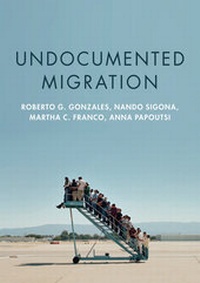
Undocumented Migration
Description

More details
Other editions
Additional editions
Persons
Nando Sigona is Professor of International Migration and Forced Displacement at the University of Birmingham
Martha C. Franco is a doctoral student at Harvard University
Anna Papoutsi is a doctoral student at the University of Birmingham
Content
Introduction
Chapter 1: Who Are Undocumented Immigrants? Chapter 2: Theorizing the Lived Experience of Migrant Illegality Chapter 3: Geographies of Undocumented Migration Chapter 4: Immigration Enforcement, Detention, and Deportation Chapter 5: Undocumented Status and Social Mobility Chapter 6: Families and Children Chapter 7: Challenging ExclusionIntroduction
A game of cat and mouse
At 225 meters long and five stories high, the former cruise ship, docked in the new port of Patras, in northern Greece, is a sight to behold. The ship dominates the entire port with its imposing body. Between ten and fifteen trucks are stationed outside. The drivers eagerly wait to board the Cruise Europa. Dozens of migrants can be seen observing the scene at a distance, eager to spot an opportunity to board the ship. Ticketed passengers and their vehicles will board much later.
Patras, a seaside medium-sized city, is situated in the northwestern part of the Peloponnese peninsula in Greece. The port was relocated out of town some years ago in order to decongest the city center from the massive trucks moving in and out of the port on a daily basis. For Vangelis, a thick-waisted employee of the Patras Port Authority, there was an urgent need to put an end to the chaotic scenes caused by migrants making a run for the trucks heading to Italy: "You cannot imagine the situation before. It was chaos: tourists, cars, trucks, and migrants all together. And the coast guard chasing them with cars and dogs. It was bad for the city and bad for tourism. And it was also dangerous for them [the migrants] too. We had many accidents and injuries."
The port of Patras is the main gateway of Greece to Europe. Due to the political upheaval and instability in the Balkans throughout the 1990s and the multiple land border crossings, Patras became the main route for both tourist and commercial transport in the region. Because the landscape around the new port is bare - the port is a vast surface of uninterrupted tarmac - there is nowhere to hide. This means that migrants making a run for the trucks are immediately in direct sight of the police.
The AVEX building, a disused wood-processing factory in the port area, is currently the makeshift home to some 380 migrants, mostly from Afghanistan, Pakistan, and the Maghreb. They sleep rough or in tents in the factory's derelict warehouse spaces that provide some protection from the winter's biting cold and the summer's scorching sun. They learn about this place mostly through their networks and through smugglers, as it is from there that they try every day to sneak into the trucks that are heading to Italy, and from there to other European destinations.
As one enters the port, one can spot migrants trying to climb the fence that separates the rest of the port from the departure gates, which is where all the trucks park waiting to board the ship. The steel fence is some two meters high and is reinforced with barbed wire on top, quite ramshackle in places from where people have climbed it.
This is an ordinary scene in the port, one that repeats three to four times every single day. Migrants show the scars and tears of these failed attempts on their bodies and clothes (see Jusionyte 2018 for discussion of migrant injury). They carry nothing with them except small bottles of water tied with thick rope around their waists or on their backs.
Attempts by migrants to board the trucks are not made in isolation. After someone gives a signal, groups of up to fifty young people make a run for the trucks. They then scale the fence, land on the other side and sprint towards the trucks. Numbers play a critical role in this endeavor: the more people participating, the better the chances that some will make it.
Truck drivers are also involved. Once the migrants come anywhere near the trucks, the drivers alert the coast guard by honking their horns. Patrolling coast guards in cars race in from the other side of the port, sending migrants scattering in all directions. Migrants hope to avoid being run over by the speeding cars or bitten by the police dogs. Usually, when migrants are apprehended, the police keep them for several hours and then let them go again.
There is a strange familiarity between the migrants and the police. They seem to know each other. As night falls and all the trucks have boarded the Cruise Europa, the police approach the fence and announce the end of the game: "Finished for today. Tomorrow we do it again. Who's injured? Let's go to hospital."
The age of undocumented migration
International migration has risen in significance on the agendas of wealthy countries. According to the International Organization for Migration (IOM), the number of international migrants reached 258 million in 2017, an increase from 220 million in 2010 and 173 million in 2000 (IOM 2019). And, while undocumented migrants comprise only a small proportion of a country's immigrants, unauthorized migration dominates most discussions and perceptions of immigration (Jones-Correa and de Graauw 2013).
In response to the rise in global migration and its heightened visibility, many western nations have installed and aggressively fortified immigration controls on an unprecedented scale to deter migration and to punish immigrants. These measures constrain everyday choices as well as life trajectories for migrants. They also sow fear and anxiety in communities across the globe. At the same time, migrants residing in these countries form families, establish community connections, participate in local economies and governments, and pursue love, happiness, meaning, and political participation, just like their citizen neighbors.
Scholarship on undocumented migration often accords primacy to the nation-state in producing illegality, due to its power to define its relationship to citizens and noncitizens and to mobilize an enforcement apparatus to police the boundaries of membership. In many respects, we agree with this depiction. However, in this book we expand the analytical focus to include the interplay between different national and supranational configurations of "illegality." We argue that, while the production and experience of "illegality" are strongly shaped and determined by the state and state-based rules and regulations, they are more broadly framed by processes involving multiple states and international agencies and increasingly nested in multiple scales of governance. Furthermore, they are stratified by gender, class, and race.
This book explores state efforts to illegalize some forms of human mobility and the response of immigrants, their families, and their political and social allies to increasingly intrusive, repressive, and punitive measures of immigration control. In doing so, we draw a wide circle around undocumented migration to capture the international foundations and dimensions of "illegality." Through an examination of empirical examples in the United States, the European Union (EU), and the United Kingdom, as well as current scholarship, we trace how immigration policies and practices inform, influence, and impact decisions to migrate, the nature and length of migration journeys, and the experiences and opportunities of migrants in diverse host-country settings. At the same time, dynamics and political developments in receiving countries further complicate experiences of migration and settlement. To that end, we illustrate how migrants' everyday experiences are shaped by a range of laws and policies, from those explicitly targeting immigration and settlement of noncitizens to others that regulate access to public services, or regulate labor market more generally, but that nonetheless shape the possibilities and opportunities available to an individual with precarious immigration status.
From the journeys that migrants take to the lives they lead on arrival and beyond, this book aims to provide a comprehensive examination of the global, yet also local, phenomenon of undocumented migration. As such, we offer a triptych portrait of contemporary undocumented migration, which links: (1) the macro-societal processes that produce undocumented migration; (2) the shifting governance of immigration across different national borders and various locales; and (3) individuals' everyday experiences residing in host countries as undocumented migrants. This book primarily features the experiences of immigrants in the United States, the United Kingdom, and Europe. As such, our examination does not, for example, capture the dynamics of migration between countries in the global South - like migrants leaving Myanmar for Thailand or Venezuelans fleeing political unrest and poverty for nearby Colombia - and of other wealthier countries like Canada or Japan. However, we draw on some of the major themes in the academic literature and in the popular discourse on immigration. Indeed, undocumented migration is now a global phenomenon. As the effects of armed conflict, environmental disasters and injustices, climate change, and economic inequality render large swaths of the planet uninhabitable, migrants seek refuge in countries of traditional settlement and those that have not been seen as long-standing immigrant destinations. This book is our effort to bring together a diverse set of issues and understandings about contemporary migration.
Our approach is driven by our interest in capturing the plurality of scales at which "illegality" is produced and experienced. In service to these goals, we have developed the concept of illegality assemblage. This is a term we use to describe the loose and dynamic system of laws and practices that transcend national borders and in which different interests and agendas find some kind of accommodation. We think of "illegality" as the product of a multi-scale and multi-actor assemblage that produces various configurations of...
