

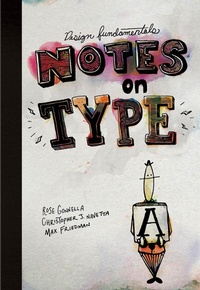
Design Fundamentals
Notes on Type
1st Edition
Published on 25. September 2015
216 pages
978-0-13-396258-1 (ISBN)
Description

Design Fundamentals: Notes on Type looks like a design student's sketchbook with handwritten notes and full-color, hand-drawn illustrations. But it's more than that. This gorgeously illustrated "notebook" is a full-blown typography course in disguise. Young designers are lured in by the lush graphics and quirky layout only to discover by the end of the book that they've learned all of the key concepts taught in a foundational course on type. They'll learn about the history of letterforms, the anatomy and physiology of type, the basics of measurements and spacing, how to recognize and choose type for design projects, and more.
Fun and fast-paced, this creative notebook isn't required reading, it's desired reading; and it's the third in a series of Design Fundamentals books that students will want to keep and enjoy long after they've mastered these basic building blocks of design.
This book includes:
* Core instruction on the history, anatomy, and structure of type
* Direction on the basics of measurement and spacing: leading, kerning, indents, and line lengths both in text and display sizes, and optical measurement considerations.
* Examination of the use, mood, and "voice" of type as seen in creative work and professional examples
* Exercises and projects for practice and concept development
* Strange and delightful illustrations created specifically for this book (to inspire action)
* A companion website stocked with additional projects, a bibliography, glossary, and links to additional visual examples.
Fun and fast-paced, this creative notebook isn't required reading, it's desired reading; and it's the third in a series of Design Fundamentals books that students will want to keep and enjoy long after they've mastered these basic building blocks of design.
This book includes:
* Core instruction on the history, anatomy, and structure of type
* Direction on the basics of measurement and spacing: leading, kerning, indents, and line lengths both in text and display sizes, and optical measurement considerations.
* Examination of the use, mood, and "voice" of type as seen in creative work and professional examples
* Exercises and projects for practice and concept development
* Strange and delightful illustrations created specifically for this book (to inspire action)
* A companion website stocked with additional projects, a bibliography, glossary, and links to additional visual examples.
More details
Edition
1. Auflage
Language
English
Place of publication
Berkeley
United States
Publishing group
Pearson Education (US)
Target group
Professional and scholarly
Illustrations
Illustrations
File size
246,75 MB
ISBN-13
978-0-13-396258-1 (9780133962581)
Copyright in bibliographic data and cover images is held by Nielsen Book Services Limited or by the publishers or by their respective licensors: all rights reserved.
Schweitzer Classification
Other editions
Additional editions
Book
10/2015
Peachpit Press Publications
€32.18
Article exhausted; check different version
Persons
Rose Gonnella is the Executive Director of the Robert Busch School of Design at Kean University in Union County and Ocean County, New Jersey, and Wenzhou-Kean University, China (2015). Gonnella has taught graphic design for over 25 years including courses in design theory and materials and techniques. She currently serves on the executive board of the Art Directors Club of New Jersey (ADCNJ); is the Director of the Kean University/ADCNJ "Thinking Creatively" design conference; and she also directs and guides Kean Cre8tive, the RB/School of Design in-house graphic design studio.
Christopher J. Navetta's diverse career boasts an eclectic group of clients and employers that includes Wendy's, Kay-Bee Toys, Natural Wonders, Jersey City Public Schools, Thomson Delmar Learning (now Cengage), PFLAG, Prentice Hall, Six Flags, the Mall of America, and Nickelodeon. He is the co-author and designer of Comp It Up: A Studio Skills Foundation, and a contributing writer, designer, researcher, and photographer for Design To Touch: Engraving History, Process, Concepts, and Creativity. He currently teaches design at Kean University, and has worked on developing curricula for undergraduate courses and a summer design program for high school students.
Max Friedman is an illustrator, designer, and filmmaker currently attending Kean University's Robert Busch School of Design.
Christopher J. Navetta's diverse career boasts an eclectic group of clients and employers that includes Wendy's, Kay-Bee Toys, Natural Wonders, Jersey City Public Schools, Thomson Delmar Learning (now Cengage), PFLAG, Prentice Hall, Six Flags, the Mall of America, and Nickelodeon. He is the co-author and designer of Comp It Up: A Studio Skills Foundation, and a contributing writer, designer, researcher, and photographer for Design To Touch: Engraving History, Process, Concepts, and Creativity. He currently teaches design at Kean University, and has worked on developing curricula for undergraduate courses and a summer design program for high school students.
Max Friedman is an illustrator, designer, and filmmaker currently attending Kean University's Robert Busch School of Design.
Content
Intro
1. Past as Prologue
2. Talkin' Type
3. The Grotesque Clinic (of Type Anatomy)
4. So Many Typefaces, So Little Time
5. Measuring the Options
6. Type for Text
7. In & Out of the Grid
8. Type is Elemental
9. Type in Design
1. Past as Prologue
2. Talkin' Type
3. The Grotesque Clinic (of Type Anatomy)
4. So Many Typefaces, So Little Time
5. Measuring the Options
6. Type for Text
7. In & Out of the Grid
8. Type is Elemental
9. Type in Design
