

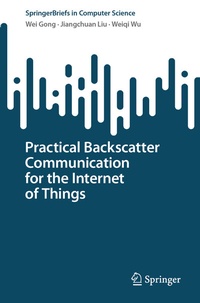
Practical Backscatter Communication for the Internet of Things
Description

This book is devoted to offering a comprehensive and detailed discussion of the design of high-reliability, high-efficiency spectrum utilization, cross-technology support and concurrent backscatter schemes. It begins with the introductory Chapter 1, introducing the background of backscatter communication, including its concepts and characteristics. Then it highlights the potential IoT applications assisted by backscatter communication. The importance of high-reliability, high-efficiency spectrum utilization, cross-technology and concurrent backscatter schemes is emphasized to actualize these applications.
Chapters 2 thru 5 discuss in detail how to achieve reliable backscatter (Chapter 2), spectrum-efficient backscatter (Chapter 3), cross-technology backscatter (Chapter 4) and concurrent backscatter (Chapter 5). Chapter 6 summarizes this book and provides a vision for future research directions to bring a broad class of IoT applications into our everyday lives.
This book targets scientists, researchers, engineers and advanced-level students studying or working in pervasive computing, IoT, backscatter communication and other related areas. Professionals working in this related field will also want to purchase this book finding it a valuable resource.
More details
Other editions
Additional editions
Persons
Wei Gong: He received the B.S. degree from the Department of Computer Science and Technology, Huazhong University of Science and Technology, and the M.S. and Ph.D. degrees from the School of Software and Department of Computer Science and Technology, Tsinghua University. He is currently a Professor with the School of Computer Science and Technology, University of Science and Technology of China. His research interests include backscatter networks, edge systems, and the IoT applications.
Jiangchuan Liu: He received the B.Eng. degree (cum laude) in computer science from Tsinghua University, Beijing, China, in 1999, and the Ph.D. degree in computer science from The Hong Kong University of Science and Technology in 2003. He is currently a University Professor with the School of Computing Science, Simon Fraser University, BC, Canada. He is also a NSERC E.W.R. Steacie Memorial Fellow. He was a co-recipient of the Inaugural Test of Time Paper Award of IEEE INFOCOM in 2015, the ACM SIGMM TOMCCAP Nicolas D. Georganas Best Paper Award in 2013, and the ACM Multimedia Best Paper Award in 2012. He has served on the Editorial Boards of IEEE/ACM TRANSACTIONS ON NETWORKING, IEEE TRANSACTIONS ON BIG DATA, IEEE TRANSACTIONS ON MULTIMEDIA, IEEE COMMUNICATIONS SURVEYS AND TUTORIALS, and IEEE INTERNET OF THINGS JOURNAL. He is also a Steering Committee Member of IEEE TRANSACTIONS ON MOBILE COMPUTING.
Weiqi Wu: He received the B.S. degree from the Department of Computer Science and Technology, Anhui University of Science and Technology (AUST). He is currently pursuing the Ph.D. degree with the Department of Computer Science and Technology, University of Science and Technology of China. His research interests include ambient backscatter communication and wireless sensor networks.
Content
Chapter 1 Introduction.- Chapter 2 Reliable Backscatter for Remote Physical Condition Monitoring .- Chapter 3 Spectrum-efficient Backscatter for Smart Homes.- Chapter 4 Cross-technology Backscatter for Smart Health Monitoring.- Chapter 5 Concurrent Backscatter for Smart Logistics.- Chapter 6 Summary and Future Directions.
