

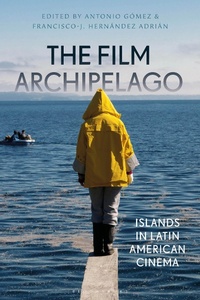
The Film Archipelago
Islands in Latin American Cinema
1st Edition
Published on 16. December 2021
360 pages
978-1-350-15798-9 (ISBN)
Description

How do the islands and archipelagos of the New World figure in Latin American cinema? Comprising 15 essays and a critical introduction, The Film Archipelago: Islands in Latin American Cinema addresses this question by examining a series of intersections between insular spaces and filmmaking in Latin America. The volume brings together international scholars and filmmakers to consider a diverse corpus of films about islands, films that take place on islands, films produced in islands, and films that problematise islands.
The book explores a diverse range of films that extend from the Chilean documentaries of Patricio Guzmán to work on the Malvinas/Falkland Islands, and films by Argentine directors Gustavo Fontán and Lucrecia Martel. Chapters focus on Rapa Nui (Easter Island), the Mexican Islas Marías, and the Panamanian Caribbean; on ecocritical, environmental and film historical aspects of Brazilian and Argentine river islands; and on Cuban, Guadeloupean, Haitian, and Puerto Rican contexts.
The Film Archipelago argues that the islands and archipelagos of Latin American cinema constitute a critically interesting, analytically complex, and historically suggestive angle to explore issues of marginality and peripherality, remoteness and isolation, and fragility and dependency. As a whole, the collection demonstrates to what extent the combined insular and archipelagic lens can re-frame and re-figure both longstanding and recent discussions on the spaces of Latin American cinema.
The book explores a diverse range of films that extend from the Chilean documentaries of Patricio Guzmán to work on the Malvinas/Falkland Islands, and films by Argentine directors Gustavo Fontán and Lucrecia Martel. Chapters focus on Rapa Nui (Easter Island), the Mexican Islas Marías, and the Panamanian Caribbean; on ecocritical, environmental and film historical aspects of Brazilian and Argentine river islands; and on Cuban, Guadeloupean, Haitian, and Puerto Rican contexts.
The Film Archipelago argues that the islands and archipelagos of Latin American cinema constitute a critically interesting, analytically complex, and historically suggestive angle to explore issues of marginality and peripherality, remoteness and isolation, and fragility and dependency. As a whole, the collection demonstrates to what extent the combined insular and archipelagic lens can re-frame and re-figure both longstanding and recent discussions on the spaces of Latin American cinema.
More details
Series
Edition
1. Auflage
Language
English
Place of publication
London
United Kingdom
Publishing group
Bloomsbury Publishing PLC
Target group
College/higher education
Illustrations
30 bw illus
ISBN-13
978-1-350-15798-9 (9781350157989)
Copyright in bibliographic data and cover images is held by Nielsen Book Services Limited or by the publishers or by their respective licensors: all rights reserved.
Schweitzer Classification
Other editions
Additional editions
Book
07/2023
Bloomsbury Academic
€55.95
Shipment within 15-20 days
Persons
Antonio Gómez is Associate Professor of Latin American Literature and Film at Tulane University, USA.
Francisco-J. Hernández Adrián is Associate Professor of Hispanic Studies in the School of Modern Languages and Cultures at Durham University, UK.
Francisco-J. Hernández Adrián is Associate Professor of Hispanic Studies in the School of Modern Languages and Cultures at Durham University, UK.
Content
Introduction - "Islands in Latin American cinema: Film(ing) Archipelagos" Antonio Gómez and Francisco-J. Hernández Adrián
Part 1: Islands at the end of the world
1. "Deserted islands for the nation: Empty land- and seascapes in three Argentine films of the Malvinas/Falkland Islands" Jason A. Bartles
2. "Marooned testimony: Chilean islandscape and the politics of memory in Sebastián Silva's Magic Magic (2013)" William Benner
3. "Memory islands: Repeating traumas in Patricio Guzmán's Nostalgia de la luz (2010) and El botón de nácar (2015)" Amanda Holmes
4. "Insular spaces: A documentary and an affective ethno-mapping of the Rapa Nui culture" Irene Depetris Chauvin
Part 2: Liminal islands
5. "Social reformation and the edges of sovereignty: Fernando Soler's La hija del penal (1949) and Emilio Fernández's Islas Marías (1951)" Ignacio M. Sánchez Prado
6. "Exposed insularities: Islands, capitalism and waste in Jorge Furtado's Ilha das Flores (1989)" Axel Pérez Trujillo
7. "Islands in Lucrecia Martel's Nueva Argirópolis (2010): Eroding and fracturing the national map" Natalia D'Alessandro
8. "Gustavo Fontán's films: On faces, specters, fragments of matter" Laura M. Martins
Part 3: Antillean relations on screen
9. "The duplicitous empire: Ambiguous representations of Puerto Ricans and Japanese-Americans in Herbert I. Leeds's Mr. Moto in Danger Island (1939)" Naida García Crespo
10. "An archipelago of crossed gazes: Intersections of documentary media practices in Cuba and Puerto Rico" Juan Carlos Rodríguez
11. "'Irreducible memories' of Caribbeanness: Mariette Monpierre's Le Bonheur d'Elza (2011)" Sheila Petty
12. "Documenting lifestyle migration: Anayansi Prado's Paraíso for Sale (2011)" Carolyn Fornoff
13."Raoul Peck's archipelagic cinema: Island contestations of the international order in Assistance mortelle (2013)" Jana Evans Braziel
Part 4: Reimagining islandscapes
14. "Notes on an island film: A journey to Martín García" Edgardo Dieleke
15. "Letters from the islands: A visual essay" Antonio Traverso
Index
Part 1: Islands at the end of the world
1. "Deserted islands for the nation: Empty land- and seascapes in three Argentine films of the Malvinas/Falkland Islands" Jason A. Bartles
2. "Marooned testimony: Chilean islandscape and the politics of memory in Sebastián Silva's Magic Magic (2013)" William Benner
3. "Memory islands: Repeating traumas in Patricio Guzmán's Nostalgia de la luz (2010) and El botón de nácar (2015)" Amanda Holmes
4. "Insular spaces: A documentary and an affective ethno-mapping of the Rapa Nui culture" Irene Depetris Chauvin
Part 2: Liminal islands
5. "Social reformation and the edges of sovereignty: Fernando Soler's La hija del penal (1949) and Emilio Fernández's Islas Marías (1951)" Ignacio M. Sánchez Prado
6. "Exposed insularities: Islands, capitalism and waste in Jorge Furtado's Ilha das Flores (1989)" Axel Pérez Trujillo
7. "Islands in Lucrecia Martel's Nueva Argirópolis (2010): Eroding and fracturing the national map" Natalia D'Alessandro
8. "Gustavo Fontán's films: On faces, specters, fragments of matter" Laura M. Martins
Part 3: Antillean relations on screen
9. "The duplicitous empire: Ambiguous representations of Puerto Ricans and Japanese-Americans in Herbert I. Leeds's Mr. Moto in Danger Island (1939)" Naida García Crespo
10. "An archipelago of crossed gazes: Intersections of documentary media practices in Cuba and Puerto Rico" Juan Carlos Rodríguez
11. "'Irreducible memories' of Caribbeanness: Mariette Monpierre's Le Bonheur d'Elza (2011)" Sheila Petty
12. "Documenting lifestyle migration: Anayansi Prado's Paraíso for Sale (2011)" Carolyn Fornoff
13."Raoul Peck's archipelagic cinema: Island contestations of the international order in Assistance mortelle (2013)" Jana Evans Braziel
Part 4: Reimagining islandscapes
14. "Notes on an island film: A journey to Martín García" Edgardo Dieleke
15. "Letters from the islands: A visual essay" Antonio Traverso
Index
